Introduction
The right to private ownership and management of property is a basic value—some would say, the basic value—of American society. So pervasive, so deeply rooted, and so systematically internalized is this value that if has often been considered a “consensus” norm.
Between 1977 and 1987, in the industrial heartland communities of Youngstown, Ohio, and Pittsburgh, Pennsylvania, consensus support for the right to private ownership and management of property eroded. The traumatic collapse of the steel industries in those communities, with the social distress that followed, led to the appearance of new ideas. Local residents began to articulate and explore the ideas that private decisions with catastrophic social consequences are really public decisions, that some kind of community property right arises from the long-standing relation between a company and a community, and that the power of eminent domain (the power of government to take private property for a public purpose without the owner’s consent) should be used to acquire industrial facilities when corporations no longer wish to operate them. As a result, media stereotypes about the inevitable absence of socialism in the United States, seem a good deal less compelling.
The entire experience suggests some thoughts about how community ideas of constitutional rights may change.
First, economic hardship makes people open to new ideas.
Second, ideas are likely to be judged on the basis of results. Corporate ideology has been significantly discredited in the Mahoning and Monongahela valleys. But radical alternatives have yet to take firm hold because we have yet to produce a successful worker or community-owned steel mill.
Third, building a mass movement against plant shutdowns is a little like pouring water through a sieve. Plants are closed one by one. At each facility, there is a typical life cycle of protest: first, overflow public meetings and a brief season of unfocused militancy; later, an ebbing of group support as each displaced worker concludes that the plant will probably not reopen and begins to devise a private strategy for survival. When the next plant closes, the movement arising from the first shutdown is gone, and everyone starts all over again.
The breakthrough achieved in Youngstown and Pittsburgh is partial but significant. A previously-unthinkable community right to industrial property has been legitimized and can now be asserted; although by no means uncontested, it is no longer taboo.
One might compare what has occurred to a successful laboratory experiment, the results of which have yet to be applied industrially, or on a large scale. What has been shown in the Youngstown and Pittsburgh laboratory is that ordinary middle Americans may endorse public acquisition of corporate property by legal compulsion.
Youngstown, 1977-1980
Overview: Three Shutdowns in Three Years
On Monday, September 19, 1977, the Lykes Coporation, conglomerate owner of the Youngstown Sheet and Tube Company, abruptly announced the immediate closing of most of the area’s largest steel mill, the Campbell Works. The first group of permanently laid off workers left the mill for the last time that week. As they crossed the Mahoning River on the footbridge that led to the clock house, many threw into the river, as gesture of protest, their hard hats and metarsal shoes.
September 19 proved to be only the beginning. In November 1977 Lykes announced an intention to merge with the LTV Corporation, conglomerate owner of Jones and Laughlin Steel. The merger was approved by the stockholders of the two corporations in December 1978. A few days later the merged company announced its intention to close the other mill owned by Lykes in the Mahoning Valley, the Brier Hill Works. Almost a year later, on November 27, 1979, the Board of Directors of U.S. Steel announced the closing of all its Youngstown-area facilities, the Ohio Works where the steel was made and the McDonald finishing mills.
Thus, in less than three years, all steelmaking in what had once been the second steelmaking city of the nation, next to Pittsburgh, came to an end. Approximately ten thousand steelmaking jobs were lost: five thousand at the Campbell Works, fifteen hundred at Brier Hill, and thirty-five hundred at the U.S. Steel mills. The ripple effect on other employment was dramatic. In the Youngstown-Warren metropolitan statistical area, a chain of communities running north and south along the Mahoning River, between 1976 and 1982 total employment fell to an estimated 26.2 percent.
Response to the shutdowns took the form of a campaign to reopen one or more of the mills under worker or community ownership. The effort was led by certain affected local unions, particularly two United Steelworkers of America (USWA) locals, Local 1462 at the Brier Hill Works, and Local 1330 at the Ohio Works of U.S. Steel, together with a coalition of church groups known as the Ecumenical Coalition of the Mahoning Valley. The campaign failed when the Economic Development Administration of the federal Department of Commerce refused to provide the grants and loan guarantees required to reopen the Campbell and Brier Hill works, and when, following U.S. Steel’s refusal to negotiate with union and community representatives, the courts declined to require the company to offer its mills for sale.
“A Property Right Arises from a Long-established Relation Between a Company and a Community”
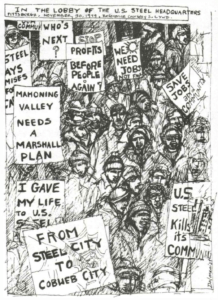
U.S. Steel’s announcement in November 1979 that it would close all its Youngstown-area operations provoked the first assertion that the community had, not just a moral claim, but a legal right to the soon-to-be-closed mill.
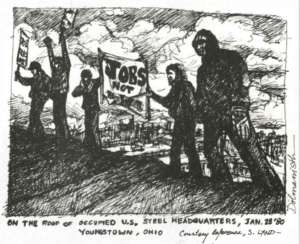
Perhaps the best summary of the ideology of the Youngstown resistance in 1979-1980 was offered by Bob Vasquez, president of Local 1330, just before hundreds of Steelworkers followed him down the hill from the union hall to occupy the U.S. Steel Administration building. “If U.S. Steel doesn’t want to make steel in Youngstown,” Vasquez said, “the people of Youngstown will make steel in Youngstown.”
To make steel in Youngstown in steel mills owned by U.S. Steel, however, the people of Youngstown needed title to the facilities. U.S. Steel would not voluntarily sell them the property, so they needed to find a legal way to take it. Such a theory of legal right evolved along two lines. On December 21, 1979, less than a month after U.S. Steel’s shutdown announcement, a lawsuit against U.S. Steel was filed in federal court.
The theory of the lawsuit was suggested by my Legal Services colleague Jim Callen. The complaint alleged that U.S. Steel had promised to keep its Youngstown mills open if the mills could be made profitable; that workers relying on those promises had agreed to a variety of concessions; that the concessions made the mills profitable but that U.S. Steel, in breach of its promises, closed the mills anyway.
A second and more radical theory laid claim to the U.S. Steel mills on the basis of a community property right. That theory was suggested by the judge in the federal lawsuit, Thomas D. Lambros.
At the beginning of the hearing, Judge Lambros unexpectedly spoke for half an hour. He said in part:
… it seems to me that a property right has arisen from this lengthy, long established relationship between United States Steel, the steel industry as an institution, the community in Youngstown, the people in Mahoning County and the Mahoning Valley in having given and devoted their lives to this industry. Perhaps not a property right to the extent that it can be remedied by compelling U.S. Steel to remain in Youngstown. I think the law could not possibly recognize that type of obligation. But I think the law can recognize the property right to the extent that U.S. Steel cannot leave that Mahoning Valley and the Youngstown area in a state of waste, that it cannot completely abandon its obligation to that community, because certain vested rights have arisen out of this long relationship and institution.
At the end of the day Judge Lambros granted the requested injunction, to remain in effect until the pending trial.
After trial, however, Judge Lambros denied both the contract and the property claims. Dismissing the property claim that he himself had suggested, the judge said:
… the lives of 3500 workers and their families and the supporting Youngstown community cannot be dismissed as inconsequential. United States Steel should not be permitted to leave the Youngstown area devastated after drawing the lifeblood of the community for so many years.
Unfortunately, the mechanism to reach this ideal settlement, to recognize this new property right, is not now in existence in the code of laws of our nation .
… this Court is not a legislative body and cannot make laws where none exist.
… this Court can determine no legal basis for the finding of a property right.
Pittsburgh, 1981-1985
“The Eminent Domain Laws Can Be Used by Communities to Defend Themselves”
At almost the same time, the idea of using eminent domain to acquire industrial facilities abandoned by their owners was proposed in Pittsburgh. Frank O’Brien, a former president of Local 1843, USWA, at the Jones and Laughlin mills in Pittsburgh, had also served in the Pennsylvania state legislature. There he noticed the frequent use of a provision in the Pennsylvania Municipal Authorities Act that permitted a city to form a development authority, which, by means of its eminent domain power, could acquire private property for such purposes as the construction of shopping centers. On reflection he realized that Jones and Laughlin had also used the eminent domain power to expand its Pittsburgh landholdings.
O’Brien advocated using the eminent domain power to acquire steel mills and put them back in production. O’Brien explained his ideas at a father-and-son communion breakfast at Saint Stephens church in Hazelwood, a Pittsburgh neighborhood, in the spring of 1981. The Jones and Laughlin hot strip mill in Hazelwood had closed a few weeks before. Speaking to an audience that included the mayor of Pittsburgh, O’Brien described how the companies had used the eminent domain law for their own purposes. “In the 1950s J&L used it to evict people from their homes in Scotch Bottom at Hazelwood. They said they needed the land to expand, but when they had evicted the people and gotten the land they didn’t expand. They just let the land sit there and stored raw materials on it.” He was thinking, O’Brien continued, that “the law can be used in reverse.”
I said the Mayor had better start worrying now about the U.S. Steel mills, that when they built that plant in Conneaut they’re going to shut down every plant up and down the river. He said, “Well, what would you do?” I told him: “You, and the County Commissioners, sit down and form an authority. We can run the plants ourselves.”
In Youngstown and Pittsburgh, advocates of eminent domain have argued that if a private owner refuses to operate a socially needed enterprise, then the community may properly step in, acquire the facility, and ensure its continued operation under alternate management. That approach can be criticized as “lemon socialism,” whereby the public acquires only what private enterprise has stripped of usefulness and is ready to scrap. However, a facility can often be viable on a low-profit or not-for-profit basis when private owners, demanding a 20 percent rate of return, wish to abandon it. Moreover, it is doubtful whether middle American workers, who only a few years ago showered rivets on anti-Vietnam War demonstrators while building the U:S. Steel headquarters in Pittsburgh, would have supported the idea of public ownership in any other circumstances. Workers in Youngstown and Pittsburgh, in my experience, are both scornful of management personnel as non-producers (hence the widely expressed belief that the mill runs better on the mid-night shift when there are few foremen around) and uncertain whether they could run the plant themselves. They will try to do so only if default by the owners makes a takeover by workers seem necessary to preserve their jobs.
The TriState Conference on Steel
The social composition of the coalition that formed to advocate the use of eminent domain in Pittsburgh was much the same as that of its Youngstown predecessor, the Ecumenical Coalition of the Mahoning Valley. In Youngstown advocates of worker ownership and brownfield development (i.e. development of previously used land) had been steelworkers active at the local· union level and clergy led by a Catholic bishop. The sources of support reflected characteristics of the local work force. Local unions, whose very existence was threatened by the shutdown of a particular mill, tended to be more iconoclastic than a national union with many constituencies and better prospects for survival. The Catholic church in Youngstown and Pittsburgh, although far from exclusively working class, was still closer to the cities’ working class ethnic neighborhoods than any Protestant church.
In Pittsburgh, too, local-level trade unionists and Catholics came together to promote the idea of eminent domain. Working through an organization with the unlikely name of TriState Conference on Steel, they were a handful of persistent advocates whose influence grew as the steel industry crumbled.
“The Threat is Real from U.S. Steel”
Inevitably, TriState faced off with the corporate leadership of Pittsburgh-based U.S. Steel. In 1979 and 1981 U.S. Steel alternately promised to modernize its Mon Valley facilities and backed away from its words.
In May 1979, board chairman Roderick hailed a consent decree negotiated with the Environmental Protection Agency, stating: “U.S. Steel is committed to remaining in the steel business in the Monongahela Valley … U.S. Steel can now act aggressively to revitalize our Pittsburgh-area operations.” But U.S. Steel’s 1980 annual report stated that the economics of required environmental investments might dictate “that certain facilities be closed instead of modified to comply with the requirements.”
U.S. Steel’s announcement in November 1981 that it would use a war chest of $6 billion to buy the Marathon Oil Company, rather than to modernize its steel mills, sent shock waves up and down the Mon Valley. Overnight, TriState’s interpretation of events became plausible, and TriState representatives began to be quoted in the media. As Ron Weisen, president of the Homestead Works local (USWA, Local 1397), told the Associated Press, “Six billion dollars would modernize and update every U.S. Steel facility in the country.” The delegitimization of U.S. Steel, its chairman of the board David Roderick, and the corporate ideology of maximizing profit, however, had not yet yielded agreement about what should be put in their place. There was still no widespread endorsement of TriState’s plan for reindustrialization through a regional development authority, using the eminent domain power.
The Movement to Save Dorothy and the Creation of the Steel Valley Authority
In the fall of 1982, the threat of an eminent domain-taking helped to prevent the closing of a large Nabisco plant in Pittsburgh. When the company announced its intention to close the plant, an ad hoc Save Nabisco Action Committee convened at which the mayor of Pittsburgh said he would learn to bake his own cookies if the plant were closed. TriState members met with the city Urban Redevelopment Authority and presented the eminent domain strategy. A vocal member of the Pittsburgh City Council publicly endorsed the idea. Just before Christmas Nabisco announced that it would keep the plant open after all.
A new opportunity to apply TriState’s ideas soon presented itself. In the spring 1984 U.S. Steel closed the steelmaking end of its Duquesne works, including a blast furnace named for the wife of a U.S. Steel executive, Dorothy 6. In September, there fell into the hands of TriState activists a brochure of the U.S. Steel Realty Division that listed among other projects the “USS Industrial Park of Duquesne, PA.” Inquiry revealed that, without public announcement, U.S. Steel was planning to dynamite the blast furnace in December in order to convert about 100 acres of the 260-acre site into an industrial park.
The projected demolition of a facility that had only recently set production records upset people more than the closing itself. A meeting of area activists and legislators called on the company to postpone the demolition pending a study. After a first study found that a reopened Dorothy could be profitable, the campaign swelled. U.S. Steel, arrogant unilateral decision maker par excellence, on four separate occasions postponed the publicly announced destruction.
The threat to Dorothy engendered a breadth and a depth of community support that the area typically produces only for incumbent presidents and football teams.
The threat to Dorothy engendered a breadth and a depth of community support that the area typically produces only for incumbent presidents and football teams. On May18, 1985, an extraordinary parade brought together the different constituencies seeking to reopen the mill. Marchers assembled at the Polish Hill Softball Field on a hill overlooking downtown Duquesne. Amid a carnival atmosphere, school bands, drum and bugle corps, fire engines, and ambulances from the towns of the Mon Valley proceeded down Grant Street to the Duquesne Plaza. Veterans of the Youngstown struggle carried a banner in a place of honor toward the front of the march. Not surprisingly, two weeks later the mayor and city council of Pittsburgh endorsed the proposal to create a Steel Valley Authority (SVA) that could acquire Dorothy by using its eminent domain power and also pledged fifty thousand dollars towards the SV A’s initial budget.
The creation of the SVA was the crowning achievement of TriState’s more than five years of agitation. Nine city councils in the Mon Valley—those governing the boroughs of Homestead, Munhall, Rankin, East Pittsburgh, Turtle Creek, Swissvale, Glassport, and the McKeesport and the city of Pittsburgh—took all the legal steps necessary for final incorporation of the authority in January 1986. It was a prodigious organizing achievement. (Appropriately, Frank O’Brien became the SVA’s first chairperson and Charley McCollester and Mike Stout were named to the board as representatives of Pittsburgh and Munhall.) The SVA remains in existence despite the ultimate failure of the project to reopen Dorothy.
Youngstown and Pittsburgh, 1986-1987
In advocating the use of eminent domain to buy and to run abandoned industrial plants, Youngstown and Pittsburgh steelworkers were motivated, not by a belief in the intrinsic virtue of public enterprise, but by their desperate need for jobs. In 1986-87, as the crisis reached beyond jobs to the pension and medical benefits that had been promised to retirees, steelworkers and their spouses came to advocate a national public corporation that would acquire at least portions of the American steel industry. They did so because the conduct of corporate executives who treated loyalty to workers, products, factories, communities, and even the nation as expendable convinced them that only public ownership could guarantee their benefits.
Conclusion
Youngstown has become a symbol of how unilateral corporate decision making can lay waste a community. But the story of Youngstown and Pittsburgh in the decade when the mills closed is also a tale of new beginnings. For example, a direct line of ideological descent leads from the November 1977 pastoral letter of the Ecumenical Coalition of the Mahoning Valley (an organization co-chaired by Youngstown’s Catholic Bishop, James Malone) to the November 1986 pastoral letter on economic justice of the National Conference of Catholic Bishops (chaired by the same bishop). The Youngstown pastoral letter argued that although some maintained that the decision to close the Campbell Works was a private, purely economic judgement and the exclusive prerogative of the Lykes Corporation, the decision was “a matter of public concern since it profoundly affects the lives of so many people.” Similarly, the bishops’ 1986 pastoral declared:
Decisions must be judged in light of what the do for the poor, what they do to the poor, and what they enable the poor to do for themselves. The fundamental moral criterion for all economic decisions, policies, and institutions is this: They must be at the service of all people, especially the poor.
As the Ecumenical Coalition’s letter had, the pastoral letter went on from that abstract pronouncement to express advocacy of public ownership on a case-by-case basis, and even of eminent domain. “The common good may sometimes demand that the right to own be limited by public involvement in the planning or ownership of certain sectors of the economy,” the bishops stated. No one has the right to unlimited accumulation of wealth. No one “is justified in keeping for his exclusive use what he does not need, when others lack the necessities.” The letter quotes Pope John Paul II’s advice that the duty to serve the common good places a “social mortgage” on all private property, so that “one cannot exclude the socialization … of certain means of production.” And the limits on the private accumulation and control of wealth are the basis of “society’s exercising the right of eminent domain.”
Such ideas are beginning to be applied in other parts of the United States. In 1984 in New Bedford, Massachusetts, where a Labor Party candidate had called for public ownership of the textile mills in the 1930s, the city threatened to use eminent domain if the conglomerate owner of the Morse Cutting Tools plant refused to sell it to a company prepared to keep the plant in operation. Gulf and Western backed down, and the plant stayed in business. Three years later the plant went bankrupt under its new ownership. In bankruptcy proceedings the judge ordered the assets sold to a bidder whose offer was slightly lower than the highest bid but who was willing to keep the plant operating in New Bedford. Union organizer Ron Carver commented that the judge’s decision “established a principle that a plant that has been around for all these years is a community resource.”
The most important contribution of the Youngstown and Pittsburgh effort may have to do with the way in which the state (and with it, the Constitution and the language of rights) is viewed by advocates of fundamental social change. One historian expressed such advocates’ ambivalence:
Beginning in the 1890s the state took on more and more the role of coordinator of the socioeconomic order … Faced with a practically irrevocable leviathan, radicals were forced into new but no less difficult choices … If to abandon politics meant to risk being hemmed in by leaving the state’s powers in the hands of labor’s enemies, to pursue the state-oriented strategy meant to risk assimilation and the taming of the movement that had launched it.
A second scholar concluded that at most American workers and their organizations have been able to gain through the state only a “counterfeit liberty.” The dilemmas present themselves specifically in the case of the steel industry. Only the federal government appears to be a practical source for the massive investment required to rebuild America’s steel mills. Yet workers and communities who have been battered by the decisions of absentee bureaucracies – corporate bureaucracies, government bureaucracies, and union bureaucracies – are understandably hesitant to turn to Washington for solutions to their problems.
The vision of public authorities acquiring abandoned industrial facilities by the power of eminent domain and operating them, or delegating their operation, on a not-for-profit or low-profit basis in the manner of Amtrak or the Tennessee Valley Authority has won wide popular support.
The Youngstown and Pittsburgh experience offers a model combining massive federal investment with decentralized administration by workers and consumers. The key ideas are, first, that means of production should be acquired from their present owners only when those owners are not willing to operate them, and second, that management should be locally controlled. Those ideas have made something akin to socialism acceptable to middle American working people. The vision of public authorities acquiring abandoned industrial facilities by the power of eminent domain and operating them, or delegating their operation, on a not-for-profit or low-profit basis in the manner of Amtrak or the Tennessee Valley Authority has won wide popular support.
UPDATE: THE FUTURE OF DECENTRALIZED PUBLIC OWNERSHIP?
In December of 1988, we [Changing Work editors] asked Staughton Lynd where he now—a year after the publication of his original article—thought the idea of local community ownership of industrial property might be heading. Staughton replied as follows:
The Steel Valley Authority (SVA) has proposed a plan for the re-opening of LTV Steel’s electric furnaces in Pittsburgh. According to the plan, the Authority would own the land and buildings and would lease them to a for-profit entrepreneur for operation. There would probably be some form of ESOP and workers’ participation in the management of the plant, but what I see as particularly novel is the idea of the public authority retaining ownership. This would enable the public authority to enforce its concerns — for example, about environmental policies — by simply writing them into the lease between itself and the private operator.
According to the plan, the Authority would own the land and buildings and would lease them to a for-profit entrepreneur for operation… what I see as particularly novel is the idea of the public authority retaining ownership. This would enable [it] to enforce its concerns — for example, about environmental policies… I see this idea as very much akin to the land trust concept that is being pursued in housing and community development…
I see this idea as very much akin to the land trust concept that is being pursued in housing and community development. In the one case as in the other, the current user has most but not all the attributes of ownership. Instead of regarding ownership as an indivisible package of rights, we regard it as a bundle of rights some of which can be retained by the community for its own protection.