Abstract
There is an urgent need to develop new types of finance to meet social and ecological needs at bioregional levels. Unfortunately, neither the financial industry nor national governments are likely to rise to this challenge. While many self-styled green initiatives purport to address ecological needs, they often perpetuate, in new guises, the core premises of conventional finance — value-extraction, private power, economic growth, hierarchical, top-down management. In a self-styled pursuit of “green” transformation, the structural norms of capitalist finance remain largely intact.
In this essay, we propose the framework for a new sort of noncapitalist finance that can support eco-stewardship of place-committed projects and cultures. We call it relationalized finance, a term designed to accent the central role of practitioner care, participation, and community control in directing flows of capital. The point is to escape the dictates of conventional finance and support new types of socio-political relationships at bioregional levels, especially through commons-based projects and loosely bounded, socially embedded markets. A new sort of noncapitalist eco-finance requires more than “new plumbing” for flows of money; it requires associated social transformations in organizational forms, relational practices, and social norms. That is the only way to catalyze effective, durable forms of eco-protection and restoration while building self-reliant, resilient bioregional economies.
Introduction
There is a long history of attempting to solve knotty ecological problems by marshalling the power of capitalist markets, finance, technology, and instrumental rationality. An incomplete list of historical examples includes proposals to treat earthly systems as “natural capital”; cost-benefit analyses to assess acceptable economic impacts on ecosystems; “corporate social responsibility” to protect the environment and serve communities; ESG investment screens [environmental, social, and governance protocols] to encourage progressive social and environmental goals; the monetizing of “nature’s services” as an attempt to “internalize” the actual value of nature in market prices and thereby shift investment; “sustainable development” as a way to keep economic growth within the natural limits of ecosystems; carbon-offset markets and eco-credits to incentivize business investment in emission-reductions and other green practices; the concepts of “green capitalism” and the “circular economy” as omnibus strategies for reducing industrial harm to the environment; and more recently, the trending adjective “regenerative” to name business practices said to foster biodiversity, resilience, and ecological vigor.
While this eclectic parade of “new and improved” eco-strategies has had some salutary effects, they have not made significant, lasting progress in “solving” the identified problems. The arc of climate collapse has continued apace, and a host of additional environmental crises (desertification, ocean acidification, volatile hydrological cycles, biodiversity loss, and more) has intensified. The modest impact of various green strategies should not be surprising; none really alters the core structural dynamics of capitalist finance and markets. Each new eco-strategy arrives with a buzz of fresh optimism and ideas, but the core priorities of economic growth, solid financial returns, and investor control of capital allocation remain firmly intact.
It may not matter whether the various eco-gambits are intended as cynical charades or serious interventions. As a recent report on “nature finance” concludes, “the global economy’s financial flows speak for themselves”:
More than $7 trillion a year in finance continues to subsidise harm, while less than $200 billion flows into protection or restorations, of which over 82% comes from public sources…This is not a question of misallocation: there are structural design flaws that entrench the very patterns that need to be shifted. These design flaws create reinforcing feedback loops: they lock in high-carbon, high extraction economic systems and make it hard for nature-positive alternatives to compete. Without confronting these systemic lock-ins, even well-intentioned capital will end up flowing along the same worn grooves [1].
The report quotes an investor’s rueful confession: “We’ve spent five years trying to make nature investable — and still, the capital barely moves.”
Mindful of this dismaying historical record, this essay proposes the development of a new, distinct class of noncapitalist finance rooted in very different socio-economic and political logics. As the Circular Bioeconomy Alliance report astutely notes, “[T]he question is not only how we mobilise more nature finance, but how we confront the nature of finance itself.” With respect to these two propositions, two overarching insights are clear:
- Changing dominant finance structures through state action (legislation, regulation, international treaties, etc.) is a nonstarter for now. The nation-state and capitalist interests are too deeply allied and mutually committed to capitalist growth and finance structures to wish to change them. (That said, there are niche opportunities, especially at the municipal level, to develop bioregionally oriented commons/public partnerships.)
- Creating new types of finance is entirely feasible, but only by expanding the scope of existing finance models beyond finance itself. There must be a coherent (noncapitalist) theory of value and empowered bioregional players (commons, communities, place-committed businesses). They, in turn, must have the motivation and capacity to limit value-extraction, privilege regenerative practices, nourish practitioner-driven eco-stewardship, and control new types of bioregional finance facilities (BFFs). [2]
While there are many embryonic, experimental finance innovations that might evolve to meet these criteria, in this essay we wish to propose a compelling scenario that we call relationalized finance, intended as a prime vehicle to develop bioregional social economies. In the course of introducing and explaining this idea, we raise several larger issues that apply more generally to the challenge of developing a noncapitalist finance and social transformation.
Relationalized finance is our generic term for finance that is not meant to generate private financial gains, but rather to support and deepen new relationships – social, economic, and political – in particular bioregions. This noncapitalist finance is nonextractive, peer governed, place-specific, humane, and designed to support the generativity of living systems. It does not regard “nature” and “finance” as separate and autonomous entities, but as artfully aligned and entwined with each other.
Because nature and modern economics have very different ontological and operational dynamics, there is a critical need for intermediary bodies for investment, to bridge and respectfully navigate those differences. It’s also important to name the value-shift that occurs when money is transferred from capitalist circuits of value to commons-stewarded regimes of value and meaning. We call this transvestment to indicate that investment in the latter value-regime has very different logics (holistic, ecological, social, ethical) than that of conventional capitalist investment. We will return to both of these topics – intermediary bodies and transvestment – in Section 5.
For now, it is enough to say that relationalized finance is quite different from “regenerative finance” or “green finance.” While the latter systems may foster environmentally beneficial results, they fail to recognize that they are foisting an alien order of money, contracts, and private property on ecosystems. Regenerative finance superimposes modern onto-epistemological logics and norms onto nature, prioritizing, for example, competition and productivity, the financial claims of investors and lenders, and Western legal regimes for property, contracts, state regulation, and finance. [3]
Relationalized finance, by contrast, is structurally designed to prioritize the ecological imperatives of a bioregional landscape, as various ventures (businesses, commons, nonprofits, state bodies) work as conscientious partners with natural systems. This may mean preserving wetlands, species habitats, biodiverse forests, and sacred spaces despite the economic constraints these priorities may impose. The point is to skillfully conjoin the terms of finance with a bioregion’s watersheds, forests, arable land as well as human provisioning systems, communities of practice, and culture.
In relationalized finance, the onto-epistemological clash of finance and ecosystems is frankly acknowledged. It is “worked with,” much as a diplomat negotiates working relationships between nations with very different worldviews and cultures. Critically, this reframing of the challenge empowers on-the-ground players with greater control over the terms of finance. They must have the ability to adopt investment priorities and methodologies congruent with their self-identified bioregional needs.
An important shift occurs when economies are reframed as bioregionally grounded phenomena. Economic activity can begin to reorient itself and adapt – synergistically, constructively, respectfully – to specific ecologies of land, soils, waterways, forests, plants, crops, wildlife, and weather patterns. This sort of bioregional integration and coherence is precisely what early visionaries such as Peter Berg, David Haenke, Kirkpatrick Sale, and others called for in the 1970s and 1980s, before the neoliberal economic orthodoxy took root worldwide, in effect imposing a forty-year hiatus (~1980-2020) on bioregional transformation.
To guide the reader through the “new logics” that we see relationalized finance enacting, we explore the following themes in the pages below:
- Reframing the Economy Around Bioregioning
- Commoning as Relational Provisioning and Governance
- Toward a New Theory of Value (and Meaning): Living Systems as Generative
- Toward Socio-ecological Markets
- Relationalized Finance: Bridging the Chasm
Reframing the Economy around Bioregioning
A big part of the polycrisis that has engulfed modern civilization is actually a meta-crisis – a failure of the framework of standard economics and the liberal polity to properly understand non-economic realities [4]. Most notably, the free-market narrative and its thought-categories do not give full weight to the living dynamics of ecosystems. Important human needs and capacities are also marginalized, such as desires for fairness, a sense of belonging, shared purpose, self-determination, and creative agency.
The economic model of humanity, Homo economicus, does not entirely override our inborn propensities to cooperate, but it does aggressively channel them into capitalist market regimes that privilege selfish, materialistic, competitive traits. Such markets elevate and engineer individual atomization and non-relationality as a strategy for maximizing seller sovereignty and revenues. State law and policy, for their part, prioritize centralized, top-down, technocratic, and siloed approaches to problem-solving. This institutional mindset of control tends to erode local agency and resilience [5]. Symptoms are treated instead of causes. People feel powerless and marginalized in their everyday lives.
The Internet and other digital networks have radically decentralized creativity and control on a global scale even as nation-states and corporations scramble to reconsolidate their massive top-down powers. As a result, there is a growing chasm between vernacular cultures of bottom-up participation and the naked authoritarianism and dysfunctional scale of nation-states. The state may claim the powers of legality, but commoners often have greater legitimacy. For now, this standoff is eclipsing serious conversations about climate, ecosystem protection, and economic change even as these challenges become more urgent than ever.
However these macro-political struggles play out, we believe that the strongest strategy for reconstituting democratic practice and culture lies in bioregionalism. The limits of remote, corruptible legislatures, regulatory agencies, and courts in overseeing structural transformation have become clear over the past sixty years. What is needed are relational worldviews and social practices that directly steward the health of land and water. Systemic change must be grounded in lived experience and culture at the cellular level; meso- and macro-institutions must play important roles, but generally do not have the situated knowledge, keen motivation, and legitimacy of place-committed players.
A bioregional lens is immensely useful in this regard because it offers practical, accessible ways to connect people with the living systems of particular places on which they depend – watersheds, soils, food systems, regional histories, and other contextual factors. The bioregional lens asks: What does this place need to thrive, and how can people here organize to meet those needs fairly and within planetary boundaries?
The bioregional vision emerged in the 1970s, when writers, ecologists, and grassroots activists recognized that modern economies were overshooting the carrying capacity of the Earth. Early bioregionalists proposed reorganizing life within ecological rather than political boundaries, watersheds instead of borders, and foodsheds instead of global supply chains. Cultivating local cultures and economic relations are powerful ways to encourage humanity to live within natural limits, rather than celebrating capitalist fantasies of no limits.
Over the decades, the bioregional vision has matured to inform both grassroots practice and systemic innovation — from ecological restoration projects and community-supported agriculture to regional food strategies and cooperative energy systems. What began as a countercultural movement is now being redeveloped as a practical framework for regeneration. Bioregional mapping helps us see that regeneration must be both ecological and social. Healthy landscapes require communities that can care for them. Healthy communities must be able to act as stewards of beloved landscapes, food systems, and waterways, and not treat them as tradeable commodities. Using a bioregional lens means that ordinary people can more readily:
- Connect scales – link local action (like a farmer restoring soil or a cooperative producing renewable energy) to systemic change across a whole region.
- Build resilience – recognize that climate, water, and food security are best safeguarded when rooted in local capacity and shared responsibility.
- Weave belonging – create the conditions where people work together, develop trust, and see themselves as co-stewards of their place.
This sensibility is not abstract theory; it is already happening. Community land trusts are keeping farmland in production for future generations. Local food initiatives are shortening supply chains while rebuilding community ties and self-reliance. Cooperative energy projects are making neighborhoods both more resilient and more inclusive. When approached through a bioregional lens, ecological regeneration and social regeneration begin to blend and fortify each another. Looking ahead, the bioregional approach will be essential for navigating transitions in agriculture, water management, housing, and energy. It can help align investments with what specific ecosystems and communities truly need, rather than conceding investments to investor allocations of capital that prioritize short-term returns and scant genuine care.
But how exactly can these goals be effectively pursued on the ground and expanded? It is not enough for people to recognize how their quality of life relates to the health of land and water around them. New productive and social relations, including new forms of finance, must take root outside of the control of capitalist investment. Otherwise, bioregions will morph into zones of neocolonial capitalist extraction. This pattern can already be seen in the long history of “green co-optation” referenced above.
Combining the bioregional vision with the pragmatics of commoning lead us to propose the following structural premises for a healthy bioregional economy:
- Establish protectable bodies of inalienable shared wealth stewarded as commons and allocated fairly for mutual benefit.
- Create new infrastructures to facilitate and support commons and bounded-market exchange.
- Rely on distributed structures to prevent corporate consolidation and abuses of market and political power. Federate distributed structures to achieve horizontal scope.
- Use peer governance to build a culture of commoning – a task that must precede transactional exchange (so that markets don’t override shared social commitments).
- Reconfigure state law, administration, and finance to facilitate commoning and bounded markets. Useful vehicles: commons / public partnerships, interfaces between state and commons (“neutral, diplomatic third spaces”), and formal legal recognition and support for commons.
- Commerce and commons must actively align with ecosystems, a challenge that requires limits on extraction and a new culture of sufficiency as encouraged by new institutional forms, including new forms of trans-local cooperation.
Commoning as Relational Provisioning and Governance
Commoning plays a crucial role in the implementation of bioregional action – and relationalized finance – because it is a proven set of social practices and organizational forms for bringing people together into shared purpose. At their core, commons are vehicles for collaboration and peer governance that are capable of limiting or neutralizing capitalist domination and control. As described in Bollier and Helfrich’s book Free, Fair and Alive, there are recurrent patterns of commoning by which commoners successfully shape the terms of their own governance, provisioning, and allocation of benefits. [6]
Commons are not a new phenomenon; they have been a consistent, productive presence throughout history. Indeed, an estimated two billion people worldwide, operating outside of the market system without private property rights or money, meet their needs through commoning, according to the International Association for the Study of the Commons. This activity can be seen in commons for stewarding land, coastal fisheries, community forests, farmland, water systems, and regional food webs.
Commoning also manifests in a growing international Commonsverse of projects in diverse modern contexts. Urban commoners use public spaces and buildings, mutual aid networks, alternative currencies, peer-savings clubs, timebanking, and urban agriculture to meet needs. Digital commoners have developed a vast oeuvre of shareable software code, network infrastructures and protocols, Fab Labs and hackerspaces, platform cooperatives, shareable content using Creative Commons licenses, open-access scholarly journals and websites, and open educational resources (curricula, syllabi, videos). The practices of commoning can also be seen in co-operatives, informal care commons, co-housing, and arts and culture collaboratives. [7]
As a socio-economic-ecological form, commons are distinct from markets and state power in that they generally strive to:
▪ decommodify their shared infrastructures to prevent their sale or liquidation except under carefully controlled terms that protect the integrity of commoning;
▪ limit use and extraction to levels that can be sustained without depleting the shared wealth;
▪ address basic needs in fair, inclusive ways, which enables marginalized and disenfranchised groups to play more active roles in meeting their needs (and indeed, to have their needs met);
▪ allocate benefits based on needs, available supply, social equity, and long-term stability, not just based on market or subsidized price;
▪ carefully control interactions with markets to ensure that money and market culture don’t undermine the social coherence and stability of a commons;
▪ peer govern participants in fair-minded, participatory, and inclusive ways; and
▪ respect local landscapes and natural systems in the course of working with them.
These behaviors offer important support for a bioregional vision because they can enable fruitful, deferential relationships with living ecosystems. Unlike capitalist markets, commons don’t regard nature as separate from humans or as mere resources. They generally don’t systemically externalize costs and risks onto nature and the community; they seek to internalize them in the course of provisioning needs. Commons don’t treat people as rational, selfish creatures of the market, but as whole human beings with a range of material, social, emotional, ethical, and spiritual needs. In this respect, commoning is a force for social reconstruction and reconnection – a counterpoint to the social separation and transactionalism encouraged by markets.
Ultimately, commons reconceptualize the whole framework of production, moving it from markets into “new spaces of collective debate and shared purpose,” notes Stéphanie Leyronas of the French Development Agency (AFD), which is now pursuing a commons-based approach to development in Africa [8]. Commoning entails a shift “from efficiency logic to shared responsibility; form expertise to knowledge pluralism; from contracts to collective engagement; and from deliverables to long-term sharing” [9]. Precisely because it is so deeply relational and interdependent, commoning blends well with the deep interrelationality of flora, fauna, and other living beings in ecosystems.
Commons are no magic panacea – they may be plagued by sexist hierarchies, poor coordination and communication, leadership cliques, social fragmentation, etc. But their constitutive logics point in a very different direction than markets and state power. They strive to build cohorts of mutual care, trust, and group empowerment outside of the circuits of the money economy and bureaucratic systems. This capacity to foster bottom-up governance and provisioning is especially important in capitalist economies that use branded, proprietary products, oligopolistic, predatory markets, and consumer debt to engineer dependency and subordination. Now that the deficiencies of state regulation and “free markets” are quite clear, it is becoming clearer, too, that “only commoners can save the commons.” If commoners do not play leading roles in developing new types of bioregional regimes, the entrenched habits and pathologies of state power and capital interests will surely continue.
To orthodox economists disdainful of the cooperative ethos and unfamiliar with the actual range of real-life commons in the world, collaborative provisioning outside of markets and the sharing of benefits are seen as novel or fanciful aberrations. Indeed, it is a chestnut of the discipline that commons are failed management regimes known as “tragedies of the commons.” But, in fact, commoning is a serious, widespread, and often-effective way to meet needs consistently and fairly. In the face of capitalist economics and states intent on asserting their dominance and control, commoners have a mindset that is more expansive, experimental, self-reliant and localist than the market/state dares to imagine. They are less interested in organizing themselves into hierarchies to maximize productivity, revenue, and growth, and more interested in meeting their needs through convivial, agreed-upon collaborative practices with long-term stability. Whereas the market and state privilege the role of individual agency, private property rights, and contract freedom – vehicles of liberation for some, but certainly not most; vehicles for short-term profit but not so much for long-term sustainability – commoners tend to see wealth in much broader, holistic, nonmarket, and ecological terms.
Seen in its fullest perspective, the commons paradigm represents an “ontological shift” from the prevailing worldview of modern, capitalist life. Life is not seen as a competitive arena in which individuals strive to maximize their material self-interests. It is a committed community of shared purpose. It embraces a wide range of ecological, social, and ethical priorities. In this sense, commons are relational social organisms. This framing represents a profound shift of perspective away from that of the liberal-modernist-capitalist world, to one of dynamic, living entanglement with an animate Earth [10]. More: this framing moves well beyond a theory of new economic value and wealth-creation; it points to a deeper register altogether – a world of relational identity, social meaning, belonging, and quest for wholeness [11].
Toward a New Theory of Value (and Meaning): Living Systems as Generative
In rethinking how “nature finance” should be structured, the distinctive modes of value-creation in commons and bounded markets are often misunderstood. Standard economics sees market exchange, money and growth as the only significant engines of wealth-creation, a process that finance purports to facilitate. It is therefore difficult for conventional finance to understand that there are many other distinctive species of “value” that ecosystems and organized commoning generate.
The word “value” brings to mind money and markets, but the value generated by nature is quite different in an ontological sense. The bounty brought by rainfall, fertile soil, and biodiversity cannot truly be expressed through quantitative proxies, prices, algorithms, or markets because this “wealth” doesn’t exist in static, objectified forms or essentialist identities. Humans may equate fish with food and trees with lumber, but of course fish and trees play many other ecological roles in sustaining life [12]. The value of living entities subsists within their symbiotic relations – the dense web of interdependencies that generates abundance in a robust, self-sustaining system. This matrix is far more complicated than standard economics or markets can begin to represent.
While it’s possible to see abundance in objectified units (a bushel of apples, a hectare of land), the reality is that this value arises only as part of dynamic, evolving living systems whose actual value eludes quantification and monetization [13]. It may take “thirty leaves to make the apple,” as Thich Nhat Hanh wrote, but businesses, fixated on the marketable fruit, have only a narrow, economic self-interest in the leaves, roots, tree trunk, orchard, ecosystem, and weather.
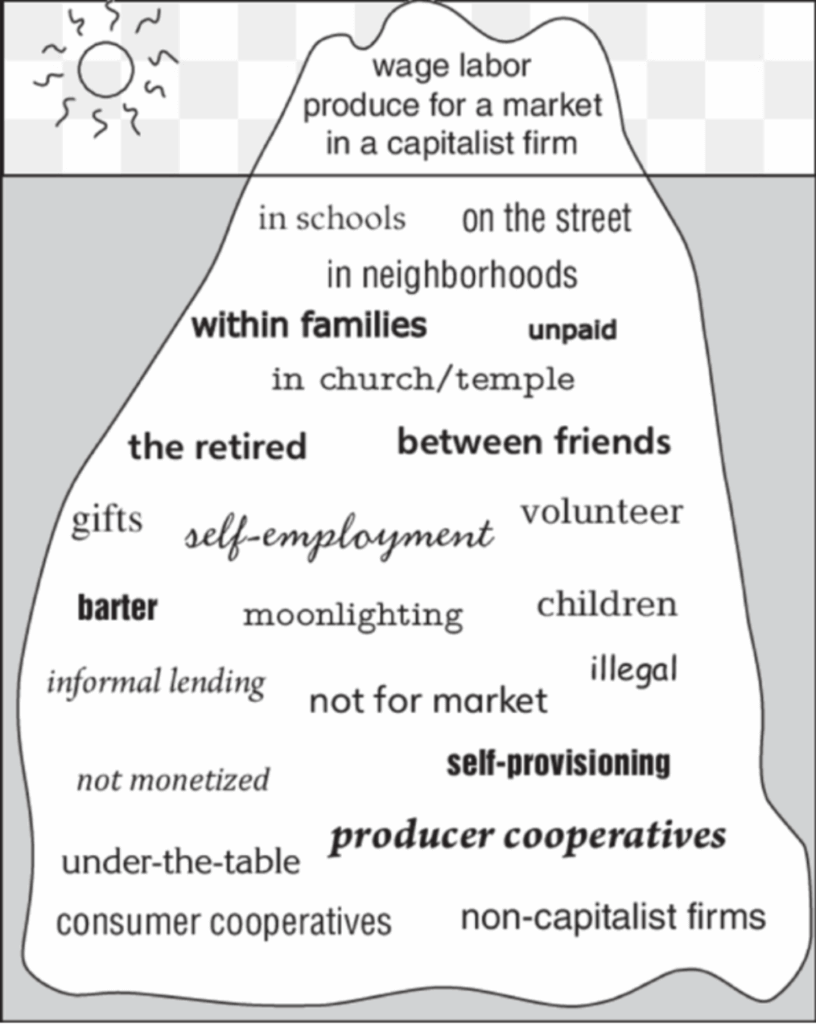
Inspired by feminist economic theory, J.K. Gibson-Graham proposed an iceberg image to suggest how much of “the economy” actually subsists outside of formal markets, remaining largely invisible and treated as inconsequential. The behaviors enumerated by the illustration below suggest how much economic work takes place in non-monetized forms, outside of wage labor and production for capitalist markets. These robust circuits of value-creation, often marginalized by standard economics and finance, can be seen in the generativity of living systems with sufficient organization: ecosystems of diverse organisms, agroecological farming, permaculture practices, online communities of collaboration, mutual aid networks, gift economies such as blood banks, scholarly disciplines, and artistic circles, timebanking collectives, and so on. Their contribution to “the economy” is enormous, but it is typically understated or ignored.
 How does value arise outside of market exchange? It emerges as individual organisms negotiate forms of interdependence across species and constitutive differences. What results over time are creative, hybrid systems whose benefits can be freely shared. Biologist Lynn Margulis famously explained how autopoiesis and symbiotic relationships at the cellular level — among various bacteria, for example — are fertile, creative evolutionary forces [14]. The cosmologies of Indigenous peoples have long recognized this idea, that a meshwork of natural living relationships – human and more-than-human – can yield stable, sustainable forms of abundance. Indeed, there is a burgeoning literature these days documenting the deep entanglement of life-forms at myriad levels, and describing how this interrelationality makes life and indeed, human economies, possible [15].
What’s crucial in any human economy, therefore, is respecting the integrity of the collective entanglements and unfolding of life, and learning to steward and care for it. This process integrates ecological dynamics with culture, and is essential to bioregional restoration and protection. Commoning — the self-organized relations of living subjects, whether human or more-than-human – is an important way to protect these circuits of (material, enlivening, naturally expansive) value-creation.
However, modern economies have become so habituated to distilling human and ecological value into prices and property (marketable “resources”) that we rarely see the reductionist violence that it entails. Price distorts and limits our very understanding of value. It blinds us to the complicated generative dynamics of living systems. Indeed, price invites us to see many things as valueless. It commodifies living phenomena that in their natural state are dynamic, relational, subtle, and alive with their own creative agency [16]. While most people intuitively recognize that many forms of value exist outside of market economics, price remains the default tool for valuation.
Indeed, economists and politicians assume that if only we could make other forms of value visible – meaning, measurable and quantifiable – then the “free market” will be able to work its magic and properly assign an accurate value (price) to everything. This is a classic category mistake – the ontological error of ascribing a trait to something that it cannot possibly possess. Ecological dynamics cannot be expressed through money, property, or finance. Economics has contrived this fiction to normalize the idea of business incorporating waterways, forests, soil fertility, biodiversity, and much else into capitalist, anthropocentric logics [17].
The power of price as a cultural category is perhaps related to its role in valorizing exchange value — and implicitly ignoring use value and intrinsic value. Investor Warren Buffett has insightfully noted: “Price is what you pay; value is what you get.” In other words, even though price is treated as a statement of value, in fact “value” has an existentially richer, separate life of its own. It has subjective and social (intersubjective) dimensions that even the term “value” cannot quite encompass. Living organisms have experiences that yield a sense of meaning (biosemiotics is the subdiscipline), relational regularities (a sense of “belonging”), and a desire for flourishing and wholeness.
It’s worth noting that this understanding of “living value” differs from that of “systems thinking,” which sees planetary dynamics as systems that humans can in principle understand and master. This framing reflects Newtonian, mechanistic thinking: “If only we humans could deploy science and technologies to become “Master Engineers of Space Ship Earth”! (Bruno Latour’s term). It is more apt, indeed necessary, to see our earthly systems as Gaia – a living personality that has its own creative agency, history, and unfathomable, interconnected dynamics. This insight forces us to realize: Humanity is not separate from the Earth. We must recognize this fact and learn to become a humble, attentive partner working with the planetary organism in which we are embedded. At this point in our planet’s history, this is not a discretionary choice, but a necessity. In response to the abuses inflicted by our modern, capitalist civilization, Gaia is now aggressively, indifferently intruding on human societies as a political actor in its own right. Our challenge is not to double-down on modernity to “change nature” as if human agency could reign supreme. It is to recognize that Gaia is a living system that is far beyond our potential ability to control; respectful collaboration is essential [18].
As Indigenous peoples have long understood, we must enter into the indirect reciprocity of gift-exchange with Gaia, a process that Lewis Hyde astutely describes in his classic book, The Gift [19]. He notes that the regenerative properties of life and nature will continue to generate their fruits (“value”) only so long as the gift ethic is honored and precious treasures are kept in circulation. (“The gift must always move.”) Once gifts are hoarded as capital and withdrawn from the circuits of gift exchange, creative yields decline and ultimately die [20]. This is a pertinent fable for our time of ruinous overextraction of fish, groundwater, timber, and every other earthly resource (the “tragedy of the market”). Bioregionalism invites us to recover and revere the “invisible economy” of relationality.
Will Ruddick, the founder of Grassroots Economics in Kenya, said that he’s encountered “more than forty-two different tribal names for traditions of social reciprocity,” such as people helping their neighbors harvest annual crops, build houses, or teach their children – all of which is maintained by people keeping informal track of everyone’s contributions and obligations. “Surprisingly,” Ruddick writes, “if you look through anthropology research, this social practice is almost undocumented, even though it seems to have been nearly everywhere” [21]. It petered out around the time of colonialism, when conquering nations introduced their own currencies, markets, and market culture. A local saying of the time held that “those who would lose their traditions become slaves” – an insightful description of what happens when colonial currencies and market wages supplant homegrown traditions of mutual aid. The currency and markets imposes a new regime of “value” on people.
To be sure, physical materials and relational life cannot be cleanly separated from each other. But in modern economies, we have not really resolved how to integrate each with the other without enshrining capital interests as the superior, organizing matrix of power and epistemic order.
Economic anthropologist Karl Polanyi sheds light on this issue in his classic history, The Great Transformation, which describes how capitalist markets in the sixteenth century began to supplant a system of commons, with markets eventually becoming the hegemonic ordering system for modern societies [22]. He explains how early capitalist markets created “fictional commodities” of land, labor, and money in order to annex them into its cosmological framework. The three realms are not in fact commodities because they pre-existed markets (land, labor) or derive their value from social exchange (money). The point is that capitalist businesses declared land, labor and money to be commodities. Early capitalism chose to objectify and monetize them in order to make them tradeable in markets. Predictably, the living character of these realms frequently clash with their ascribed status as “commodities” as workers assert their human needs, ecosystems deteriorate from extractive farming practices, and societies buckle under the demands made by capitalist currencies. Hence the persistent structural tensions between living systems and capital.
This brings us to the conundrum of financing for living systems today. Modern economies continue to misconstrue the value generated by living systems (local ecologies, academic disciplines, open source software communities, commons) by objectifying and monetizing them. So we have dueling ways of seeing them. We see them as living organisms AND financialized property, much as physicists have shown that light can manifest as either particle or wave. Living systems can be viewed through the prism of relationality as ecologists and Indigenous peoples do; but in modern capitalist societies, living systems are generally seen through the prism of price, as a commodity.
Relationalized finance is an attempt to candidly declare that there are other circuits of value-creation and meaning that have their own logics, outside of the market, that require their own forms of nourishment and protection. Property rights and financialization don’t acknowledge that living systems, as relational phenomena, may actually live on the “other side” of an ontological divide. Which raises a crucial question: Can the coherence and integrity of symbiotic living relations be maintained on their own ontological terms, or will investors, corporations and the state continue to misconstrue and enclose (privatize, commodify, sell) them, often in the name of helping and protecting them? Section 5 explores how finance and living systems – two classes of value (if that’s an appropriate term for living systems) might “play nicely together.”
For now, it’s important to stress that capital accumulation is not the point of commons. The goal is to fortify relational strategies for systemic and individual well-being. The goal is to strengthen social and ecological (and even cosmic) meaning. Indigenous cultures are renowned for their commitment to these realities. The problem for we moderns is to develop a discourse and vocabulary that will let us see and understand relational dynamics [23], much as physicists have had to move beyond the language of Newtonian physics to understand the relationality of quantum mechanics. The social and ecological dynamics of living systems cannot truly be understood through numbers and financial sums; they must be articulated and expressed in nonmonetized, nonfinancial terms.
Community forests in India flourish through the affective labor of villagers working together. Villagers love and care for their forests, and community culture flourishes because people share responsibility for tending the forest, allocating wood and fruit, and scaring off poachers. Their affective stewardship (and stinted market sales) acts to conserve the forest while serving household needs [24]. In similar fashion, open source software communities thrive as more people coordinate their contributions to produce high-quality working code. “Many eyeballs tame complexity” and “the grass grows taller when it’s grazed on,” are two aphorisms of early open source hackers, attesting to the relational ethic and how it produces value [25].
The primary problem in commons is not managing scarcity through price, as economics states; the task is to align living forces into shared purpose and create structures and cultures that can generate abundance and protect it. Permaculture expert Joline Blais explains how this works in natural landscapes through self-organizing “catchment” areas that bring together synergistic flows of energy — “permaculture’s alternative to capital.” Blais writes:
Where capital is centralized accumulation that resists redistribution, catchment is a system for accumulating a critical mass of a needed resource, like water or soil minerals, in order to trigger self-organizing system, i.e. life forms, that then spread over the landscape. Some natural examples of catchment include the sun, plant carbohydrates, bodies of water, geothermal energy, and plate tectonics.
How does catchment work? Since the ‘driving force behind all natural systems’ is energy, catchment focuses on ways to capture naturally occurring flows of energy in such a way as to maximize the yield over time and space. As we know, entropy is the natural tendency to disorder, but it is balanced by an opposing tendency toward self-organization – or what we call life. This kind of self-organization happens ‘whenever energy flows are sufficient to generate storages.’
If the metaphor of capitalism is building a pyramid on the desert, the metaphor of catchment is growing a forest from the desert. In his film Planting in Drylands, Bill Mollison [the permaculture pioneer] shows a small rolling device that forms tiny divots over the desert floor. These small depressions in an otherwise flat surface collect dew and stray seed, so that over a surprisingly short amount of time, small sprouts shoot up, which in turn are able to collect more dew and hold more water in the soil. Under the right conditions, this positive feedback loop can actually turn a desert path to a living one with minimal human intervention – not even the need to sow seeds. Whether the result is a grassland or forest, the terrain moves from a handful of green spots to a terrain so evenly covered with life that it is no longer possible to find the spots where the wealth was initially concentrated [26].
One might say that ecological and human-assisted commons (and potentially, bioregions) amount to “catchment areas” for organizing flows of energy, co-creativity, and biophysical matter. They bring people and other living entities into shared purpose to generate needed outputs and allocate benefits in fair, transparent ways. They nourish life. Commons eschew the organizing logic of capital and prioritize the instincts, needs, and creative agency of living systems, aligning individual, collective, and ecological needs together.
“Unlike capital, whose increase is measured only in financial terms, catchment wealth is measured in terms of real wealth,” notes Blais. “It replaces short-term, centralized profit with long-term asset building for the benefit of future generations.” In nature, for example, the “real wealth” assets are “soil fertility, seed saving, reforestation, key line water harvesting, and carbon, water and nutrient storage in the landscape,” Blais writes. The beauty of real wealth, she continues, is that it is self-maintaining, depreciates slowly, uses simple technologies and processes, and resists monopolization, theft, and violence. Stabilized by such real wealth, commons provide long-term security and protection from enclosures.
Commons in modern life pose a conundrum for capitalist finance and state policy, however. Even though commons generate enormous, diverse streams of value – social, personal, ecological, economic – most of it is not easily propertized or monetized. Indeed, introducing private property rights, market transactions and individualism into a commons can destroy its generativity as a catchment zone. For example, the vitality and cachet of Couchsurfing, the hospitality gift-exchange for travelers, dissipated after venture capitalists bought the website and converted it into a paid travel service. Similarly, open source software networks are often fractured when money is introduced into a community of cooperating peers. A research community that flourishes by sharing its knowledge can be crippled if some of its members patent collectively developed insights for private gain.
How, then, can the special value-generating dynamics of commons be protected and nourished within a capitalist system that has a very different worldview and priorities? Can the ontological norms of conventional finance build respectful interfaces with the intersubjective, relational norms of commons and ecosystems?
Toward Socio-ecological Markets
If bioregions are going to become more economically self-reliant and culturally self-directed, they must be able to insulate themselves from the neocolonial workings of global finance and markets. This means that bioregions must be able to assert their own investment priorities and become more self-reliant by intensifying their intra-regional commerce. Their basic challenge is to fend off outside commercial control and extraction (while obviously continuing many commercial dealings) so that the regional economy can benefit from the “multiplier effect” of locally circulated money while ensuring strong ecological stewardship and regional identity and culture.
Without some deliberate strategies for consolidating market activity within bioregions – making enterprises more interdependent and regionally focused – the priorities of capitalist businesses and global capital will override regional eco-stewardship and self-determination. Attempts to build a coherent regional economy and identity will be subordinated to “free market” imperatives and everything they privilege.
It is impossible to prescribe a single strategic template for addressing these issues, however. An agenda this broad, ambitious, and long-term will necessarily vary from one bioregion to another. That said, in conjunction with commons, bioregional market structures and strategies could prod commerce to become more place-committed and socially embedded. These bioregional strategies include:
- Community-designed infrastructures for bioregional production. Community participation in creating and managing small, shared infrastructures can be catalytic for the bioregional economy in general (commercial, commons-based, social, ecological). Shared bioregional infrastructures can reduce overhead, transport, and retail costs. It can make essential services like WiFi access, solar energy, water systems, grain milling, information-sharing, and databases — more accessible and shareable, all while strengthening social cohesion and bioregional identity.
- Inalienable shared assets. Assuring that major bioregional assets like arable land, groundwater, housing, forests, and other “natural assets” remain inalienable – off-limits in perpetuity to private purchase – makes a bioregion more stable and secure. It prevents companies and private equity funds from acquiring essential infrastructure through which they would extract exorbitant rents, siphoning money away from the bioregion. Keeping shared assets inalienable also addresses social inequity by making essential equity assets free or lower-cost, and available in perpetuity. For example, groups like Agrarian Trust (US) and Terre de Liens (France) rely on community land trusts to make land inalienable and stewarded as commons, which has all sorts of salutary effects: farmland for a younger generation of farmers, reduced equity costs that enable organic, local agriculture, and meaningful long-term employment for local residents.
- Bounded market structures and relationships. Food system expert Ken Meter, author of Building Community Food Webs, has spent his career bringing together farmers, suppliers, food processors, wholesalers, distributors, institutional food services, and restaurants as coherent regional “food webs” [27]. When disaggregated players are organized into interdependent networks of mutual commitment and commerce, a region benefits. It can insulate itself from the vagaries of national and global markets while also building regional identity and pride. Many experiments are underway to build more coordinated, integrated regional food systems.
- Peer-organized governance of specific sectors. A group called “Float” — funding lab for open agroecological technologies – is experimenting with “community-led innovation prioritization and resource allocation” among its network of agroecological farmers, technologies, researchers, and civil society players [28]. The project is a self-conscious attempt to build commons-based infrastructures, open source technologies (“good enough for now, safe enough to try”), and knowledge-sharing practices that can work at multiple, interconnected scales (farm, community, territory, ecosystem). Float’s community-based governance prototype suggests the promise of self-organized, independent regimes for bioregional governance.
- “Stinted markets” to assure affordable access. The “stinting” of markets has a long history in medieval markets as a way to protect community interests, as Lewis Hyde explains in his book, Common as Air: Revolution, Art, and Ownership [29]. Hyde reports that markets in the eighteenth century “could not operate without regard for the provisioning of commoners and the poor. Farmers, for example, were obliged to bring grain to market rather than sell it in the field to wholesalers, and markets themselves were fenced, as it were, so that speculators couldn’t outbid the poor.” The “orderly regulation of Preston market” in 1795 held that “none but the town’s people are permitted to buy during the first hour, which is from eight to nine in the morning…” In another town, writes Hyde, “’hucksters, higglers, and retailers’ were excluded in the morning until noon” [30]. Modern-day adaptations of this principle, as well as gleaning – the right to scavenge for crops left in the field after the harvest – could also be considered.
- Complementary bioregional currencies. Place-based currencies have great promise as a way for communities to retain the economic value generated in a region, rather than allowing it to be siphoned off to big-city financial centers and private firms. Of course, it can take a lot of work to launch a bioregional currency that is used by a large and diverse enough group of businesses and consumers, in ways that engender trust and market exchange. Still, the idea has proven precedents. For example, the BerkShares in western Massachusetts, used by hundreds of businesses and thousands of consumers, amounts to a sophisticated buy-local program that distinguishes local businesses from their global counterparts and builds pride in Berkshire County-sourced goods and services [31]. There are many possible designs for bioregional currencies and token systems, but the goal is generally to privilege and intensify regional market exchange over that of undifferentiated national or international markets that extract value from a region rather than re-circulate it.
- Mutual credits systems, timebanking, crowdfunding. At more modest scales, these vehicles for pooling money have shown their effectiveness. While each has different functional challenges, small scale mutual credit systems (regional, local and even neighborhood-based (see groups like Grassroots Economics Foundation in Kenya), mutual aid networks that operate timebanks, a service-barter system, and crowdfunding platforms for commons projects (see Goteo in Europe) offer worthy models. The challenge is to develop sufficient social commitment-pooling before the introduction of an exchange system so that people can prioritize shared community goals, and not simply revert to transactional, self-interested roles.
- Common funds, aka ROSCAs. The informal pooling of money has a long tradition throughout history, most notably among women in Africa and the African diaspora. Social money-pooling, or a common fund, has many names – susu, partner, meeting-turn, box-hand, sol – but the practice is generically known to scholars as ROSCAs, an acronym for “rotating savings and credit associations” [32]. ROSCAs provide a way for people of color and modest means to take care of their financial needs (saving, borrowing, investment) when banking systems are unfriendly or unaffordable, often for racialized reasons. Such traditional systems of self-help could play an important role in bioregional finance, helping to integrate economic exchange with regional self-reliance.
- Government procurement policies. State policy can be used to develop regional businesses channeling its large purchasing demand toward in-region vendors. Using state, regional, and local government purchasing to “buy local” could help any number of commercial sectors to grow and invigorate the bioregional economy.
- Import-replacement strategies. The Schumacher Center for a New Economics has long advocated that regions develop “import replacement” strategies so that specific crops, goods, and services can be offered by “homegrown” independent businesses as possible, rather than depending on national and international businesses. The point is to foster greater regional self-reliance and an economic multiplier effect within the region, rather than losing that money to external businesses and financial institutions. Some players in the degrowth fashion movement are actively experimenting with designing fiber-growing and textile production as integrated bioregional systems. British activist Zoe Gilbertson of Liflad CIC has focused on how to grow flax and hemp bioregionally in the UK, as are groups like Fashion Act Now, OurCommon.Market, and open source textile processing company Fantasy Fibre Mill.
- Community Wealth Building. The nonprofit Democracy Collaborative has developed a number of strategies to invigorate regional economies through “buy local” relationships, strengthening local businesses, and creating worker cooperatives. In cities like Cleveland, Ohio, and Preston, England, “anchor institutions” like universities and hospitals commit to purchasing goods and services locally, spurring shared economic prosperity, racial equity, ecological sustainability, and democratic ownership and control [33].
- Geographic indicators for bioregional products. When distinctive products are widely identified with a particular region, they are often able to get formal legal recognition through a kind of trademark-like protection known as “geographic indicators,” or GI. This legal form is a way to support businesses that produce distinctive, region-specific products such as wine, cheese, textiles, and meat such as Chablis, Champagne, Parma ham, and Kente fabric design. There is legitimate controversy over what types of product names should be considered generic, and the circumstances under which a region should be allowed to claim exclusive control over a name. That said, with appropriate safeguards (i.e., avoiding the privatization of existing generic names), there is a strong case to be made for developing bioregion-specific trade names to support those economies.
- Local bio-based building materials. Without much fanfare, a number of experiments are underway to develop climate-friendly, hyperlocal building materials that can acceptably substitute (in terms of fire-resistance, moisture-control, etc.) for carbon-intensive modern synthetics. Examples include hemp, stray, clay, ecologically harvested timber and wood chips. While such materials hold great promise, they often require new design methods, construction procedures, commercial sourcing, building code reform, economic efficiencies, etc. – areas that deserve further exploration and development [34].
- Culture-led energy transitions. Although most energy-generation in industrialized countries is controlled from the top down via large utilities, energy companies, and the state, there is growing experimentation with decentralized legal regimes and tech innovation controlled by local and regional players. This is often driven more by local culture than by technology alone, a topic often studied under the term “energy humanities” [35]. In particular, countries like Germany, Austria, The Netherlands, and Ukraine (following the devastation of war) are finding it useful to support local energy-generation to unleash greater local self-determination, creativity, and system-resilience. The Danish island Samsø has become a model for self-sufficient renewable energy using wind, solar, and biomass, and will host a major conference in 2026 on localized energy [36].
- Support to democratize local ownership. The City of New York has a dedicated program to encourage the creation and financing of cooperatives. In the UK, the Centre for Democratic Business is strengthening localism through the “social club movement” as forces for social solidarity and collective investment. Innovative financial schemes such as “Exit to Community” are enabling privately held small businesses to sell to community members rather than to private investors through IPOs [Initial Public Offerings]. Michael Shuman, a leading expert on local economics and finance, believes that latent synergies among community banking, public finance, and crowdfunding are finally arriving, opening up new possibilities for Main Street investment [37].
- Cosmolocal production. A new stage of common-based peer production is known as “cosmo-local production,” an outgrowth of open source software that shares design and knowledge on a global scale, via the Internet, while enabling the production of physical equipment at local levels, using less expensive, modular components than conventional manufacturing. The system provides ways for farmers, scientists, entrepreneurs, and hobbyists to produce first-rate innovations without the burdens of carbon-intensive transport and proprietary corporate control and prices. Cosmo-local production techniques are currently being used for such varied things as furniture, farm equipment, motor vehicles, prosthetic limbs, and automated insulin-delivery pumps for people with diabetes [38].
- Collaborations with Indigenous peoples. For obvious reasons Indigenous peoples have enormous contributions that they can make to bioregioning efforts – in resurrecting eco-cultural practices of the past, learning about the spirits and behaviors of more-than-human life, and forging shared commitments to restoration. For example, the Cascadia Department of Bioregion has worked with tribes in Canada to develop maps of Indigenous homelands – noting heritage orchards, fishing spots, bird colonies, ancient First Nation sites — before colonial conquests had decimated them [39]. Such ecological, cultural, and practical knowledge offers importance guidance in developing a bioregional vision.
- Bioregional festivals. The importance of nurturing a bioregional culture cannot be overstated. Besides promoting bioregional commons and markets, it’s valuable to host festivals to celebrate the culture through learning, exhibitions, and family fun. Pete Seeger’s famous Clearwater festivals on the Hudson River in New York State were an early example of this. Many communities already have festivals to celebrate local agriculture or signature fruits or vegetables. Expanding such efforts and giving them a bioregional focus – such as the Green Heart Festival planned for 2026 in The Netherlands – are important ways to popularize the challenges and enlist the support of a broader public.
How to pursue the above strategies? That, truly, is the work ahead. Brave, experimental, creative work is needed to develop functional, socially integrated initiatives and infrastructures. One overarching priority must be the nurturing of new modes of finance. We must move from a finance that demands private benefits at scale, as purely transactional and extractive, to finance systems grounded in particular places and cooperative relationships, all closely aligned with living systems.
Relationalized Finance: Bridging the Chasm
As should be clear by now, the core puzzle that relationalized finance seeks to mitigate or resolve is actually an ontological and cosmological clash that takes place in everyday circumstances. It’s a struggle between different notions of value and meaning. It’s the glimmer of a worldview that steps away from many premises of liberal-capitalist-modernity. Does humanity consist chiefly of rational, self-interested individuals seeking material gain through market exchange, and exploiting nature as a (dwindling) resource that stands separate and apart from humans? This is the cosmology of contemporary finance.
Or does humanity consist of interdependent, cooperative individuals nested within collectives, which themselves are nested in complicated ways within an animate Earth of countless living beings engaged in a symbiotic, evolutionary dance? We need a finance in sync with this world.
Without some adaptation of conventional finance and its implicit cosmology, capitalist finance will continue to inflict harm on nature and communities. It will continue to financialize life-systems as assets, and in so doing, superimpose an alien matrix of value and extractive production on them. So a key goal here is to help commoners secure much greater equity and control over their shared wealth, and to help them avoid becoming beholden to distant investors, lenders, and state authorities with their own empire-building priorities.
What might a relationalized finance regime look like? It would be one version of a Bioregional Finance Facility (BFF), a breakthrough idea introduced by Samantha Power and Leon Seefeld in their pioneering book of that title [40]. A BFF is intended as a kind of bridge between the current finance paradigm and an ecologically minded economy on a bioregional scale. How exactly a BFF should be structured and managed remains something of an open question because there are so many practical challenges, if only because bioregions themselves are so varied.
We conclude, however, that there are deep tensions between conventional and progressive finance on the one hand, and the aspirations to protect and restore bioregions on the other hand. Modern finance cannot really comprehend nonpropertized, nonmonetized forms of value unless they are properly “coded” in dollars, numbers, and units of property. So to make investment or lending intelligible, the ontological realities of generative living systems – its value and meaning proposition – are de-natured and misrepresented.
Hence the conundrum: Dominant forms of finance tend to stymie or co-opt novel, emergent alternatives, casting them as impractical and marginal. And yet building effective alternatives that might render the current models obsolete (the R. Buckminster Fuller admonition [41]) has its own serious liabilities – a logic that conventional investors and lenders reject and a social coherence that is embryonic and culturally invisible to mainstream players, which of course limits the capacity of novel alternatives to grow.
Given the dismal history of “green finance” models in redirecting capital and catalyzing transformation (see p. 1), we believe the clear necessity is to create novel alternatives that can tap into social and local energies (commoning, cooperation, bioregioning) and grow viable new forms of finance in tandem with these movements. Bioregional players need the ability to borrow and receive “transvestment” from capitalist circuits of value, in order to establish stable new regimes of care, reciprocity, cooperation, and bioregional coherence.
We therefore propose a relationalized finance system that is able to direct funds to commoning and socio-ecological markets that work as stewards of generative living systems. To overcome the ontological clash of finance and ecosystems, we propose a simple but versatile entity that would serve as a buffer, or intermediary, between finance and commons. The buffer entity – a type of BFF that, in this instance would be a “regrantor group” — would mitigate or neutralize the extractive ambitions of capital investment and lending so that funds would flow to stewards of the generative value of living systems.
The chart below illustrates a general scenario. Commoners, through their affective labor and care for a body of shared wealth (land, water, farms, buildings, parks, etc.), would act as stewards of living value. And businesses that agree to participate in quasi-bounded, stinted bioregional markets would have access to capital and lending. Under this scheme, a transfer of money is much more than a money-making transaction; it is an affirmation of the recipients’ shared commitments to commoning, bioregional markets, and the alternative theory of value (living systems as generative in nonmonetized, nonpropertized ways).
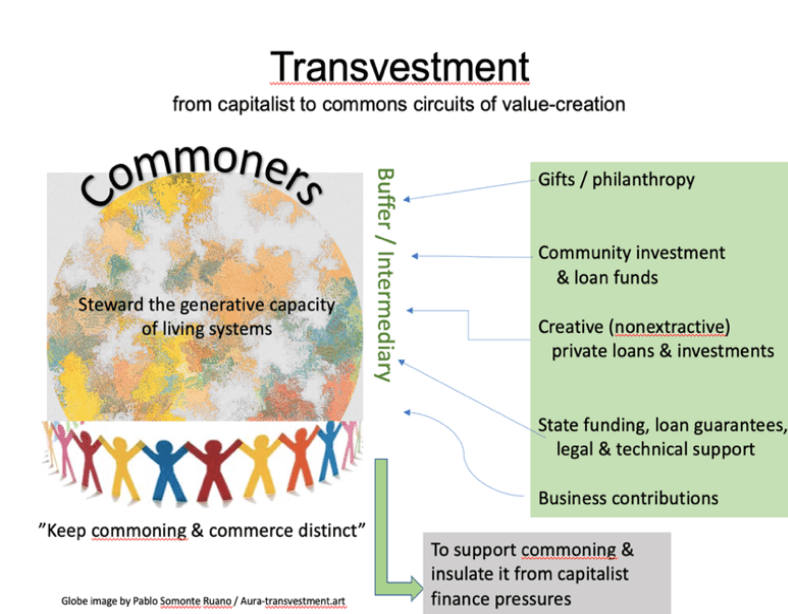 Money would flow through a “regrantor fund” that pools money from commoners themselves, friends and allies, and adjacent movements, augmented by money from crowdfunding, supportive businesses, philanthropies, and community foundations. The state, especially municipal and regional governments, could be potentially important sources of additional funding because their ostensible purpose is to protect and advance the common wealth (in all its forms, not just market value).
The regrantor fund would act as an independent, non-governmental buffer/intermediary, standing between funding sources and the commons. Its role would be to act as a central collector of funds to support bioregional work (a BFF), especially via commons, and to neutralize any direct, transactional demands on funding recipients.
Since the elders of the Commonsverse and bioregional community would be the trustees of the regrantor fund, the fund would be a vehicle for noncapitalist practitioners to exercise autonomous judgment and leadership, in resonance with peers to whom they are accountable. The larger terms of governance (how appointments are made, funding criteria, performance requirements, etc.) deserve more discussion, but in any instance would reflect local priorities, aspirations, and needs.
The idea of a regrantor fund is inspired by the many foundations associated with free and open source software projects, especially for software that is essential for the Internet and computer operating systems (GNU/Linux, Debian, Apache, Perl, etc.). These foundations typically accept funds from various donors (including Big Tech companies) to support their commoning to produce non-proprietary, shareable software. The foundations, governed by respected community practitioners, act as intermediaries to prevent transactional “purchases” of the community’s talents and to advance the community’s key priorities and projects.
The foundation-as-intermediary model upholds an essential pattern of commoning — to “keep commoning and commerce distinct” [42]. This rule helps prevent business opportunities or sudden inflows of money from disrupting the social solidarity of the group. Obviously, securing money is always a temptation and often useful, but no commons will succeed unless it first cultivates a strong, committed culture of commoning. Strong relationships of trust, a shared purpose and ethic, community rituals, and a good reputation are bulwarks against market enclosures.
Seen in this larger social context, it becomes clear that a regrantor fund is not merely be a financial institution. It is a force for propagating the social logics of bioregionalism. It would champion a different value-creation regime: the power of living, intersubjective human and more-than-human lifeforms working in concert, with carefully peer-regulated market relationships. In everyday parlance: the fund would foster eco-stewardship through commoning and bounded, stinted markets. The fund would make capital allocation and funding decisions (for new infrastructures, startup experiments, software platforms, operational needs, public engagement, etc.). It would also host deliberations about strategic interventions and initiate public outreach as part of its mission to champion a bioregional transition.
While the regrantor fund would function as a Bioregional Finance Facility (BFF), not all BFFs would necessary embrace the regrantor fund idea as a tool to support generative living systems and commons on their own ontological terms. Green finance, for example, might be content to channel existing pools of capital to generically defined “green” projects, without attempting an OntoShift in finance itself. And they would probably continue to demand private extraction of economic value (perhaps in lesser ways) and control management and production practices from the outside.
While we focus on the idea of a regrantor fund here, there are other notable examples for allocating money in democratic, participatory ways (rather than investors or philanthropies retaining that authority for themselves). The Chorus Foundation has empowered Anchor Organizations in four regions (Alaska, eastern Kentucky, Richmond, California, and Buffalo, NY) to allocate funds to support a “just transition” from fossil fuels, with an accent on democratic governance, participatory budgeting, relationship-building between geographies and grantees [43]. A related model is “flow funding,” which eschews grant applications and bureaucracy in favor of grantmaking through social collaboration and trusted relationships. The essential purpose of flow funding is to empower grassroots players in a given bioregional to allocate resources themselves, relying on their direct, grounded knowledge of their challenges, without the paperwork and delays that often characterize conventional philanthropy. This approach “accelerates real impact, strengthens local economies, and ensures resources go directly where they are most needed” [44].
As climate collapse grows more proximate, the frequent justification for retaining basic forms of existing finance (and philanthropy) is that “we don’t have enough time” to instigate serious changes through bottom-up, cultural means. What matters most is making massive, rapid shifts of capital to fund eco-revitalization, goes the argument. These are powerful arguments so far as they go. But the disappointing performance of so many capitalist-facing finance schemes over the decades does not inspire confidence, which leads us to conclude that failing to revamp the foundational premises of capitalist finance has its own significant liabilities and risks. Can we dare not to develop a new genre of noncapitalist finance?
Another objection is that bioregional or local approaches are “too small” to make a difference quickly enough. But one can argue that large-scale “solutions” have their own problems associated with their very scale. The higher ROI requirements and efficiencies of large, centralized projects summarily preclude consideration of a whole class of distributed solutions at smaller-scales, which, given proper support, could leverage nonmarket community energies in cost-efficient ways. In addition, large-scale mono-solutions are brittle; their centralization and rigid design templates reduce resilience.
It’s important to add that decentralizing power and innovation to localities (“subsidiarity”) is an important way to fight authoritarian state power and empower democratic practice and norms. In short, the profitability thresholds for large corporate projects entail many disabilities of their own.
While novel forms of capitalist finance surely have a role (and indeed, they remain the dominant vector of eco-financial innovation), let’s admit that the future of nature finance is not a binary proposition – capitalist or noncapitalist? Rather, it’s a matter of dynamic coexistence. Economist Kojin Karatani has noted that world history may be best understood not through modes of production, but through its modes of exchange: the reciprocity of gifts (clan society), ruling and protection (state society), commodity exchange (industrial capitalist society), and a fourth and future one that transcends the other three [45]. Our point for this discussion: the different modes of exchange driving eco-finance are not mutually exclusive. They can coexist simultaneously, but in varying degrees. We believe relationalized finance animated by the gift ethic, open source-style cooperation, social solidarity, community loyalties, and other attributes of commoning have a far greater potential than conventional finance can understand.
So while relationalized finance will certainly not displace capitalist finance, it has the capacity to introduce a very different, catalytic logic that can have far-reaching ramifications and influence. The wager being made by relationalized finance is that it could begin to displace Old Finance with stabilizing, satisfying new forms that reflect a new, emerging worldview and set of social practices.
Relationalized finance represents a bet that the factors that Old Finance regards as peripheral, will in fact come together to bring forth a new value-paradigm and Ecocene forms of finance. Old Finance will continue to cling to its perceived (but waning) base of power, capital-centric logic, its functional efficacy as a legacy system, and its worldview. The point of relationalized finance is to herald and enact a new Ecocene finance that catalyzes power-shifts in ontology, personal values, social relations, provisioning practices, and cosmic beliefs. It would both reflect and animate a new order that will far transcend finance alone.
Our very categories of thinking will evolve and mutate. While contributions to a regrantor fund might be characterized as “donations” or “subsidies,” the point of relationalized finance is to give new cultural meanings to such flows of money. It is frankly difficult to say whether giving money to build a new bioregionally resilient civilization should be seen as a donation, an investment, social redistribution of wealth, or empowerment for commoners in building a new socio-ecological-economic order. It is all of the above. Perhaps the social utility of potlatch – the Indigenous practice of tribal chiefs giving away their wealth to tribal members in showy displays of redistribution – may be a relevant concept.
One thing is clear: In a world that still inhabits the cultural mindset of capitalist finance, new ways of thinking about finance as a socio-political and ecological phenomenon are needed. New logics and meanings will take time to emerge. There is always the danger that Old Finance will use any new thought-categories and language as performative in any case — emotive guises that enable Old Finance to maintain the basic structures of finance without truly recognizing the ontological character of living systems.
For this reason, we believe it’s important to talk about the transvestment of money from capitalist-circuits of value (monetized, propertized) to commons-stewarded realms of value (relational biophysical life). Transvestment occurs when funds circulating in capitalist markets are given to the regrantor fund, and then allocated to well-vetted commons and businesses in loosely bounded bioregional markets.
The term transvestment underscores that the transfer of money is executing a serious shift in the value-paradigm and bio-material practices. The money is not simply pursuing return on investment; it represents a commitment to a new order of a different character, one that is simultaneously an investment, gamble, donation, and solidarity statement in a political/cultural sense. Transvestment is not simply capitalist investment and lending in a freshly named extraction zone. It is an affirmation of the generative value of a coherent, organically integrated living system.
This reframing and shift of meaning for money transfers are important because conventional eco-finance fails to acknowledge the OntoShift that bioregioning requires. For example, biodiversity credits and carbon-offsets do not truly recognize the particular value of particular places. They assert the fiction that ecological harm inflicted in one place can be compensated for somewhere else, as if one landscape was essentially equivalent to all others. This is the danger, too, of “payment for ecosystem services” (PES) and KPIs (“key performance indicators”), which monetize ecological “services” and convert them into tradeable commodities. In effect, natural biodiversity (or healthy waterways or forests) are reconceived as “resources” that can be bought and sold in eco-mitigation markets [46].
The term transvestment signals that money from capitalist circuits of value is in fact being re-purposed. It is not a purchased token of ownership or services, but enabling support for commons-based stewardship of a specific place. By supporting “stewardship support agreements” or “commons stewardship funding” (as the transfer might be named), transvestment signals a break from the Old Finance paradigm. It pierces the veil of eco-finance charades by conceding that such schemes “run fundamentally in opposition to the cosmovisions of many Indigenous Peoples and other communities, who understand Nature as our mother, not as a commodity,” as an environmental coalition put it [47].
A regrantor group functioning as a BFF could help commons develop themselves while nonetheless existing in a capitalist society. Transvestment could give eco-stewards the freedom to pioneer qualitatively new types of production, governance, and eco-relationships. For example, CSA farms would be able to produce organic crops for local households without the costly markups, herbicides, and marketing expenses of industrial agriculture. Coastal fishers would be more able to harvest fish within the carrying capacity of the regional fishery while still making a living from the work. Software programmers would be able to develop network protocols and apps that could be open source, shareable, and respectful of user privacy and social needs. There would be no financial pressure for programmers to design code that maximizes user screen-time via anti-social algorithms and privacy-invasive data-surveillance.
The criteria for distributing regrantor funds would require careful thought, however, because relationalized finance operates from some very different socio-economic and ontological premises than conventional finance. The risk models of conventional finance presume a stable society, regulatory institutions, and economic growth, and the heft of finance history supports the prioritizing of exchange-value and private profit. But in a world of unpredictable disruptions, ecological decline, and social unrest, the very parameters for investment are likely to change. It could well be that a well-organized bioregional space with a coherent web of commons and bounded-business relationships would be a safer long-term investment.
On the other hand, it could be that only a noncapitalist finance could support what commons treat as primary – care-work over productivity; meeting basic needs for all rather than catering to the most profitable market demand (for those who have the money); and conscientious long-term eco-stewardship over short-term financial performance. In any case, it’s clear that a single set of performance metrics and a single bottom-line are inapt ways of assessing investment. For a regrantor group with an agenda that blends finance, bioregional vitality, and social coherence, there are currently too many unknown, interconnected, floating variables. Metrics for value-generated may be more properly applied to the entire socio-ecological system than any single borrower or investment asset run by a commons or business enterprise.
That said, there are some useful and necessary tools for evaluating the performance of projects. Peer certification is a process that convenes respected players in a given community of practice, and asks them to assess the internal participation, coordination, communications, trust, and efficacy of the project. The City of Barcelona has a Community Balance peer certification system for evaluating local community organizations [48]. Many agroecological farmers use a locally focused peer certification system, known as the Participatory Guarantee System (PGS) [49]. This system certifies the qualifications and practices of producers based on the judgments of active, known, and trusted participants in the community. One virtue of peer certification is that it allows situated judgments and nuanced discernments by practitioners themselves, rather than relying on somewhat artificial, abstract, rigid standards that cannot be reliably applied.
The City of Amsterdam is currently exploring the development of a relationalized finance system. Its office for cooperatives and citizen participation has hosted a number of workshops and public presentations on the topic [50]. In Kingston, New York, a group of ordinary citizens has developed a participatory community fund, Kingston Common Futures, whose funding grants are made by ordinary people, not local business and political elites [51]. There is wider interest in the promise of relationalized finance and other fascinating experiments in finance, but there is not yet a focused field of inquiry or coordinated movement to move the ideas forward.
This essay is an invitation to take action. We hope to advance this process, first, through further discussion and debate about relationalized finance, so we welcome your comments and suggestions at the email addresses below.
In time, we hope to convene a small working group to help develop the ideas of this memo in greater depth. New strategic initiatives and pilot projects should be launched in collaboration with venturesome partners. As feasible, we hope to collaborate with existing bioregional initiatives, activist networks, relocalization projects, and municipalities to explore how relationalized finance might be organized in their circumstances. We hope you agree that there are many promising paths for developing independent, noncapitalist forms of finance.
This reality is seemingly confirmed by the experimentation and energy already underway in bioregional spaces, albeit in quite disaggregated and diverse ways. New seed-forms urgently need attention, collaborators, and funds if they are going to address unfolding climate disruptions and related ecological and social crises. Moving forward effectively requires clarity about the limits of conventional finance – and the creation of new finance vehicles that honor the deep complexities of commoning and ecosystems at bioregional scales.
David Bollier
Reinventing the Commons Program
Schumacher Center for a New Economics
david@bollier.org
Natasha Hulst
Coordinator, Land Commons Initiatives in Europe
Schumacher Center for a New Economics
natashahulst@centerforneweconomics.org
Notes
[1] Circular Bioeconomy Alliance and Ostara et al., “Designing for Life: Reimagining Nature Finance,” October 2025, at
https://www.ostaracollective.org/designing-for-life-reimagining-nature-finance. The report notes: “Only 18% corresponds to private finance ($35 billion), of which more than half is channels through biodiversity offsets and credits, and sustainable supply chains, while the annual contribution of philanthropy and NGOs is estimated at $3.9 billion. Meanwhile, harmful subsidies (from industrial agriculture to fossil fuels) continue to incentivise extraction over regeneration. Global trade norms, shaped by the priorities of capital mobility and market liberalization, systematically devalue nature’s relational and place-based functions.”
[2] The concept of BFFs was introduced by Samantha Power and Leon Seefeld in their report, “Bioregional Financing Facilities: Reimagining Finance to Regenerate Our Planet” (Oakland, California: The BioFi Project, 2024), at https://www.biofi.earth/biofi-book.
[3] See, e.g., Katharina Pistor, The Code of Capital: How the Law Creates Wealth and Inequality Princeton University Press, 2019).
[4] Jonathan Rowson and Perspectiva, “Prefixing the World,” September 5, 2023, at https://perspecteeva.substack.com/p/prefixing-the-world.
[5] For more on the propensities of state power, see, e.g., the books of political scientist James C. Scott, such as Seeing Like a State, The Art of Not Being Governed, and Against the Grain.
[6] David Bollier and Silke Helfrich, Free, Fair and Alive: The Insurgent Power of the Commons (New Society Publishers, 2019), at https://freefairandalive.org.
[7] For an overview of the Commonsverse, see David Bollier, The Commoner’s Catalog for Changemaking: Tools for the Transitions Ahead (Schumacher Center for a New Economics, 2020), at https://commonerscatalog.org; and Bollier, Think Like a Commoner: A Brief Introduction to the Life of the Commons, Second Edition (New Society Publishers, 2025), at https://thinklikeacommoner.com.
[8] Stephanie Léyronas, Benjamin Coriat, et al., editors, The Commons: Drivers of Change and Opportunity in Africa (World Bank Publications, 2023).
[9] Stéphanie Leyronas, Research Office, French Development Agency, “From Silos to Cooperation: The Commons-based Approach at AFD,” UN FAO Science and Innovation Forum 2025, Rome, Octobert 15, 2025, at https://webtv.un.org/en/asset/k15/k15vhmxbnp.
[10] See, e.g., Stephan Harding, Animate Earth, Second Edition (Green Books Ltd., 2006).
[11] This theme is brilliantly explored by Andreas Weber in Matter & Desire: An Erotic Ecology (Chelsea Green, 2014).
[12] Data and numbers can yield useful information, of course, but they cannot represent the complex, subjective relational ontology of living systems. That is the nub of the problem for conventional finance.
[13] See Sian Sullivan website, “The Natural Capital Myth and Other Stories,” at https://the-natural-capital-myth.net. Sullivan describes numerous business efforts to redefine the value of nature in market-friendly, ecologically problematic terms.
[14] James Lovelock and Lynn Margulis co-developed this theory in the 1970s. See “Gaia Hypothesis” entry, Wikipedia, at https://en.wikipedia.org/wiki/Gaia_hypothesis. On the power of relationality in commons, see Andreas Weber, Being and Desire (Chelsea Green, 2018) and “Sharing Life: The Ecopolitics of Reciprocity” (Heinrich Boell Foundation, September 2020), at https://in.boell.org/en/2020/09/10/sharing-life-ecopolitics-reciprocity.
[15] Robin Wall Kimmerer, Braiding Sweetgrass: Indigenous Wisdom, Scientific Knowledge, and the Teachings of Plants (Milkweed Editions, 2013); Merlin Sheldrake. Entangled Life: How Fungi Make our Worlds, Change Our Minds, and Shape Our Futures (Random House, 2021); Peter Wohlleben. The Secret Life of Trees: What They Feel, How They Communicate — Discoveries from a Secret World (Greystone, 2016); Suzanne Simard. Finding the Mother Tree: Discovering the Wisdom of the Forest (Vintage, 2022); Eduardo Kohn. How Forests Think: Toward an Anthropology beyond the Human (University of California Press, 2013); Wahinkpe Topa and Darcia Navaez, Restoring the Kinship Worldview: Indigenous Voices Introduce 28 Precepts for Rebalancing Life on Planet Earth (North Atlantic Books, 2022); Vanessa Marchado de Oliveira, Hospicing Modernity: Facing Humanity’s Wrongs and the Implications for Social Activism (North Atlantic Books, 2021); Yuria Celidwen, Flourishing Kin: Indigenous Wisdom for Collective Well-Being (Sounds True, 2024); Tyson Yunkaporta, Sand Talk: How Indigenous Thinking Can Save the World (HarperOne, 2020); Andreas Weber, Enlivenment: Towards a Fundamental Shift in the Concepts of Nature, Culture and Politics (Heinrich Boell Foundation, 2014); and Matter and Desire: An Erotic Ecology (Chelsea Green Publishing, 2017).
[16] This theme is extensively explored in Adrienne Buller, The Value of a Whale: On the Illusions of Green Capitalism (Manchester University Press, 2022).
[17] A similar fallacy is the idea that aggregating “small initiatives” into larger bundles will make them “investable,” thus enabling capitalist investment to provide market-driven solutions to environmental problems. This fiction encourages us to adapt the living world to conform to financial logic, rather than the reverse: devising new types of finance to honor the living dynamics of natural systems.
[18] Philosopher Isabelle Stengers and Bruno Latour note that Gaia is intruding on the nation-state and human affairs as an unacknowledged political player in its own right. Latour notes that “nature” has historically been seen as indifferent, impartial and causally regular, but now, more properly seen as Gaia, is revealed as an assemblage of “living organisms that are capable of playing a role in the local history of the Earth….Far from being disinterested with respect to our actions, it now has interests in ours. Gaia is indeed a third party in all of our conflicts….” See Stengers, In Catastrophic Times: Resisting the Coming Barbarism (Open Humanities Press and Meson Press, 2015), Chapter 4; and Latour, translated by Catherine Porter, Facing Gaia: Eight Lectures on the New Climatic Regime (Polity, 2015), p. 238.
[19] Lewis Hyde, The Gift: Imagination and the Erotic Life of Property (Vintage, 1979).
[20] Capitalist finance is constantly trying to privatize and marketize its relationships with nature, with the blessings and empowerment of law. Examples include patents for genes and lifeforms; financial instruments that securitize flows of natural resources like water, fish, and timber; payments for the use of “ecosystem services”; and the REDD program [Reducing Emissions from Deforestation and forest Degradation].
[21] David Bollier, “Will Ruddick on ‘Commitment Pooling’ to Build Economic Commons” (March 1, 2024), at https://www.bollier.org/blog/will-ruddick-commitment-pooling-build-economic-commons
[22] Karl Polanyi, The Great Transformation: The Political and Economic Origins of Our Time (Beacon Press, 1944/1957).
[23] David Bollier and Silke Helfrich, Free, Fair and Alive: The Insurgent Power of the Commons (New Society Publishers, 2019), Chapters 2 and 3, at https://freefairandalive.org/read-it/#2 and https://freefairandalive.org/read-it/#3.
[24] Neera Singh, “The affective labor of growing forests and the becoming of environmental subjects: Rethinking environmenrtality in Odisha, India,” Geoforum 47 (2013) 189-198.
[25] Eric Raymond, “The Cathedral and the Bazaar,” at http://www.catb.org/~esr/writings/cathedral-bazaar/cathedral-bazaar/index.html.
[26] Joline Blais, “Indigenous Domain: Pilgrim, Permaculture and Perl,” Intelligent Agent, 2006, at https://www.researchgate.net/publication/ 299460968_Indigenous_Domain_Pilgrim_Permaculture_and_Perl. Blais sees the idea of generative catchment areas as relevant to living systems in diverse realms. In her essay, she focuses on Indigenous cultures, permaculture, and open source software.
[27] Ken Meter, Building Community Food Webs (Island Press, 2021).
[28] https://float.ag/about
[29] Lewis Hyde, Common as Air: Revolution, Art, and Ownership, (Farrar, Straus and Giroux, 2010), p. 34.
[30] Hyde, p. 37.
[31] https://centerforneweconomics.org/apply/local-currencies-program
[32] Caroline Shenaz Hossein, The Banker Ladies: Vanguards of Solidarity Economics and Community-Based Banks (University of Toronto Press, 2024).
[33] Community Wealth Building, at https://www.democracycollaborative.org/community-wealth-building
[34] See e.g., Autopoeiesis, at http://www.autopoiesis.life; and UMass Amherst Design/Build program, and its BIO-Pod design concept (Build It Ourselves – Bio-based materials).
[35] https://www.energiesunited.com
[36] https://clean-energy-islands.ec.europa.eu/news/profile-samso-island-inspiring-energy-communities-around-world
[37] Devin D. Thorpe and Jen Risley, “The Superpowers of Main Street, Main Street Journal, November 7, 2025, at https://www.superpowers4good.com/p/the-superpowers-of-main-street.
[38] See, e.g., The Cosmolocal Reader at https://clreader.net.
[39] Sheila Harrington, Julie Stevenson, et al. Islands in the Salish Sea: A Community Atlas (2025).
[40] Samatha Power and Leon Seefeld, Bioregional Financing Facilities: Reimagining Finance to Regenerate Our Planet (Biofi Project, 2024) at https://www.biofi.earth.
[41] Fuller wrote: “To change something, build a new model that makes the existing model obsolete.”
[42] David Bollier and Silke Helfrich, ˆFree, Fair and Alive: The Insurgent Power of the Commons (New Society Publishers, 2019), pp. 151-155.
[43] Ben Roberts et al. and r3.0, Blueprint 8: Funding Governance for Systemic Transformation: Allocating investment and grant-making for a regenerative and distributive economy, September 2, 2022. See esp. pp. 68-77.
[44] Kinship Earth, Flow Funding: A Collaborative, Trust-Based Model of Giving, at https://www.kinshipearth.org/flow-funding. See also Syd Harvey Griffin, “Bioregional Flow Funding Opens New Grassroots Possibilities,” February 12, 2025, at https://www.bioregionalearth.org/blog/flow-funding.
[45] Kojin Karatani, The Structure of World History: From Modes of Production to Modes of Exchange (Duke University Press, 2014).
[46] Fréderic Hache of the Green Finance Observatory skillfully dissects the fallacies of biodiversity offsets and credits in a report, noting, “These approaches fundamentally misunderstand the uniqueness and complexity of ecosystems, making the idea of substituting one ecosystem for another scientifically unsound and ethically questionable….[B]iodiversity credits are likely to be used almost entirely for offsetting rather than voluntary conservation, echoing the failures of carbon markets.” https://www.biodmarketwatch.info
[47] Civil Society Statement on Biodiversity Offsets and Credits, October 2025, at https://www.biodmarketwatch.info.
[48] Gregorio Turolla, “A Focus on Barcelona’s Community Balance,” URBACT, February 20, 2020, at https://urbact.eu/articles/focus-barcelonas-community-balance-protocol-granting-process-and-evaluation-citizen-assets
[49] IFOAM Organics International, at https://www.ifoam.bio/our-work/how/standards-certification/participatory-guarantee-systems
[50] Natasha Hulst, Annelies van Herwijnen, and David Bollier, “Building a Finance System for Thriving Commons in Amsterdam,” April 2024, working report at https://openresearch.amsterdam/nl/page/109389/building-a-financial-ecosystem-for-thriving-commons-in-amsterdam
[51] https://kingstoncommonfutures.org
December 8, 2025

