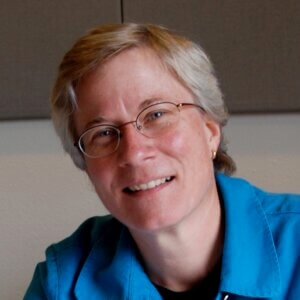
Susan Witt is Executive Director of the Schumacher Center for a New Economics, which she co-founded with Bob Swann in 1980. She has led the development of the Center’s publications, library, seminars, and other educational programs, which has established the Center as a pioneering voice for an economics shaped by social and ecological principles. She helped to incorporate the Community Land Trust in the Southern Berkshires in 1980, a CLT that holds both agricultural and residential land. Then in 2015 she helped incorporate the Berkshire Community Land Trust, the sister organization to CLTSB. In 1985, she worked with Robyn Van En to form Indian Line Farm, the first Community Supported Agriculture farm in the country. In 2006, she co-founded BerkShares, a local currency program for the Berkshire region.
The Educator Who Showcased & Supplemented the Seminal Work of Swann and Schumacher
Lisa Byers: I want to thank you for agreeing to do this interview, Susan. I feel delighted that I get to be the one to be in conversation with you. I’m also grateful to John Davis for wanting to capture these stories for next-generation folks and activists. The rhythm of today, the themes and questions that I’d like to explore, include some about you and your story, some about how you got into this work, some about the Schumacher Center, and some about how the community land trust is nested within the Center’s larger mission. I’m hoping you’ll reflect on the way that community land trusts have actually developed from theory to practice, so I’d like to hear your thoughts on that. We’ll wrap up with your thoughts on where we might be headed and what you hope for the future. How is it that you came into this new economics work? I understand that it was, in part, through Bob Swann. My hunch is you already had an inclination because you took a job at the Institute for Community Economics, right?
Susan Witt: Not exactly. I have no formal background in economics. In fact, I was a literature teacher in a small Waldorf High School in New Hampshire and I deeply love the world of great literature. However, I came to believe that the world’s most pressing social and environmental problems could only be solved through fundamental changes in the economic system. In 1977, I heard Robert Swann on the Cambridge Forum radio program talking about his friend Fritz Schumacher’s book Small Is Beautiful: Economics as if People Mattered, and my course was set. I decided to volunteer for the Institute for Community Economics to have a better understanding for this realm of new economic thinking. Three years later Bob and I founded the Schumacher Center for a New Economics (originally the E.F. Schumacher Society) in the Berkshires of Western Massachusetts.
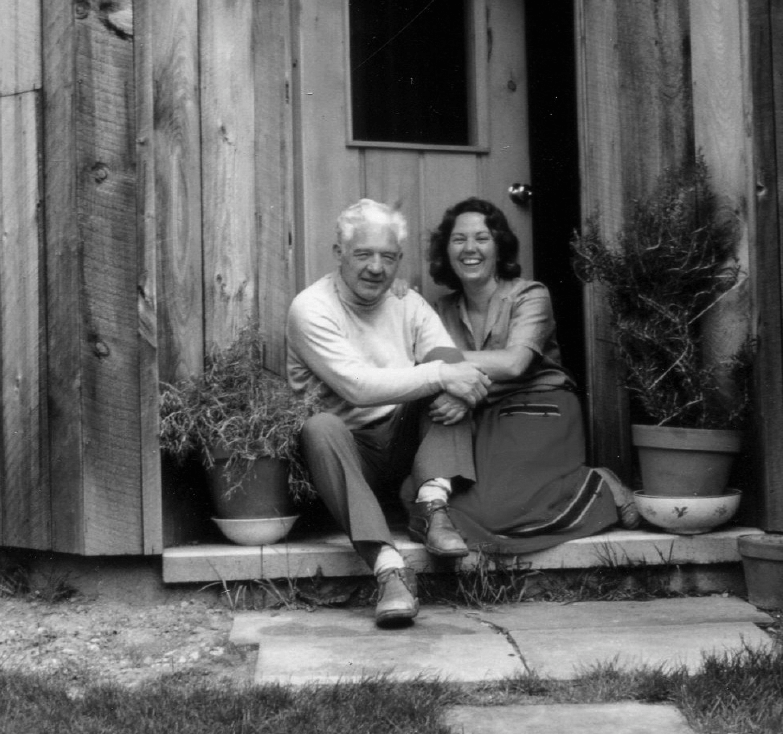
Bob Swann and Susan Witt, 1980s
Lisa Byers: What insight did you find in Schumacher’s work that moved you to change your life’s course?
Susan Witt: In his book, actually a collection of essays, Schumacher offered a fundamentally different approach to conducting economic life. To arrive at this understanding, he was not reading books on economics; he was studying the great esoteric literature from all the world’s religious traditions. His essays begin in spiritual principles and then lead to economic practice. This seemed to me the correct progression. At the same time such thinking is not dogmatic, but allows practitioners to explore their own solutions.
Lisa Byers: How would you characterize Schumacher’s new economics?
Susan Witt: Schumacher offered a positive and locally-rooted way to respond to the problems of a global economy in which the processes of production are hidden from the eyes of the consumer — separating people, land, and community. He advocated for human-scaled economic systems, appropriate technology, cooperation between consumer and producer, and a re-thinking of the institutions of land and money.
Lisa Byers: Could you describe this need to re-think the institution of land?
Susan Witt: We’ve commodified land, enabling it to be sold on the market, resulting in the accumulation of land in the hands of a relatively few. Concentration of ownership prevents the poor from gaining affordable access to land to build their homes and earn their livelihood. The result is great wealth alongside unrelenting poverty. Without access to land, it is hard to achieve even modest self-sufficiency and a sense of dignity. In the Berkshires we face the problem of rising land prices mostly due to demand from second homeowners, making home ownership and farming less and less affordable for local people.
Schumacher spelled out a philosophical framework for a new economics. Bob Swann then devoted his life to working out the operational details. What deeply impressed me about Bob’s approach to creating the community land trust model was it was grounded in an economic analysis.
Bob was a CO, a Conscientious Objector, during World War II. He spent two and a half years in a Kentucky federal prison with other COs. He later called prison his university. He and other COs, including Bayard Rustin who trained Martin Luther King in nonviolent tactics, shared books and had time to talk about what were the root causes of war. Bob learned through his readings and his discussions with other COs that land, when it’s commodified, creates an imbalance in the economy. New wealth is created when labor transforms the natural world into new products. These new products are appropriately owned and traded in the economic sphere. But land itself is nature-given and access should be by social contract, not through the market.
He went to Israel with Slater King and other founders of New Communities in Albany, Georgia to study the lease agreements of the Jewish National Fund. The JNF and the State of Israel own most of the land in Israel. The land is then leased to users who build homes and businesses on the land but cannot sell the land. Of course, this is done to prevent non-Israelis from gaining landownership. It is a racist reason, but the lease itself is ingenious. The lease can be written to an individual homeowner. The lease can be written to an intentional community like a kibbutz. Or the lease can be written to a mixed community like a moshav, where there are private homes and cooperative farming. The lease of the land is independent of the social structure on top of the land.
That’s what Bob brought away, an understanding for the genius and flexibility of the lease that separates ownership of the land from ownership of improvements on the land. He realized what was needed was a new community-based structure to hold land. If we were to start from scratch to develop a new economic system, then where would we place land? Not in private ownership or state ownership. Bob would have all land held in regional commons or community land trusts and then allocated via the social contract of a lease. Bob might have favored the term “trusteeship,” a term used by his mentor Ralph Borsodi.
You can add anything on top of the lease. You can add subsidies to make the housing less expensive. You can add organic restrictions or restrict use to only full-time residents. You can designate the scale, the character, the ownership structure of a business leasing the land. The community land trust is just a platform for holding land off the market. The lease embeds the regional values and priorities for how the land is used—be that residential, office, manufacturing, retail, public building, or agricultural.
And Bob’s innovation of the three-part structure for the board is brilliant. What’s the organizational structure for a new way of holding land if designed from scratch? Well, you would want the users to have a say, but not a majority so as not to be able to arbitrarily amend restrictions. You would want the general public engaged to represent the still unmet needs for land use, so keeping the organization dynamic and forward-moving. And you need the experts who bring valuable skills such as legal, land-use planning, and financing in order to carry through projects.
Lisa Byers: Just to focus in on that a little bit. In Bob’s Autobiography, he says that he thinks the most important thing that he contributed to the CLT movement was that idea of an open membership. Do you agree with that assessment, when you think about his legacy?
Susan Witt: Well no. In his conversations with me, it was the threepart board in conjunction with open membership which he understood as his most valuable contribution. Through his work with Ralph Borsodi and from experience with his brother Jim and his family, Bob had known of a number of intentional communities. These were initiatives where people joined together to purchase land, establishing rules about ecological land use and cooperative living. All were very well-intentioned and noble in their origination. But by the second and third generations, if only users made up the board of directors, it was tempting to look at the rise in land value and suggest selling the land and splitting the profit. The three-part board structure of the community land trust was a way to address this problem of self-interest of users.
Lisa Byers: Do you believe that his addition to the model of the tripartite board is really the piece that was the most instrumental in the ongoing success of the community land trust?
Susan Witt: The tripartite structure creates a natural tension between leaseholders and non-leaseholders. Leaseholders would prefer that the organization turn its resources to improvements on land already acquired—removing invasives, improving the driveway, or reducing lease fees. They object to the ground rent being used to purchase new land. The non-leaseholders rightly push the CLT to find ways to increase holdings so that more people have affordable access to the land. A seat on the board can thus be a coveted position. At the Dudley Street Neighborhood Initiative, there have at times been 30 people running for one open position. Thirty people! It can be a democratic nightmare.
Lisa Byers: Talk about splitting the ticket.
Susan Witt: It is that. Rosalind Greenstein, a professor at Tufts University and a longtime advocate of community land trusts, said she believes that the highest and best contribution of the CLT movement has been experience and training in direct democracy. Lisa Byers: Interesting. And what do you think of that?
Susan Witt: I think the highest purpose of a community land trust has been in educating about the role of land in economics—an understanding that land should not be treated as a commodity, but “as a community to which we all belong,” to quote Aldo Leopold. But to be successful as an educator, the CLT must be structured to achieve its goal of holding all the land in a region. That’s why I find OPAL so inspiring. Lisa, your community land trust currently holds 10% of the land on Orcas Island. You and your partners have built OPAL to hold all the land on the Island. That is OPAL’s vision, even if not explicitly stated. Your goal is not just another housing project, but to stabilize land values on the Island to broaden access, create diversity, and narrow the wealth gap. Not that such a goal is achieved in year one of forming a CLT, or in year 20 or even in year 50, but that it could almost be achieved by year 75 is the point. Yes, that is what I believe is the greatest contribution of community land trusts, as Bob envisioned them—that clear economic analysis of the benefits of decommodifying land.
Lisa Byers: I remember talking to you about what I would characterize as a disappointment you had about how community land trusts evolved to be focused on affordable housing and went down the charitable 501(c)(3) route. I wonder if you still feel that disappointment and how you’re resting with that now.
Susan Witt: When we moved to the Berkshires and founded the Community Land Trust in the Southern Berkshires, we did not want to incorporate as a 501(c)(3) for affordable housing. We did not want to exclude anyone from placing their land in trust based on income. Nor did we want the perception that decommodifying land is only for poor people and the rest of us can go on speculating. We were making an economic argument, not an affordable housing argument.
But, at the same time, without a (c)(3) designation the organization could not accept tax-exempt gifts of land or money. Income from the leases alone could not carry the costs of the organization. In the early 1980s, I researched and put forward the option of a parallel 501(c)(2) organization to a (c)(3) with multiple purposes—education on land use, affordable housing, preservation of natural resources, historic preservation, and economic development. As land is multiuse, the purpose of a land-holding organization, I argued, should reflect that complex, overlapping nature of uses.
The (c)(2) would be the actual “title holder” of the land and could lease it out to those of any income while providing equity in improvements. I called for a national meeting of CLTs to discuss this approach, which would open CLTs from being the narrow provider of affordable housing to a vehicle for broad land reform. But the idea was, at the time, rejected by those already deeply dependent on government subsidies for affordable housing.
Times have changed. Both community land trusts with the single focus of affordable housing and conservation land trusts with the single focus of preserving open space find that their structures are limiting. Conservation land trusts realize that taking land out of production for ecological purpose raises the cost of access for those that need housing and work purposes. Community land trusts are recognizing that subsidies for affordable housing are too narrow to meet the broad need for workforce housing and other land-use issues. More tools are needed. The (c)(3) and (c)(2) discussion is kicking open a lot of exploration, a lot of answers. That’s tremendously exciting.
You’ve seen my proposal for a “Black Commons”? I wrote it at the direction of the board of directors of the Schumacher Center who asked me to explore how community land trusts could be applied to the question of reparations. I called for a national level 501(c)(3) Black Land Trust that could receive voluntary gifts of land and create a land-use plan for each site with a proposed lease that would specify the strengthening of African American cultural traditions. The national organization would then turn the land over to an existing or newly formed regional CLT to manage, with the 501(c)(3) having the right to repurchase buildings and other improvements when they come up for sale.
The model has been adapted, in part, by the Agrarian Trust and by the Northeast Farmers of Color. What Bob was calling for was new institutions, region by region, which would hold land and allocate land through a democratic process. His argument was not primarily focused on affordable housing nor conservation nor urban development. It was an economic analysis about the place of land.
Lisa Byers: You’re reminding me that in the 1972 book, The Community Land Trust: A Guide to a New Model for Land Tenure in America, the authors laid out four pathways to pursue. One was new rural and urban communities, primarily to benefit the poor. Two was a broad-based effort with a legislative emphasis on the government as the funding source. Three was trusteeship of scarce resources, transferring control of natural resources to community land trusts, including coal beds and oil fields. Four was what you’re referring to as regional land trusts, formed from existing communities. If you think about the growth of the community land trust movement as it exists today, where do you think the most growth has occurred and why? And moving forward, where do you hope most of the growth will occur? Maybe those four concepts from the 1972 book are useful in that framing—or maybe they’re not.
Susan Witt: Remember, that book was published by the Center for Community Economic Development which was formed to be a national advocate for creation of Community Development Corporations (CDCs).
Lisa Byers: Right, right. They were the funder for it, correct?
Susan Witt: Oh, it was more than that. Bob’s Cambridge office for the Institute for Community Economics (formerly the International Independence Institute) actually shared space with CCED.
Bob saw CDCs as the nonprofit community developers on land held by community land trusts. He did not imagine CLTs as developers. If you think of the board of a CLT, it is a board to allocate and steward land. It is not a board to do development. He saw CDCs as doing the development, but the holders of the land would be the community land trust.
However, in the late 1980s and early 1990s, community land trusts were lured into a focus on affordable housing because there was a steady stream of government funding for administrative costs. That then created dependency and a bureaucracy. Community land trust administrators were professionals who did not themselves live on CLT land, but rather served the poor. The vision of having two separate organizations—the CDC as builder of homes and the CLT as land reform advocate—was lost. You now have community lands trusts and community development corporations competing for the same money and the same projects and they’re different. One is short-term. You build a house or a high-rise and it’s over and done. Then someone else manages the long-term use of the land under the house. One’s short-term. One’s long-term. You need a mixture of the two, because you’ve got CDCs who don’t want to be long-term managers and you’ve got CLTs who aren’t equipped to do the short-term development.
Lisa Byers: Yes, although many CLTs have become community development corporations for that purpose rather than partnering. Yes, but it is a different skillset. If you blend the aspect of the community land trust model that so resonates with you in terms of the keeper of the land, the steward of the land, what would be your thoughts about the current state of the mosaic of community land trusts around the country? What would you hope for the future?
Susan Witt: The Schumacher Center has invested a significant amount of time in creating a directory of community land trusts. It is a very “high touch” procedure, meaning we review materials— website, articles—about the CLT, create a profile, then reach out to see what changes/additions the CLT would like to include. That kind of respectful engagement gives us credibility with what are often grassroots groups.
Lisa Byers: And connection, yes. Probably almost more than any other organization, the Schumacher Center has insight into the current state of play as to the way that community land trusts are showing up.
Susan Witt: Right, and we’re good at it. We are story tellers and documentarians. Our library contains books and papers on the theory, evolution, and practice of building new economic institutions for holding land. Our newsletters draw from that vision. We bring in speakers like George Monbiot who provide a new lens on the old question of how to achieve land reform. And all those accumulated resources are available for free to these old and emerging CLTs as they build their boards, build their membership base, and learn to tell the story of what it would mean if land in their region was removed from the market to be replaced by a democratically structured citizen group that oversaw allocation through a lease.
I am a champion of the idea that concerned citizens, working together in communities of place, can solve problems of the community. A community land trust is a tool for activating that concern and addressing problems.
Lisa Byers: I have two more questions. First, one going back in time. You and Bob sponsored E.F. Schumacher to come to the United States, right?
Susan Witt: Bob, not me. In 1974 Bob organized a US tour for Schumacher to bring greater attention to Small Is Beautiful. During that trip Bob and Schumacher became good friends. They recognized that they approached this economic work in similar ways. Schumacher asked Bob to found a companion organization to his British Intermediate Technology Group (now Practical Action), but Bob declined. He was not prepared to take on a new organization.
Lisa Byers: Okay, that was before you were involved much. Did you know him personally? Did you meet Schumacher?
Susan Witt: No, I started working with Bob in September of 1977, the same month that Schumacher died, Erick Hansch died, and Ralph Borsodi died—all who were close to Bob.
Lisa Byers: Oh wow. Wow. This is my final question and I’m going to bridge the two questions together a little bit. What keeps you going? If we recognize that the pace of change is slow, what is it about the writings, the teachings of Bob Swann and E.F. Schumacher that keep you going?
Susan Witt: I think of Wes Jackson at the Land Institute who has not a five-year plan or a seven-year plan, but a hundred-year plan to grow a perennial grain. He is breeding a perennial grain so that the prairies no longer need to be tilled, so there’s a rich enough content in the grain to feed 8 billion which is the task before us. And there was no doubt in his mind that that’s a long-term goal.
So, it’s this picture of a new economics that is moving me. I have just such confidence in the approach Bob brought forward out of his years in prison to decommodify land, to democratize money issue, and to build thriving place-based economies. There is such an urgency to it. This outline for action that Schumacher shared in Small is Beautiful and that Bob confirmed through a lifetime of work is further strengthened by what I learned from Jane Jacobs and from my readings of Rudolph Steiner’s economic lectures.
I have confidence in the direction we’ve set. So I’m not discouraged by the length of time. I see the vitality of the concepts. I see how they light up the young people who come to work with us. I see how it radicalizes them. Land reform. Monetary reform. This is work that can transform the whole economic system to one that is more just, more socially accountable, more ecologically responsible. A vision that gives hope in a time of crisis.
Lisa Byers: Got it. That’s great. Thank you, Susan.
Susan Witt: And thank you, Lisa. Not just for today’s interview, but for your decades of leadership in the community land trust movement. On Orcas Island where the OPAL community land trust, which you founded, is such a fine example of a CLT well-applied. But also nationally in the creation of the Community Land Trust Network, now a part of Grounded Solutions, in the development of educational modules to provide training in the theory, history, and practice of CLTs. You set a tone, set a standard for this work for which I’m most grateful.
Lisa Byers has been the Executive Director of OPAL Community Land Trust since January 1996. She was a co-founder of the Northwest Community Land Trust Coalition and the National Community Land Trust (CLT) Network, serving as founding President of the Network’s board. A throughline of her work—first in historic preservation, then land conservation and ultimately … Continued
Newsletter
Sign up to get regular updates from the Schumacher Center.
Learn
Since its founding in 1980 the Schumacher Center has been a leading voice for building local economies.
The Schumacher Center for a New Economics is a 501(c)3 tax exempt organization. Donations are tax-deductible and can be made for general support or for specific programs.