Publications / Annual E. F. Schumacher Lecture

Planetary Economics: New Tools for Local Transformation

Introduction by Natasha Hulst
Founder, Dutch Land Trust Grond van Bestaan
Staff Member, Program Director for European Land Commons

It’s really my great pleasure to introduce the 42nd Schumacher Lecture by Kate Raworth. I’m talking to you today from just outside Amsterdam, the Netherlands. Kate Raworth is a renegade Economist. She focuses on making economics fit for the 21st century realities. 

She is the creator of the Doughnut of Social and Planetary Boundaries and Co-Founder of the Doughnut Economic Action Lab. Her internationally best-selling book Doughnut Economics: Seven Ways to Think Like a 21st Century Economist has been translated into over 20 languages and has been widely influential with diverse audiences from U.N General Assembly to Extinction Rebellion. Kate is Senior Associate at Oxford University’s Environmental Change Institute where she teaches on the Masters in Environmental Change and Management. She’s also professor of practice in my hometown at the Amsterdam University of Applied Sciences. Over the past 25 years Kate’s career has taken her from working with micro-entrepreneurs in the villages of Zanzibar to co-authoring the Human Development Report for UNDP in New York, followed by a decade as Senior Researcher at Oxfam. She holds a first-class BA in Politics, Philosophy and Economics and a MSc in Economics for Development, both from Oxford University. She has been awarded honorary doctorates by the University of York, KU Leuven, and Business School Lausanne. She is also a member of the Club of Rome.

I’m proud to say that Amsterdam was the first city to call itself a Doughnut City and the Amsterdam Doughnut Coalition brings together over 100 local organizations, city government and local citizens initiatives, working hard to get the city within the sweet spot so that people can thrive in a thriving place within the planetary boundaries and social thresholds within the Doughnut. This is also where she started to turn the brilliant ideas of the Doughnut into action, which later became DEAL, The Doughnut Economic Action Lab, that now works with cities and regions all over the world from Cali, Colombia to Brussels, Belgium.

Kate Raworth’s work stands on the shoulders of great renegade economists of our time, many of whom have given Schumacher lectures in the past forty-two years. Kate embodies the spirit of E.F. Schumacher himself, showing that there are exceptions to the well-known saying that “anyone who thinks that you can have infinite growth on a finite planet is either a madman or an economist.” I remember during one of the events that Kate spoke at when her book Doughnut Economics first came out in 2017. Older, more traditional economists, stood up at the end of her talk, clearly irritated, and said, “most things that you say in your book have been said before.” I will always remember Kate’s brilliant rebuttal, “you are right, but obviously nobody was listening so I thought I would say them again.” 

Kate is a brilliant communicator and has done so much important work communicating these crucial ideas to a broad audience and also tirelessly works to make economics education fit for the 21st century. With the beautiful visual simplicity of the Doughnut she has worked with artists and animators and has been able to connect to a broad audience and bring across these vital ideas openly with humor and clarity. Kate Raworth is a 21st century economist and obviously one of the sanest people around. Without further ado, I give you Kate Raworth and the 42nd E.F. Schumacher Lecture, Planetary Economics: New Tools for Local Transformation. 
Thank you so much Natasha. What a lovely welcome. I’m delighted to be standing on the shoulders of giant renegade economists and saying things that have definitely been said before but since nobody was listening they have to be said again. Thank you so much to the Schumacher Center for inviting me. It means a lot to me to be giving this talk this evening because it’s making me reflect on the shoulders of those renegade giants on whom the work I’m doing builds. It’s that sense of being handed ideas generation to generation, and it is our responsibility to bring them into practice. It’s also a particularly poignant day for me, and I think for many people who may be on this call, because today is the memorial service to Herman Daly the founding father of ecological economics, who very sadly passed away just about two weeks ago. So I’m really aware of the legacy that’s handed to us by our elders. Our economic elders and thinkers. I’m delighted to use this opportunity to celebrate some of the elders who have hugely influenced me and whose ideas I believe deserve to be center stage in the 21st century economy. 

I want to take you into Planetary Economics and how these ideas can be turned into tools for local transformation. So, especially for today, I’m going to begin where I began. My economics journey began on a train. I was on my year off between school and University. I was on holiday with my boyfriend in Italy and I was reading a textbook. Some of you may even recognize it from what you can see on the screen. This is the Introduction to Positive Economics by Lipsey. I was about to start studying economics at Oxford University. The year was 1990. I was so excited about studying economics that I was reading the textbook on the train on holiday in Italy with my boyfriend. I was studying economics…Why? Because I had been a teenager of the 1980s and like every teenager in the 1980s I saw the news on the TV and in that news what I saw was a hole opening up in the ozone layer, a famine in Ethiopia, and I heard the first talk of the greenhouse effect. These issues, social and environmental, made me—in that brilliantly naive way that many teenagers have, and must always have—say “I want to help change the world.” I believed that learning economics, the mother tongue of public policy, would give me the tools to help tackle challenges like these. So I bounded off to University and I was soon disappointed and frustrated because the concepts in Lipsy’s book and indeed in all mainstream economics textbooks do not equip us to transform these challenges. 

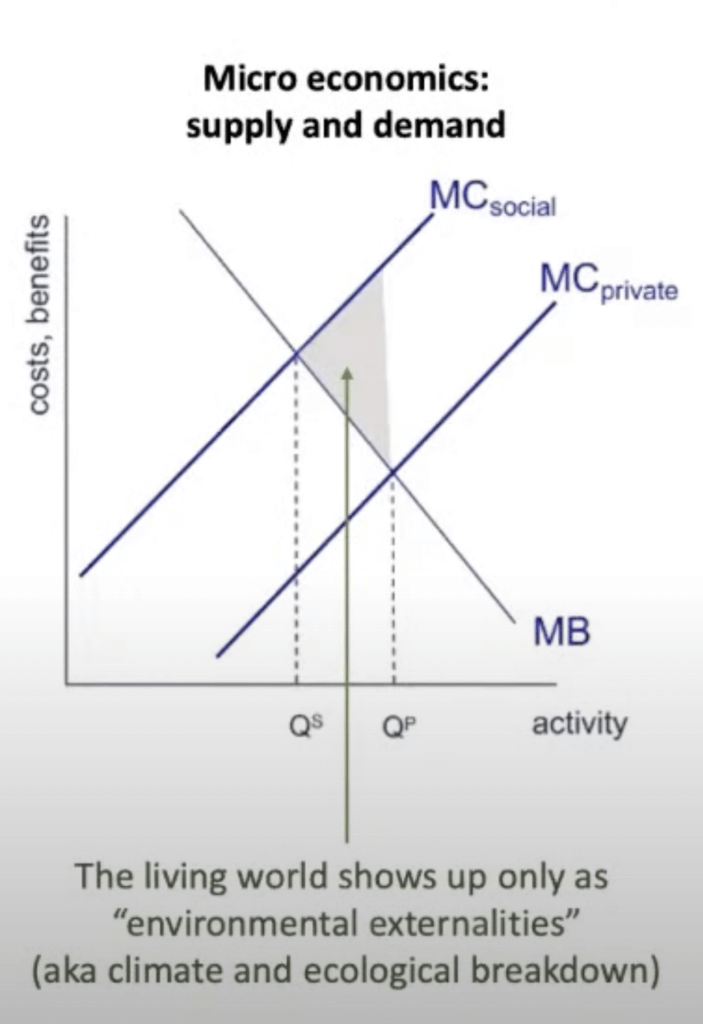
Let me tell you, the first image in almost every single economics textbook in the world…you can try asking roomfuls of economic students as I still do today, “what’s the first diagram you remember learning?” and it’s always the same…it’s supply and demand. That’s a very political act. Why do we start there? By doing that we put the market at the center of our vision, we make price the metric of concern, and we find ourselves calling everything that falls outside the price contract an externality. This is a profound problem to which I will soon return.


A portrait of humanity: Who are we? We are told we are rational economic man and the model that’s made of us would look like this if it were actually drawn in the books. He would be a man without caring responsibilities. He’s standing alone, independent of others. He’s got money in his hand, that’s how he interacts with the world. He’s got ego in his heart, that’s what drives him. He’s got a calculator in his head, that’s how he knows the answer to everything. And he’s got nature at his feet. Nature as his resources. If we carry on telling ourselves that we are like him…and by the way as we tell ourselves we are like him we all the more end up being like him…he becomes the model for us. We start to actually value the traits that he caricaturedly tells us we are. We will never learn to thrive and live together as 10 billion human beings on this planet with this as the model of ourselves. 

A third big diagram or concept that comes across in all economics textbooks is the idea that the goal is growth. In fact, we don’t even need to talk about it. The goal is endless growth. No matter how rich a nation already is, the economists and the politicians will tell you that the solution to its problems lies in yet more growth. I believe these three ideas are profoundly problematic. The idea that they should equip us to challenge, not only the challenges of the 1980s, but now, the 21st century, is outrageous. I get very angry very quickly when I think and I know that today’s students are still encountering these ideas when they study economics. 

Now I had an added problem. I was studying economics in Oxford at Baylor College, and one day I strolled down the street to try and find something wider and I picked up this book in the local bookshop. [shows an image of E.F. Schumacher’s Small is Beautiful] I started reading it and of course it was completely different to anything that I was being taught so it was mind-blowingly exciting. Here was my problem though, my professor was Wilfred Beckerman who had written the counterpart to Small is Beautiful. He had written a book called Small is Stupid. He had written a book in defense of economic growth. Now the first thing I have to say is that Wilfred turned into a great friend in my life. He became a wonderful lifelong friend and he so sadly passed away a few years ago and I miss him. I miss going for walks with him but my goodness we had different world views. What Wilfred really taught me was to dare to critique. I know ultimately he did not approve of my critique of his critique, but we remained firm friends to the end. But of course what he was teaching me and what the syllabus told him to teach me was so radically different to what Schumacher was offering that I didn’t know what to do with it. 

My solution came in the second year when I opted to study development economics and I had the great blessing to be taught by Professor Francis Stewart. The very first essay that she set for me has really been the question that I’ve been trying to answer for the rest of my working life: What is the best way of assessing development? That was my first handwritten essay for Francis Stewart. Written almost 30 years ago to the day. What has struck me as so extraordinary was that I had to opt for this rather specialist paper called Development Economics, the economics of developing countries, to be invited to ask what success looked like, because over there in the mainstream economics department that’s not a question. We’ve got economic growth. That’s what we’re oriented towards and we’re not going to have a conversation about it. I find it extraordinary that you have to go to a special discipline to actually ask the question. I realized I have been trying to answer that my whole career. I’ve come up with one version of an answer, and it looks like a doughnut. I owe a huge debt of gratitude to Francis and if she’s with us right now thank you Francis for steering me with this question through this mire of world views. I believe every student today should ask “what does success look like?” Because only if we start there will we have even half a chance of guiding ourselves well in the 21st century. 

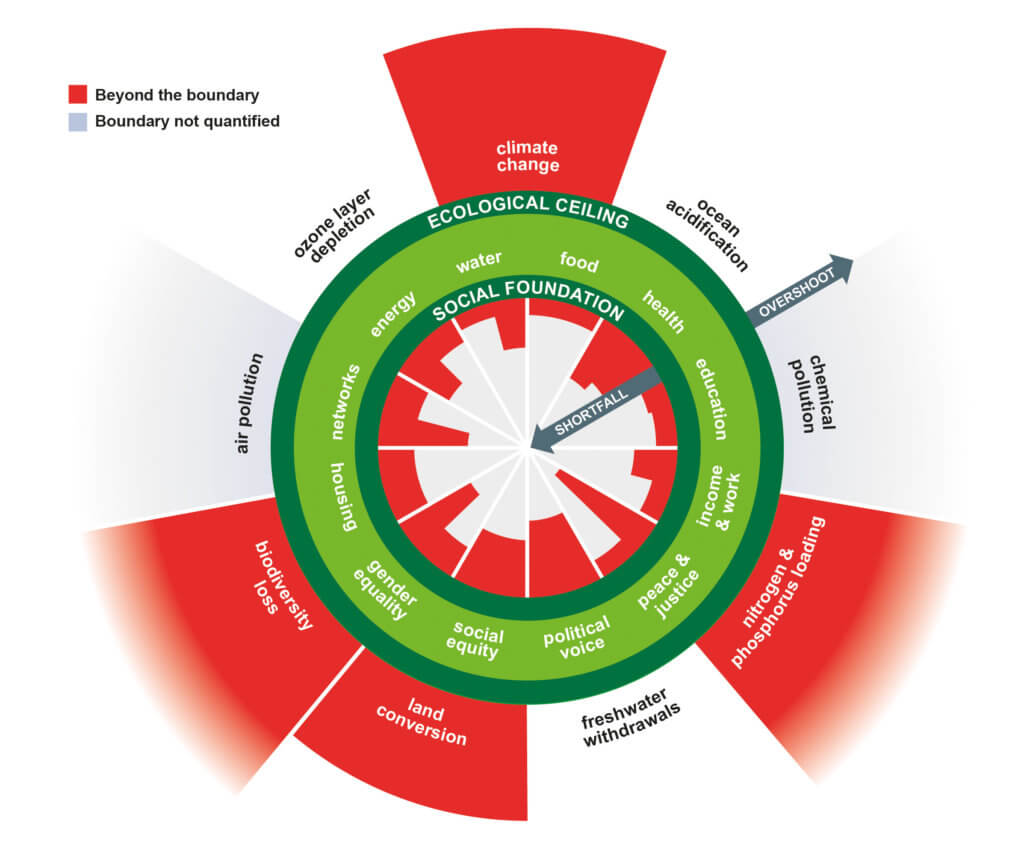
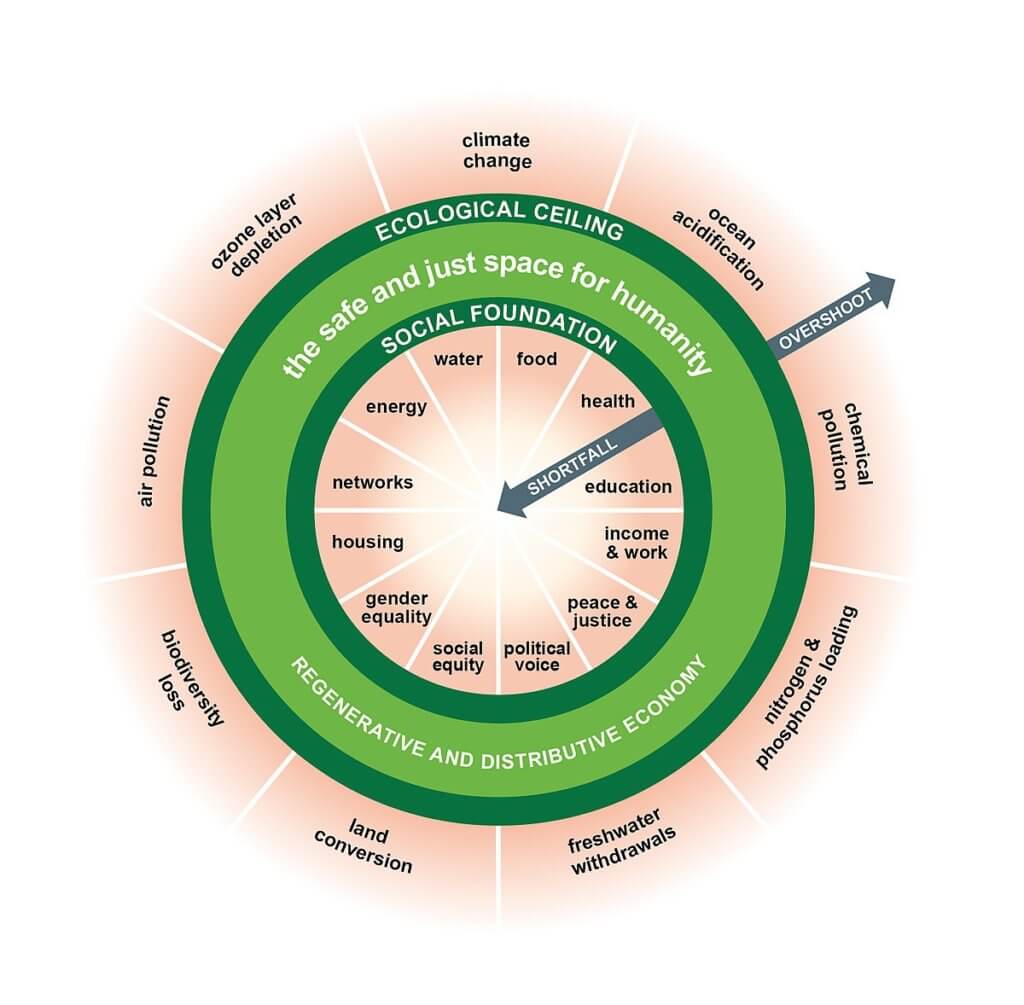
Let me show you this compass that I came up with many many years later. In fact, it was 20 years after. In 2012 I first drew this diagram. It’s a doughnut. You don’t have to eat doughnuts. This is the only one that actually turns out to be good for us. It’s conceptual. The best ones are. You can think of it as a compass for human prosperity. If you think of humanity’s use of Earth’s resources radiating out from the center of this picture, then the hole in the middle is a place where people are left falling short on the essentials of life. It is where people don’t have the resources they need for health, education, housing, voice, income, and the dignity to participate in society. 

This is profoundly inspired by the work of Amartya Sen and his work on human capabilities. It was actually the first book that Francis put in my hand when she was teaching me. Don’t start economics with supply and demand. Start it with human capabilities. I asked myself, what does every person need to lead a life of dignity and participation? And how can we express Amartya’s concept of human capabilities? Well, I crowdsourced from the world’s governments because they have in their list of Sustainable Development Goals recognized what every human being needs to meet these essentials of life. I call it the social foundation. Leave no one in the hole. Get everyone out of the hole into the green of the Doughnut. 

This is only half the story, because we also know that as we collectively seek to meet our needs and our wants we start to use Earth’s resources. Then we start putting pressure on our planetary home. Let me turn to Fritz Schumacher. One of the quotes you’ll find early on in Small is Beautiful, “there is overwhelming evidence that the great self-balancing system of nature is becoming increasingly unbalanced.” He understood this. He sensed it. He spoke it. He didn’t have the data at the time, but we’ve got them now. In 2009, Earth system scientists led by Johan Rockström and Will Steffen created what they call the planetary boundaries. These are the nine life supporting systems of our planetary home. The self-balancing system of nature. And so they started to quantify them for the first time. That is what you see on the outside of the Doughnut—those systems that keep life working on this planet. Now put the social foundations and the planetary boundaries together. We want to leave no one in the hole, but don’t want to overshoot Earth’s limits. The aim is to meet the needs of all people within the means of the living planet. 


When I first drew and published the Doughnut in an Oxfam discussion paper people responded so rapidly. I was fascinated by the power of shapes and pictures. I looked to many indigenous cultures and other world views and was struck by how often the symbol for health and well-being in these cultures was a dynamic circle. Dynamism caught within the circle. Whether it’s the Maori Takarangi, the Ensō or Zen circle, the Daoist Yin and Yang, the Medicine Wheel of Turtle Island, the Celtic Double Spiral, and the Buddhist Endless Knot. The Doughnut begins to give a western economic mindset a chance of moving towards the shape of wisdom that many other cultures have long known. I’ve begun to think of Doughnut Economics as somehow a western economic mindset recovery program. We can’t just take the Yin and Yang or the Medicine Wheel. That would be cultural appropriation. The western mindset needs to find its own way away from its inheritance. How do we learn from these other cultures? How do we find and express it in our own way?

If balance, which the Doughnut shows us, is where we want to get to, we are currently dangerously out of balance. The shape of progress is not endless growth, it’s thriving in that green circle. But we are massively out of balance as the red in this diagram shows. Billions of people are falling short on the essentials of life, and we are overshooting multiple planetary boundaries. Now, as I went back and looked again at Small is Beautiful I found really interesting different approaches to economics. Of course Schumacher is very well known for this quote, “the aim should be to obtain the maximum of well-being with the minimum of consumption.” Indeed if we were doing this we would be thriving in the Doughnut. But the Doughnut itself aims for something complementary, yet slightly different. The Doughnut’s aim is to ensure that everybody can fulfill at least the minimum of their essential needs…leave no one in the hole…and we must do that within a maximum of pressure on the planet. So the Doughnut is coming from a different place. It’s coming from a place of saying look how violated people’s rights are. Look how degraded the living planet is. Right now, rather than aim for the optimum, let’s ensure that whatever developmental steps are taken next we at least prioritize meeting the needs of all people and we start coming back within the means of the living planet.

We can see the degradation, the injustice in the headlines of the newspapers, whether it’s the climate crisis, pollution, plastics, phosphorus, water shortages, land degradation, destruction of other life on Earth, or toxic air. I love this headline from NASA, however, “Hole in Earth’s ozone layer finally closing up because humans did something about it.” That’s the point. We can do something about all of this. In the words of the American writer William S. Burroughs, “after taking one look at this planet any visitor from outer space would say ‘I want to see the manager.’” We want to see the manager not only for the ecological degradation, but for the human impact. Water and energy shortages are fueling a global food crisis. The statistic that I find really hard to comprehend is that the richest one percent of people own half the world’s wealth. I’ll say that again, the richest one percent of people on the planet own over half of the world’s wealth. There is no chance of getting into the Doughnut with these dynamics. This is a world that’s profoundly degraded. We are running down the living planet. This is a world that’s profoundly unequal. We have to turn this story around. I’d say that this story…the headlines, the image of the Doughnut…is what we know of humanity in the living world, and I believe it’s what our children and their children will judge us for. What did you do once you knew? Once you’ve seen this picture you can’t unsee it. Because none of last century’s theories, government policies, business models, and lifestyles were designed to solve this. We need new theories, new government policies, new business models, and new lifestyles to turn around this story.

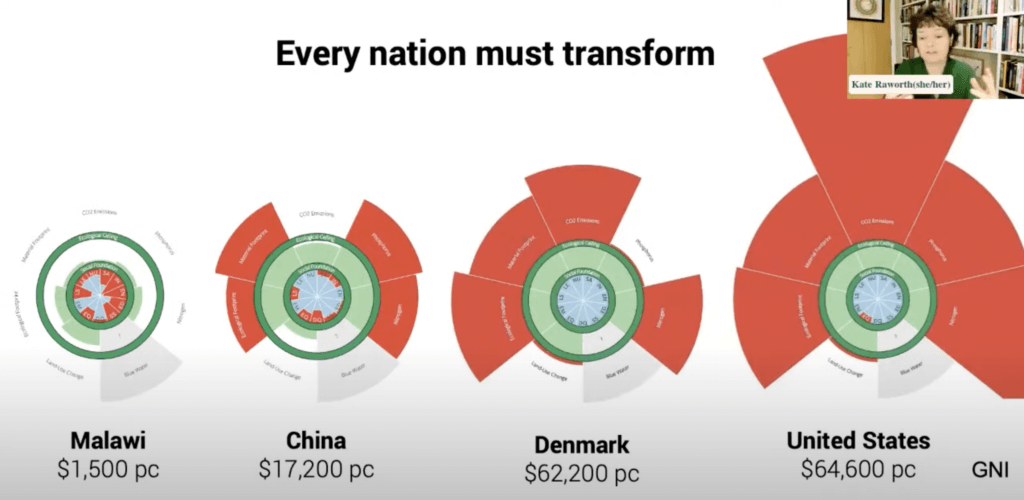
What I’m showing you is the Doughnut at the global scale, but of course a lot of action and policy making happens at a national or more local scale. So let’s go to the national. My brilliant colleagues Andrew Fanning, Dan O’Neil, and others created these national Doughnuts. So we can see, for example, Malawi, which is around one thousand five hundred dollars per person per year, has massive human shortfalls, but they are not overshooting their share of the pressure on the planet. You’ve got China with that double whammy of both human shortfalls and overshooting their planetary boundaries. At the end you’ve got the United States. There is strong inequality…that’s the red wedge on the inside. The inequality that causes deprivation for many. And you see they have a massive ecological overshoot too. The reason I’m showing Denmark today, and I could have shown you Sweden or Norway or Finland, is because people think those Scandinavians got it sorted. I mean they are really ecologically sound aren’t they? No they’re not. They may have clean air and clean water and forests, but their consumption footprint is overshooting planetary boundaries just like every other high-income country. So I throw a challenge to everybody, next time you find yourself talking about developed countries, I ask you where are you talking about, because there is absolutely nothing developed about overshooting planetary boundaries. I can’t think of a single nation in the world that has a right to say we’re a developed country. We’re all developing on a transformative journey. 

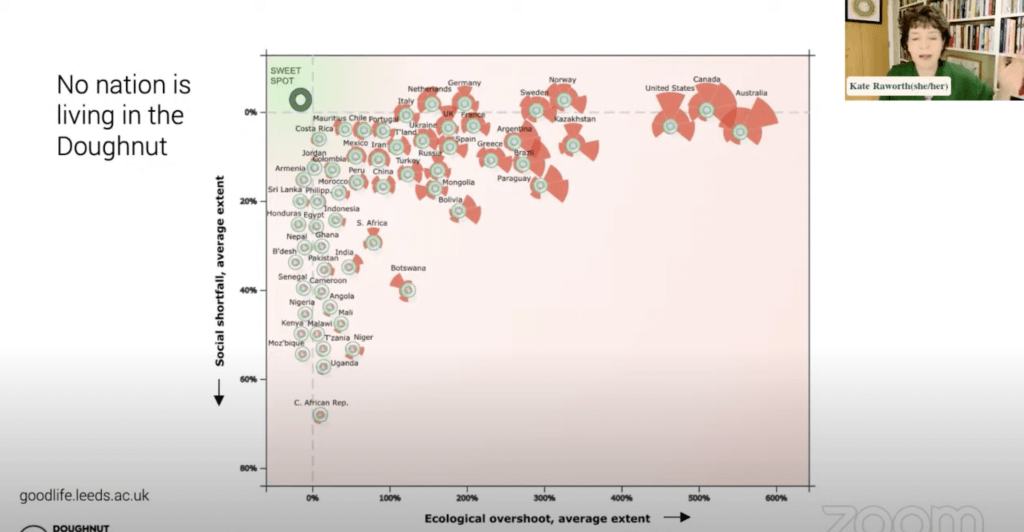
Let me make that really clear. Here’s a diagram of over 50 national Doughnuts. Now the goal is to be in that sweet spot in the top left-hand corner where you are meeting the needs of all people and coming back within the means of the living planet. First of all, you can see there is no country that’s there, and the nearest country is Costa Rica. It is merely meeting the needs of its people, and it is closer than any other country to being within the means of the living planet. What can we learn from Costa Rica? See at the bottom there you’ve got Uganda, Niger, Kenya, Malawi, Bangladesh. How can these countries meet the needs of their people without overshooting the planetary boundaries in the way that every country before them has done? It’s an unprecedented journey. How can middle-income countries like China, Turkey, Bolivia, Russia, South Africa both meet people’s needs and come back within those planetary boundaries? That’s never been done before. And then the high income countries. Hello United States, Canada, and Australia! The big red ones, throbbing and sticking out there at the side. Sweden, Norway, the UK, Germany, the Netherlands, any high income county you like needs to come right back within the planetary boundaries. That’s never been done before. We don’t yet know how we’re going to do this. So every country here should have an unprecedented level of humility and ambition. And let’s recognize that although they stand as separate dots on the page here, all of these nations are profoundly interconnected by histories of colonialism, military power and corporate power, by trade and finance rules, by resource extraction, and by the present and future impacts of climate change. These impacts of course are hitting predominantly from the global North to the global South. We need to transform within countries and between them. 


How on earth do we do this? We need new economic ideas. It was actually this urgent need for new ideas, having drawn the Doughnut and seen the impact that it was having on people in the world, that led me to ask, “what kind of ideas would actually help us get there?” This is actually where I owe my biggest debt to Fritz Schumacher. Everybody has their favorite quote from Small is Beautiful or from his writings. The one that jumped out at me and set me off on a path is a bit of an unusual one: “What matters is the toolbox of ideas with which, by which, through which we experience and interpret the world.” I remember I was sitting in a cafe in Brussels reading his book at the time. And in the midst of all of his ideas this sentence jumped out to me. It gave me such a feeling of permission to start gathering ideas for that toolbox, to push aside the textbooks and the logical consequences of all that’s gone before, and to ask what ideas would you want to source, find, and create now and put in your toolbox. So I literally…I’m a very visual person…so I literally got a picture of a toolbox and I photoshopped inside it the Doughnut. And this became the way I wrote my book. I had a big PowerPoint file. The name of it was “Toolbox of Ideas Keep Adding”. I’ve still got it. And I just started gathering ideas. Almost all of them were visual pictures that either excited me or that reframed the fundamentals of the world. Whether they were about feminist economics, the second law of thermodynamics, systems thinking, planetary boundaries, a circular economy, distributed design, the logistic growth curve that doesn’t grow endlessly but grows up, or resilience thinking, these pictures got me to start thinking about what were the big principles I wanted to draw out. 

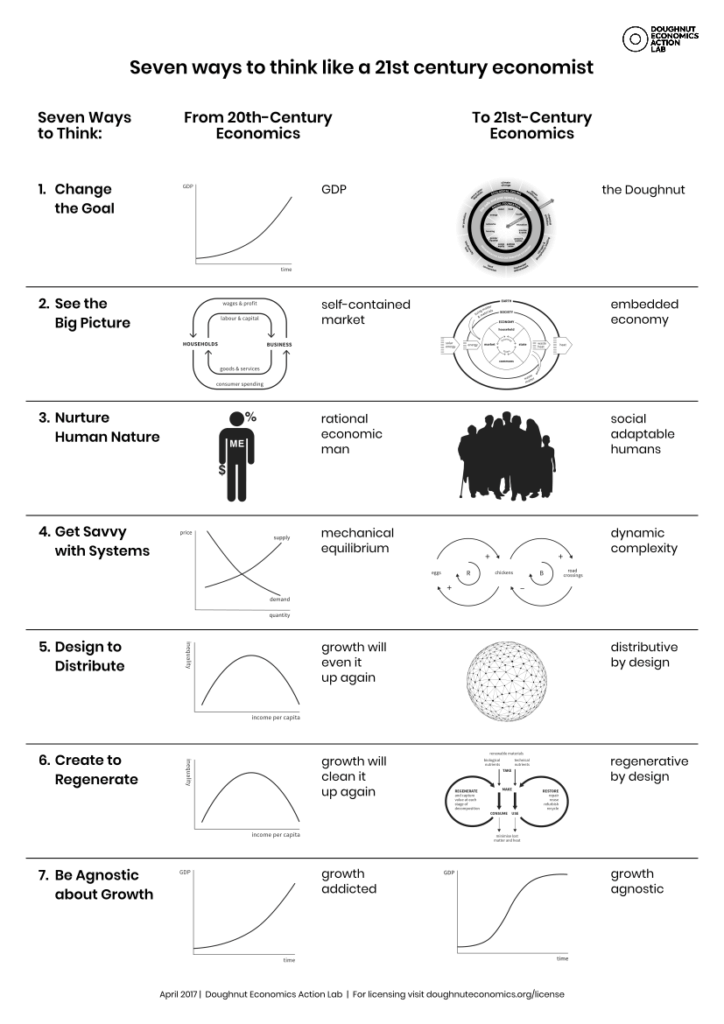
This was me thinking along the way and it ended up being seven ways to think. Seven old diagrams and seven new diagrams. And this was published as Doughnut Economics the book in 2017. I’m just saying this to say thank you to Fritz Schumacher because it was literally this quote and this idea of assembling your toolbox that excited and inspired me. It made me feel free and permitted to just gather ideas from feminist economics, ecological economics, institutional economics, and behavioral economics and see what happens when they all dance on the same page. I was thrilled by what I found. This was the economics I hadn’t been taught and it was so exciting. That’s what compelled me. I believe that these ideas and many others should be the starting point for 21st century economics. This is what should already be being taught in the curriculum and yet still isn’t.  

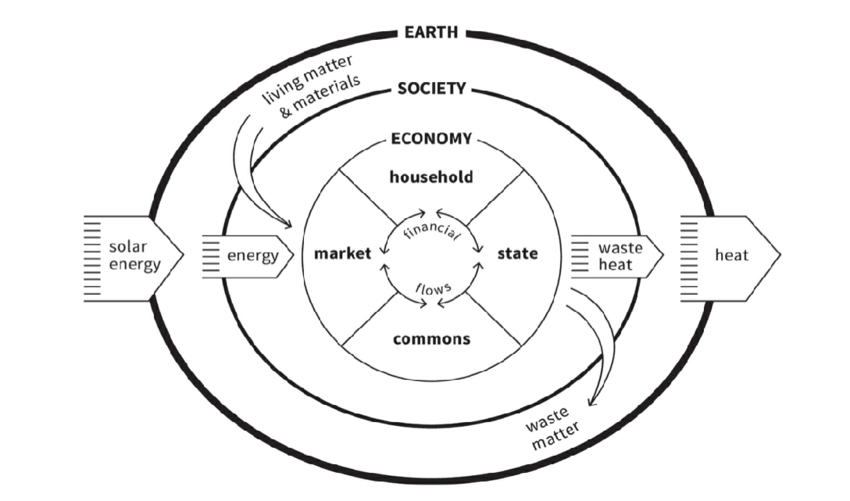
Let me take you into some of this story. What’s the first diagram you would want to show if you introduce the Doughnut as a goal? Among many other cultural goals, here’s one goal: we want to meet the needs of all people within the means of the living planet. We can debate that goal, but let’s say we just take it as our primary goal for now. What would be the first diagram representation of the economy you’d bring? I would never ever start with supply and demand. I start with this diagram. I call it the Embedded Economy diagram. It’s as Natasha introduced, it’s built on the shoulders and on the ideas of many others. If you know of ecological economics, feminist economics, and commons thinking, they’re all right here. It’s an economy that’s embedded in society because the economy is a social construct. We invented it, and we can reinvent it. And human society is embedded in the rest of nature because we are a part of nature and the living world. In this move of placing humanity and society in the living world I owe a big debt to Herman Daly, Robin Wall Kimmerer, and Janine Benyus. These three writers massively inspired me. Today I’m going to just lean into talking more about Herman Daley because he has so recently left us in this world and I feel the legacy of his ideas so strongly. 

Here’s the problem that Herman Daley encountered. It still is the problem we face. This is the way mainstream economics represents, or it literally fails to represent, the living world. In microeconomics it shows that when you have your supply and demand there’s a gap between the private marginal cost and the social marginal cost. From here we create this little gray triangle wedge. That’s the living world. If you ask a mainstream economist to tell you how they talk about the death of the planet, how they talk about the hole in the ozone, climate breakdown, and ecological collapse, they will tell you it’s an environmental externality. There it is, they would say. It’s that gray wedge. I swear if aliens from outer space wanted to take us down they wouldn’t need to invade, they would just show us this supply and demand graph. “Oh humans this is a really good way to represent your planetary home!” They know that we have absolutely no chance of protecting the living planet, on which we depend and of which we’re apart, if we’re going to show it in economics as a shaded gray wedge. 

So that’s the micro. The macro doesn’t even show up at all. Macro economics’s main diagram is of the circular flow of income and goods. If you really want to try and make the living world visible, you say well it’s a form of capital. You’ve got labor and capital provided by households to business and in return they get wages and profit. Let’s call the living world a kind of capitalist land. So all of life, all of the delicacy and complexity of the world, is bound up in a form of capital and we call it land. We are giving ourselves no chance of protecting the only known living planet in the universe if we carry on like this. These aliens, they’re laughing. They’re laughing all the way to the intergalactic council because we are completely going to fail. 

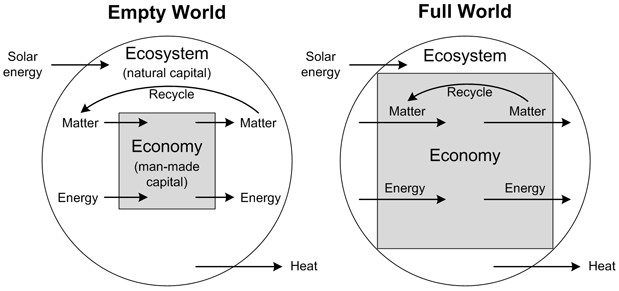
Herman Daley was having none of this. He was working at the World Bank, and he recognized that you have to see the economy as a sub-system of the living world. He said that the living world is a wholly owned subsidiary and the economy is an open system. It’s drawing in matter and energy and it’s putting out waste matter and waste energy. So it’s within the living world, which is a closed system because it’s closed to energy. There’s just energy coming in from the sun and waste heat going out. Herman Daley brilliantly said, well maybe once we could have imagined that we lived in an empty world. There was so much sky, so much sea, so many fish in the sea, and timber in the forests that we could just puff out our carbon emissions and it would just go up into the cloud. The atmosphere is so big that we couldn’t possibly disrupt it. We could kind of treat it as “out there” and just leave it blank. But the reality is that we don’t live in an empty world. We live in a full world. We live in a full world where the economy is bumping up against the edges of the ecosystem. It’s the point of pressure. The point of scarcity. And when it’s not labor that’s scarce but the living world that’s scarce. When it’s not resources but nature’s capacities. Then your priorities change. Don’t they? 

When I first saw this diagram it completely changed my worldview and it taught me the power of pictures. As Donella Meadows would say, pictures can change our paradigms in a blink of an eye. What turns out to be the case is not that we are delicately touching up against the edges of the planet and planetary boundaries but, as the scientists who came along decades later and told us, we are actually massively overshooting our pressure on the planet and are at risk of serious breakdown and irreversible decline. So thank you Herman Daley for bringing this in. That’s why I would always start by showing any student of economics that the economy is embedded in the living world. 


Let’s dive inside the economy and let’s recognize that there are many different ways we provision for our wants and needs. Yes there’s the market, but there’s also the state with public services. So let’s begin with the market and think about our own identities. We can be a consumer or a producer in the space of production. You might be a capital owner earning a rent or labor earning a wage. You may be excluded from the market and destitute. 

Now it was Karl Marx who teaches us never to forget the distinction between whether you own capital or you earn a wage. This is all the power in market relations. When mainstream economics starts with markets they don’t usually start with Karl Marx but let’s do that today. If you start with markets and say well sometimes the market may fail, you then might want the state. In relation to the state you could be a public servant, a teacher, a doctor, a regulator, a civil servant, you could be a resident of a place, a voter, and a protester. Or, you could be stateless, excluded from that state relation, excluded from recognition and access to public services. 

Two people who I think have done a really great rebalancing of this market-state boxing match of the last 50 years are Mariana Mazzucato, whose work is on recognizing that the state can actually be entrepreneurial, and Ha-Joon Chang. He was born in Korea when it was called a third world nation, watching his state use public regulations and trade policies to become one of the richest countries in the world. He tells a very different story about the role of the state in industrial policy and in the nation’s development. 

So we’ve got the market and the state. Of course these two show up in GDP. That’s what national income accounting measures when it shows the output of an economy. But across this horizontal we are missing two massive other ways that we provision for our needs and wants every single day. Let’s go to the household where you may be a parent, a partner, a relative, or a child, engaged in all that unpaid care work of cooking, washing, cleaning, sweeping, raising the kids, and doing it all again tomorrow. You are getting labor fresh and ready for work to show up at the factory door. Or, you may be kinless, excluded from that family relation and many feminist economists, such as Nancy Folbre, Diane Elson, and Peggy Antrobus, have made that unpaid care work and its essentiality so central to the economic story. How can it ever be left out? It’s an utter subsidy to the productive paid economy. This is the reproductive unpaid care work or the core economy as many people are now calling it. 

Let’s also recognize the commons where people meet not through the market or the state but as a community and co-create goods and services that they value sometimes with no money changing hands. You may be a co-creator, a sharer, a repairer, a steward, or you may be excluded from the commons. This of course is the space of Elinor Ostrom, who, unlike Garrett Hardin, didn’t just declare the tragedy of the commons and generalize about it. She said there are actually a few places in the world that seem to be working, and I’m going to go there and do research to find out how they’re doing it. As it turns out, the commons can sometimes be a triumph, not just a tragedy. Elinor came up with the core design principles of how commoners need to collaborate. 

Lastly, let’s look at the finance sector. You may be a creditor, a debtor, an investor, a trader, or you are financially excluded. This of course is an area I believe needs massive rethinking and re-theorizing…money. The design of money and in its role. Two people who definitely influenced me are Stephanie Kelton, who brought back what’s now known as modern monetary theory, and Bernard Lietaer, who looked at the deep design of money itself and how it profoundly shapes our relationships, our actions, and our inequalities in society. 

So that’s my detour into the designs and different traits of the common market. We can now ask ourselves what happens when we add in the context of power and the context of crisis. What’s going to happen? What is happening in these contexts? These relationships look very benign, but in the context of power and crisis we see market capturers and rent-seekers becoming dominant. The state can become corrupt or the oppressor. In the financial markets it’s the speculator and the hoarder. In the household it’s the patriarch and the exploiter. And in the commons it’s the enclosure and the extractor. How do we ensure that—as we are in this era of crisis, permacrisis, and polycrisis—these red highlighted roles don’t become the norm? Because there’s always power at play in our economies. How can we design our economies? How can we teach our economic students to make sure we don’t end up with economies that only perform in these exploitative and power-based ways? How can we make sure that we actually protect the commons, we value the household, we make markets in service, finance in service, and we protect and reinvest in the public good?


Let me pull back and say here’s the Doughnut. Here’s where we are. This is a world…as the red shows us…of extreme social shortfall. This is a world that’s deeply unequal and it’s a world that’s deeply degraded. We are running down the living planet. How do we turn this story around? With that richer starting point of what the economy is…as I previously mentioned…I believe there are two dynamics we fundamentally need to change. We need to become distributive and regenerative by design. Let me speak a little on what I mean. 

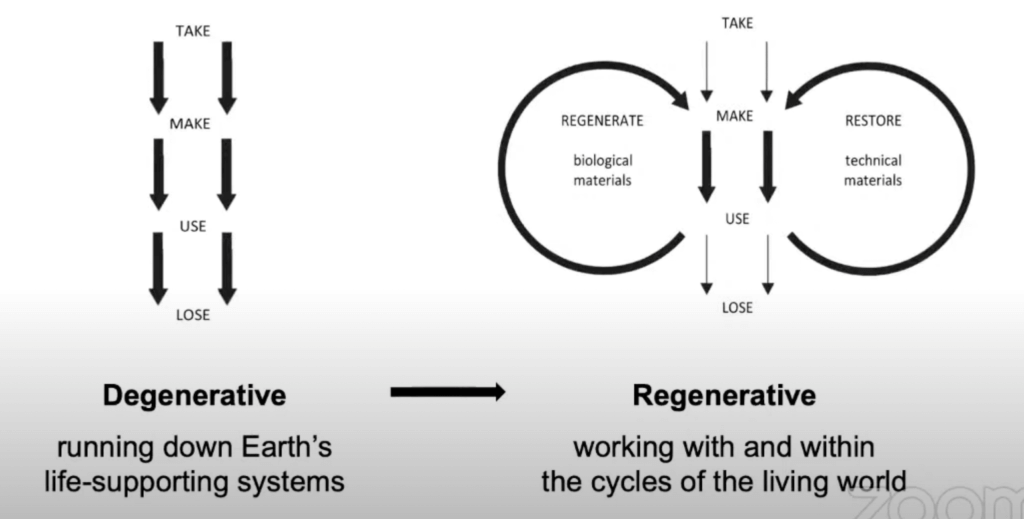
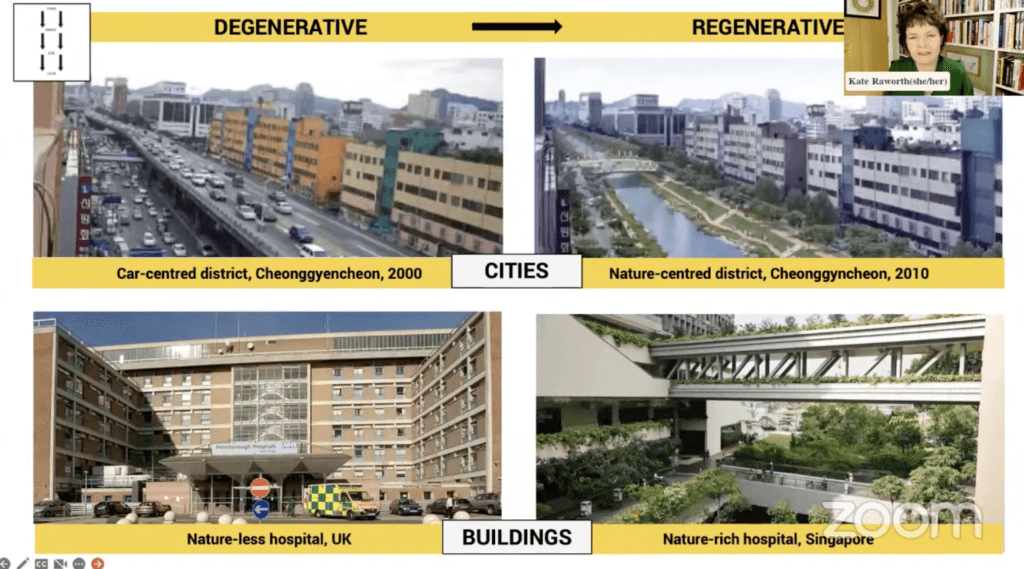
If we want to change the future, we need to change the dynamics that are driving the direction of the economy. We’ve inherited linear, degenerative, industrial systems that take Earth’s materials, make them into stuff we want, use it for a while, and throw it away. This is pushing us over planetary boundaries every single day. We need to become regenerative, circular, cyclical by design so that we don’t use resources up but we use them again and again. We can come to work within the cycles of the living world. We work with Earth’s cycles: the carbon cycle, the water cycle, and the nutrient cycle. We work with the capacity of Earth to generate resources and the capacity of Her sinks to absorb our wastes. This is a totally different kind of economy. What would it look like? We can only begin to get glimpses of its possibility. From land degradation to land restoration…nature coming back. From industrial systems that throw our waste in the neighborhoods of the world’s poorest people to industries that are designed to repair, reuse, refurbish, repurpose, and share. Completely different business models are needed to make this happen. From cities with ten-lane highways that are replaced by a river and a park. From hospitals…imagine if you were ill and you needed to be in the hospital, which hospital would you rather be in? This one in the UK where there’s not a single living thing in sight? Or, this one in Singapore surrounded by nature? We know that humans heal faster when we feel and see nature around us. How do we bring nature back into our cities? So from degenerative to regenerative design. But that’s just one of two dynamics.

We have inherited economies that through regulation, through the code of capital, through privilege, through networks, and through success value and opportunity is driven into the hands of a few. We see the rise of a one percent in many economies, in many countries, and globally. And Covid has supercharged that. We need to create economies that are distributive by design so that value and opportunity that’s created is shared with all who co-create it. What would that look like? Thinking of places, I grew up in London, a city that like many high-income cities and middle-income cities has a housing and rent crisis. This is because housing is treated as an investment and speculative asset. The majority of people are left desperately trying to pay the rent that’s extracted by the landlord. The city of Vienna, however, almost 100 years ago realized that housing is a human right and decided to own the housing in the city. Over sixty percent of the people in Vienna live in housing that’s social housing. It’s owned by the city or city-run co-ops. It’s central, it’s affordable, and it’s normal. That’s because they made the choice to make housing a human right. They made it distributive by design. 

What about business itself? Why should business be profit driven? That’s a very 20th century norm. It’s so ingrained in the business model and in the legal fiduciary duty that we think it’s just the only way business can be. It isn’t. We can have business that’s actually purpose-led…like this craft company in Mumbai where the workers own the factory. The companies pay a profit share. Their cooperatives and their employee-owned. There are so many ways we can redesign business to make it far more distributive by design. And when these ideas come together…and they can come together in places like cities and in nations…how do we create infrastructures, economies, markets, and public goods that are distributive and regenerative by design? Together, they start to bring us into the Doughnut from both sides. 


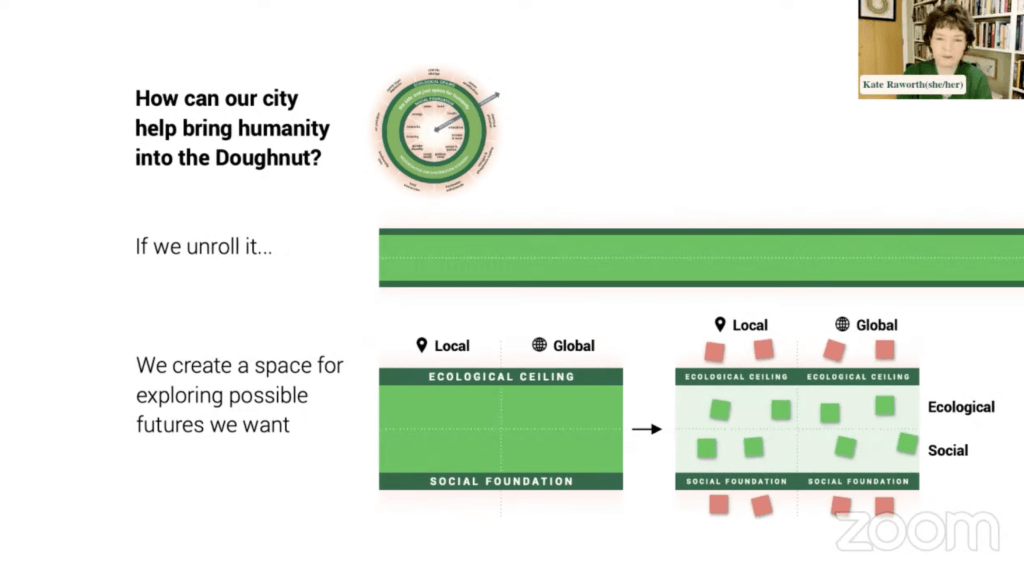
These are some of the ideas from Doughnut Economics. What I did then was say, okay the ideas on the page are very nice, but let’s get into practice. How do we do that? We’ve been doing that work at Doughnut Economics Action Lab, which I set up after my book came out. So many people said we want to do this and so we created an action lab to do it. We’ve been working a lot with cities, towns, neighborhoods, communities, regions, and districts. I’ll talk you through how we actually turn this into a practical tool. Ever since I drew the Doughnut in 2012, cities, councilors, and mayors started getting in touch and asking how their city can live in the Doughnut. How can they help bring humanity in there? So we’ve created a tool. We unrolled the Doughnut and opened that space up because we needed to go inside. We needed to create space for ourselves between the social foundation and the ecological ceiling. And we can actually use it as a canvas…as an exploratory space for imagining the future we want. Here’s the spoiler alert, the Doughnut does not tell you the answers. I mean it would be absurd if it did. If it had an answer for Dhaka, and Dar es Salaam, and Dubai, and Dundee. All of these totally different places in the world. The answers come locally from local possibilities, local values, local culture, and ecological contexts. Let me show you how. We invite every place to ask itself this question: how can our place become a home to thriving people in a thriving place, while respecting the well-being of all people, and the health of the whole planet? Yes, that’s a big question. Let’s break it down into parts. 

We break this into what we call the four lenses. We start by looking at the local aspirations of a place. Recognizing that we are all interconnected with people worldwide, we must address these local aspirations in the context of global responsibilities. The first lens asks, how can all the people of our city thrive? What would it mean for everybody here to meet those essentials of health, education, food, housing, transport, culture, voice, and income? These are from the sustainable development goals. The way this question is going to be answered is different in Dar es Salaam, in Dubai, and in Dundee because it’s a different culture, it’s different people, and it has different values. That’s the beauty of making it a local question with local answers. 

There is also the local ecological question: how can our city be as generous as the wildland next door? This is inspired by the brilliant biomimicry thinker Janine Benyus. If Janine were here with us she’d say, well, wherever you are right now go to the wildland next door—the nearest healthy, natural habitat of your place—because in every place Nature has a genius. She’s figured out how to thrive there. She knows how to sequester carbon where you are. She knows how to store groundwater after a storm, cleanse the air, house biodiversity, and regulate the temperature from the treetops to the forest floors. She knows how to make us feel at home. She continually recreates the conditions conducive to life. So wherever you are, Nature’s generosity becomes our ecological performance standard for our city. Now, can your city aim to sequester as much carbon as Nature does? At the moment our cities release carbon. Flip that around. How do we sequester carbon? How do we store water instead of having stormwater runoffs? How do we cool the temperature instead of having urban heat island effect? How do we make people feel at home instead of making them feel urban alienation? Beautiful questions. And again there are unique answers to every place. How do our cities and settlements become settled and nestled within nature’s ecosystems? 

These are the local aspirations. Now we’ve got to put them in the context of global responsibilities because if you think of all the clothes you’re wearing, the food you’ve eaten, the electronics we’re all using right now, the construction materials that built our homes, and our consumer goods, they have come from all over the world. We have a global footprint of carbon, materials, fertilizer, land use, water, and minerals. So we have to ask…and this is our third lens…how can our city respect the health of the whole planet? We need to come back within that red overshoot of planetary boundaries and reduce, reuse, and create a circular economy that enables us to thrive here. 

Lastly, still thinking of all those global supply chains that we’re connected to, how can our city respect the health and the well-being of people worldwide who made our clothes, who packed our food, who dug the materials that became our walls, who assembled your phone and your laptop? Thinking of global labor rights and supply chains, who’s impacted today? Is it in Pakistan? Is it in Nigeria? Who’s impacted today by the floods, the droughts, and the climate extremes that are caused by our lifestyles? How does our place welcome refugees and migrants when they arrive? What’s the official welcome? What’s the feel of that welcome? How do we relate to and build solidarity with others? 


These are the four lenses. As you can see, the answers will be unique to each place. We started using this tool in Portland, in Philadelphia, and in Amsterdam in 2019. You can see this is before Covid. These are policy makers in the city and community members. What they said in these workshops is that it’s such a relief to be together working with a holistic framework that lifts us out of our silos. It’s not just transport strategy, or climate strategy, or water strategy, or social inclusion strategy. It’s all here together. Let me tell you some stories of places that have adopted the tools.

Amsterdam, as Natasha said, was the first city to create its portrait through the four lenses of the Doughnut and launch it in April 2020. That was during the height of the city’s Covid crisis. They put it on a Dutch orange Doughnut, and they said our goal as a city is to be a thriving, inclusive, regenerative city for all residents while respecting the planetary boundaries. They put this concept at the top of their circular strategy with a commitment to being fifty percent circular by 2030. That’s a tall order. And one-hundred percent circular by 2050. They started with housing, textiles, and food. We know that when Amsterdam kicked off this amazing peer-to-peer inspiration with other cities that within six weeks the city of Copenhagen had a massive majority vote in the council to say we too want to explore the Doughnut. And it started kicking off all over.

What was also crucial in Amsterdam was the Amsterdam Doughnut Coalition. As Natasha mentioned, a network of civic organizations said hang on we’re doing many many different things but they all contribute to bringing humanity into the Doughnut. We’re going to create the Doughnut Coalition here, celebrate the pioneers, and recognize that what’s already in action is taking us in this direction. I think in Amsterdam it’s been particularly powerful having both the city council and this civic network holding each other to account, pushing each other along. So it’s the government and the civil society, together, that are making progress. 

In Leeds the civic organization, together with the council, took on the concept. They created their own Doughnut. You can see here that they re-rolled it and said this is Leed’s Doughnut and this is our vision for Leeds in 2030: a low carbon and safe inclusive place for all. They are doing it in a very playful way, involving a community conversation. In Barcelona the city council has adopted it and they are doing a data analysis. You can see those four lenses spread out along the unrolled Doughnut. But they are also holding events in the park, inviting citizens and community members to tell how they are experiencing the city of Barcelona and what their vision is for what they want the place to become. In Bhutan the government said actually, we think there’s a real connection here between gross national happiness and the Doughnut. We can see that connection, and we want to explore and use the Doughnut as a concept for their plans for Thimpu and Paro, the two major city regions in the country. 

If you want to bring this right down to the community level, amazing community work is happening in the city of Birmingham led by an organization called Civic Square. Within the neighborhood of Ladywood they have taken the concept with full integrity right down to the street level. They asked, how can we do street retrofits? How can we create dreamers and recognize that everybody here can be an economist in the way that we shop, buy, consume, invest, divest, and protest. We are all economists in action. Incredible work they’re doing. 

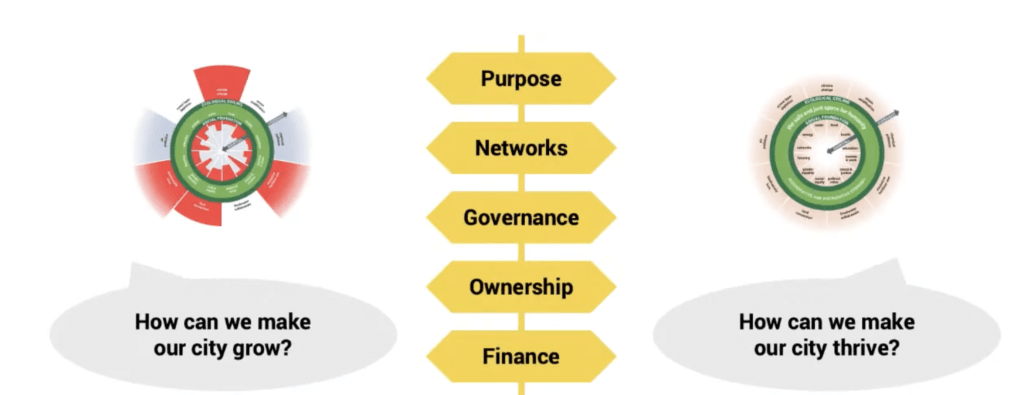
In fact, there’s over 40 governments worldwide already using the Doughnut as a tool in their cities and regions. And there are many many more community groups in action. What we found is that all of these groups come back and say if we’re going to transform, we need to transform our own institutions. We need to look at the deep design of our places. Many mayors and councilors have said they’ve inherited this idea from the 1980s that a city’s success is based upon growth and its GDP. We don’t want to aim for that. That’s not what we think success is. We want to thrive. This Doughnut actually makes a lot more sense to the goals we already hold. How can we be a place that thrives? What is it that leaves one city aiming still to grow and another pursuing that thriving? 


We think there are five deep design traits, which we’ve borrowed from the brilliant analyst Marjorie Kelly. A place’s purpose, networks, governance, ownership, and finance. In these last few minutes I’m going to share this last idea. So what is the purpose of your place? What’s your vision of the city, or the town, or the community you want to become? Is it shared? Have you got the metrics to know whether or not you’ll be getting there? Is it ambitious enough for the times we live in? 

What about networks? All the relationships that your city council should hold. Amplify the voice of civic networks. Connect with other cities and learn from that peer-to-peer inspiration. Bring in change makers and enable their pioneering work to become the new normal. How is the city governed? How do you use experiments to pilot and then scale up what’s working? How do you promote deliberative democracy and citizens’ voices? How do you get your people out of those silos that they so desperately want to get out of and work collaboratively? 

Let’s go deeper. How is the city owned? How are the key sources of wealth in your place owned? What about public services? What’s the power of bringing those back? Paris, for example, privatized water in the 1980s. They then realized that they were not only losing the revenue from the water services but massively losing control of the water supply. They’ve brought it back under public control. Recognize the value of controlling core assets, supporting community-owned and managed projects like community land trusts. How can a city or place make that possible? Bring back the commons and enable spaces for commoners to thrive. How can we use public land to accelerate change and create an energy revolution?

Then let’s go deepest, and it’s always at the bottom…finance. How can we transform finance so it’s in service to our cities, to the places we live, and to our economies? Whether it’s through participatory budgeting, divesting pensions, community wealth building, or anchor institutions, which use the resources we have to procure from small enterprises that are already exemplifying the future we want to make the norm. So we put these five design traits on a canvas and we said of course you’re not in control of everything because every city is embedded in a nation, which is embedded in a region that is embedded in the world. You don’t control all the legislation that has shaped your city. We’re all part of a global financial capital system. 

Let’s just recognize where we’re being held back and where we can already move forward. Let’s then ask what we can stop doing. Because we have the power. What can we start doing because we have the power? Indeed, we’ve had these conversations from Amsterdam to Ipoh. In Malaysia, Toronto, and Barcelona city policy makers are really exploring power relations and where transformation can begin. 


I’m going to pull right back. We began with the ideas that I encountered in my very 20th century economics book called Positive Economics. There was actually nothing positive about it. It was neither value neutral nor optimistic and useful to me. I’m sorry David Lipsey but positive economics is out. We need a 21st century starting point for today’s students. I’m in the city of Oxford. What are these students in Oxford University learning? What are they learning in Stanford, Harvard, or MIT? What are they learning in Cambridge, Beijing, or India? What are students around the world being taught? These are the policy makers of 2050. These are the people who are going to steer the whole of humanity through this century. What ideas should be in their minds? It’s not these ones. I’m getting angry again. It’s a travesty! It’s an outrage that they are still being taught this starting point because it is no way equipping them and they know it. They deserve to begin with ideas that are informed by people like Fritz Schumacher, Hermann Daly, Donella Meadows, Elinor Ostrom, Amartya Sen, and many many others whose ideas I’ve shared today. 

Start with a goal: meet the needs of all within the means of the living planet. Recognize that we are social adaptive humans dependent upon one another. Recognize the economy is embedded in society and in the living world. Recognize that we need to become regenerative and distributive by design. Recognize that we need tools…accessible and playful tools…so that nobody is left feeling intimidated by economics because we all should be part of this conversation. 

Here’s my last thought: how long is it going to take until this is just normal? Schumacher wrote Small is Beautiful in 1973. Herman Daly wrote his most core ideas in the 1970s. Limits to Growth was written in the 1970s. I’m 51 years old and almost 52, so I’m a baby of 1970. They probably hoped their ideas would be taught to me and others like me when we hit school. Nope. Because it’s still not happening. It’s still on the fringes. The mainstream curriculum still doesn’t do this. I reread Small is Beautiful and I found this quote from Schumacher. He said the third or fourth generation…that normally is the time it takes from the birth of an idea to reach its full maturity, when it fills the minds of a new generation and makes them think about it. It’s time for these ideas to be presented to students. One thing I do know is that when students encounter these ideas they say this is my starting point. This is what I want to learn. And they actually start to rise up and rebel against the textbooks and the mainstream curriculum. The international rethinking economics movement is leading this work. Young students and teachers, I encourage you to be part of that network and take it forward. 

Let me finish by saying that we founded Doughnut Economics Action Lab because when people read Doughnut Economics they started getting crazy and playful. They turned the Doughnut into glasses and a tablecloth. They made a design of a city plan and started teaching it in classrooms. So we knew that these people wanted to come together and we would learn together. We founded DEAL to bring together any change makers who want to be part of it. We’ve now got over 10,000 members on our website, and I invite every single person here to join. You can also just browse. You can use the tools. They’re in the commons. We’re part of the 21st century commons, so we put our tools on there for free. But they are the commons, so we ask for reciprocity in return. If you use them, share back what you learned, share back your innovations because we know that is incredibly inspirational and powerful to the next change maker. The tools I shared today…we call it Doughnut Unrolled…if you want to explore them for your place, these will be the tools to go for. Take a look. I very much hope you use these tools and let’s do justice to the legacy of Schumacher, of Herman Daly, and of all those whose ideas have long been waiting to be put into practice. It’s time. 

Thank you very much. 

Question and Answer Period

Q: To start with the Doughnut that you presented and came up with, in the inner circle of the social foundation there seems to be a bar graph that’s split into two for each item. Why is it split in two? How would you encourage someone to make a doughnut for their own community? And how long does this process normally take? What’s involved?

Oh great question! Why is it split into two? Some of these…like here’s food…there’s only one bar, and that’s the number of people in the world who don’t have enough food to eat every day. That’s the caloric shortfall. Now some of them have two. Let’s say energy. It’s split. The reason there are two is because when I was doing this I was thinking how do we show visually and very simply…in a snapshot…the number of people in the world who don’t have access to clean energy services. Of course if you start looking at data there’s a lot of different metrics. My challenge to myself was can I show it with just one or two. So for energy we’ve got the percentage of people who don’t have access to electricity and then we’ve got the percentage of people who don’t have access to clean cooking sources. They’re cooking over fires and breathing in polluting smoke or coal from wood or charcoal. Instead we want everyone to have access to cooking facilities that don’t destroy the lungs of women and children. So it’s two metrics here. On health, for example, there might be two different indicators. So that’s the reason it’s split.

And this segues very nicely into the second part of the question: how can you do this in your local community? As I showed, the Doughnut Unrolled tools goes into much more detail. Let’s say we were looking at access to health in your local community. It then becomes a community question. One, what’s our target here? Often city councils or town councils have got a target: everybody here should have access to good health services and lead a healthy life no matter their background or income. Cities have targets. So if the city already has a target, let’s ask ourselves if it is good enough. Do we want to improve our target? This is an opportunity to set our sights higher. Two, how would we know if we are meeting it? What data do we have in our city about the people’s health status and what kinds of metrics could we find? Some cities have great sources of data. But there are other places…people have used this for example in Uganda. They said well we’ve got almost no data, so they start by taking photographs or collecting stories. They are thinking of other ways to gather data. It can become an amazing community project. I’m actually very excited about the idea of schools taking this on as a project. They can do this for either their school community or for their school in their town and neighborhood. How can we turn this into a project where we gather the data? 

How long does it take? Well it can take as long as you like. In the city of Leeds there is a brilliant academic at the University of Leeds called Paul Chatterton. He had four master’s degree students who were looking to do a dissertation. For their dissertation they gathered the city of Leeds’s targets that they had and they gathered the best available data. Together, those four dissertations created the basis of the Leeds Doughnut. So that’s one way. In Ladywood in Birmingham they did a community-led portrait. They did it over the course of three or four months as a community initiative, engaging and inviting people to get involved in citizen-led science. The city of Barcelona is probably doing it over about six months. So of course it depends on how in depth you want to go and how many people are involved. You can see that if you create that portrait then it becomes a baseline. We can use this over time to measure how we’re doing and how we’re improving. All of this information and the many examples of different ways of getting started are in those tools that I shared. I’d really encourage everybody to go on DEAL’s website and look for the Doughnut Unrolled tools.

Q: For those tools I saw that you have some that are meant for cities or communities and then you also have some that are meant for businesses. I was wondering if you see certain aspects of those tools or steps of the process where people often stumble? Do you see that happening? If so, how do people overcome those stumbling blocks?

Let me just say that with businesses we have been really careful around business. When I first drew the Doughnut in 2012 cities and towns said we want to do the Doughnut and businesses came too. “Oh we want to be a Doughnut business!” My hackles immediately went up and I thought well this is going to get co-opted pretty quick. When we founded DEAL we said sorry please don’t use it businesses. Don’t use it publicly. It’s in the commons but we’re going to protect it. It’s not a free-for-all. As Elin Ostros taught us, the commons are not a free-for-all. There are rules that we follow as commoners. So first we said you cannot use it as a business until we’re ready. Because otherwise business will eat us for breakfast. That’s what it likes to do. They take a concept, co-opt it, water it down, greenwash it, and then it’s degraded for everybody.

This past week we launched our tools for business. Doughnut design for businesses. It’s another tool on our website. It invites every company to look at itself. How is it pushing humanity out of the Doughnut? That’s the way business actually was traditionally profitable. How is a company helping bring humanity in the Doughnut? How could it become regenerative and distributive by design? These are radical ideas, and we invite companies to imagine transformative ideas to become regenerative and distributive. And, as you just suggested, we say to every company that we don’t particularly need to talk about the design of your products. I mean that’s ultimately what is going to change and what consumers are going to see differently, but that’s not where we want to end up. We don’t want to end up talking about the design of your products. We want to talk about the design of your company. Guess what? It’s around these five design traits: Purpose, Networks, Governance, Ownership, and Finance. Marjorie Kelly actually drew this up first around the design of enterprise. What’s your purpose as a company? Why do you exist in the world? How do you network with your suppliers, your customers, your staff, your community, and your industry allies? How are you governed? Who has a voice on the Board? What are your metrics of success? How is this company owned? Whether it’s owned by its employees, its founding entrepreneur, its shareholders, by venture capital, by the state, by a cooperative, or by a founding family, ownership is going to have huge implications for how the company is financed. It will impact where that money comes from, what that money is expecting and demanding, and whether this company is ultimately really in service of finance or of its purpose. 

I think there’s really interesting examples. I’ll just say one: Patagonia. I’m mentioning it not because it’s the world’s most perfect company but because it’s a big company that many many people have heard of and they did something pretty impressive recently. They transformed their ownership from being owned by the family to a steward ownership company. Now the voting rights are held in one trust and the money is dispersed to an NGO that spends that money on its purpose, which is protecting and restoring the living world. So it’s possible for big companies to transform.

If I say what’s the stumbling block, and we’re in the world of business, I think that for many major publicly shareholder-owned companies this is really hard. Because when you’re a publicly shareholder company there’s a particular design that you’ve got of your ownership and therefore your finance and your governance. You’re caught in the quarterly reports. You’re caught in short-term thinking. My question to them is, how are you ever going to be able to transform and become regenerative? In fact, at DEAL we spend a lot of our time working with small startups. Startups that are creating products that are transformative, regenerative, and part of a circular economy. We want to make sure that, as much as they put energy and time into designing their products, they make sure they design the enterprise so they don’t get captured and sold off to venture capital that then actually rubs out their purpose and mainstreams them. So it’s that question of how do we redesign the deep design of institutions and will that enable us to transform. We’re only beginning now to do this work. Cities are just beginning. We’re just getting going, and we’re going to come up against the very big interests of the vested system, the wider economic system, the mainstream capitalism that’s around. We don’t yet know what will happen. This is an experiment and we’re learning together.

Q: On that point, are you able to name vested interests? For example, if we look at the sustainable development goals, it’s written that the eighth goal is to promote sustained sustainable economic growth for all. Is this idea still stuck because it’s just a habit or is there active resistance that you’ve come across? Can you name what those things are?

Certainly in the sustainable development goals goal eight is like the Trojan Horse inside the social goals. When I show the sustainable development goals I’m only showing the social priorities. That goal does not show up in the Doughnut, and the Doughnut actually is a major counter to the presumption of endless growth. It says no we need to learn to thrive.

A bit on the history around the writing of the SDGs (social development goals). I remember they were being created at the Rio+20 conference in 2012 when the Doughnut was first launched. I know that originally the concept of planetary boundaries was there. Then, as the finance ministers got closer and closer, as the conference got closer, suddenly the big ministry started turning up. I know there was a meeting where the Finance Minister of Brazil said what’s this planetary boundaries. That is a limit to our development. Take it out. Planetary boundaries were taken out and this idea of growth gets put in. It’s not just growth for the low-income countries. I profoundly believe that low-income countries like Malawi and Bangladesh, their economies will and must and should grow and that growth should be channeled into meeting the needs of all people. Then they will need to grow in regenerative ways. I want to be very clear. I’m not against growth where it’s needed, so that we grow until we’re grown up. But it’s used to meet the vested interests of all countries. It’s like a shield that says all countries must grow. Now that’s because we’re locked into the growth-centric paradigm of mainstream capitalism. We’re locked into an economy where finance has been designed and…this takes me back to the work of Bernard Lietaer…with cumulative interest so it assumes that it will accumulate endlessly. It’s profound because everything on this living planet deteriorates. Potatoes rot. Newspapers rot. Human bodies die and metal rusts. We are subject to the second law of thermodynamics but money accumulates. It has compounding interest and Fritz Schumacher knew that. Aristotle knew that and Marx knew that. So the design of money means it’s endlessly seeking its return, and it exploits and consumes the living world, and it exploits and consumes the unpaid care of parents. There is racial capitalism that exploits Black and Brown bodies to drive that return. There is the vested interest, and it shows up in the major fossil fuel companies that are still today raking in record profits because they have for so long lobbied to obfuscate and to delay action on climate change. I think it’s happening in major companies that are driven by this shareholder return. It’s the power of the owners of capital who invest in protecting the power of the rentier economy. And then many governments are in service to this. So I’m shocked actually that in my own country both the leaders of the conservative party and the leader of the labor party recently have said the goal of our government would be growth, growth, growth. Have we learned nothing? On both the Left and Right in the UK this is all we can imagine? This is the biggest vision that is being put forward now. It’s extraordinary.

Q: So COP 27 is underway right now and you just mentioned how plenty of politicians are still locked into the growth mentality. That discourse is also often zero-sum where if somebody gains something, somebody else is losing something. I wonder if you’ve seen any politicians or leaders in the state realm be able to get away from that discourse and talk more about balance and regeneration? Have you seen anybody been able to translate the Doughnut Economics message and take it into the political realm successfully?

I will say that I haven’t gone to a COP for several years. I first went to a COP in 2006 when I worked for Oxfam. It was held in Nairobi. Thinking of the COP as being the conference of all these parties…of the world’s governments getting together and trying to negotiate a climate accord, or not trying…I was really struck when I went to the COP in Nairobi because the only people who you could say were representing indigenous interests were Maasai drummers, and they were entertaining us, playing the drums while we were drinking cocktails after the negotiations. There was no indigenous representation. There were no indigenous voices. It was so shocking. That was in 2006. 

Now one good thing I’m going to say about the COP is that that has changed over the years. The indigenous leaders from around the world, from many different indigenous cultures, now have a voice. And I would say that they have always stood for a world of balance, a world that recognizes social and ecological balance. As I showed at the beginning, many other cultures have this so deeply ingrained in their world view and the Doughnut is like a western recovery program, helping us move towards what is deeply held in their cultures. I will say that I think in New Zealand, because of the rich Maori cultural heritage, that way of thinking is beginning to be recognized. It informs, for example, their living standards framework. It’s much more based on an ecological understanding. Now I’m not saying that means New Zealand is doing as much as they should in the climate negotiations but that’s a country that has moved away from growth towards having a richer, more indigenous-informed framework. 

There’s a group of countries called the Wellbeing Economy Alliance. It includes Scotland, Iceland, Wales, and New Zealand is also among them. Interestingly, it’s all with female leaders who are saying let’s stop trying to grow endlessly and let’s go and do something more interesting. They aim to be wellbeing economies. So there’s a movement there. And let’s not forget small island nations who are literally about to be lost under the waves. They are calling against the endless growth. They have spoken that very loudly and for very many years.

I’m going to move away from national politics because the work that I’m experiencing is happening more often at the city level. I think cities are a greater site for experimentation and are daring to move and transform your vision. As I showed in that map, there are 40 cities, districts, and regions embracing the Doughnut and saying well we want to thrive. This actually acts as a compass for us. Just this week the city of Copenhagen in Denmark started advertising to hire a doughnut policy advisor. It’s a real job in Copenhagen city council. They’re saying we want to adopt the Doughnut model and we want to hire somebody to help us do this. It’s exciting to me that these are real jobs being created inside governments. It’s beginning to pop up and of course, to repeat what I said, it’s the power of peer-to-peer inspiration. I can do a TED Talk. I can talk about what if cities did this and this. But it’s a whole other thing when the deputy mayor of Amsterdam says yeah we’re adopting the Doughnut because it makes sense and it enables us to pursue a transformative vision. Other city policy makers follow that and are inspired by that. We  at DEAL amplify those voices. If something’s happening at this moment and of course it’s often a crisis. I have this great quote from Milton Friedman: “only a crisis, actual or perceived, creates real change,” and he said, “when it comes, people turn to the ideas that are lying around at the time.” That was his framework for receiving the ideas of neoliberalism from the 1940s and it got picked up by Reagan and Thatcher in the 1980s. Well I’m going to take that same inspiration and say yeah, when a crisis comes people will turn to the ideas that are lying around at the time. But why have them lying around? Why not have them up and running? Why not have them demonstrated in cities, in communities, and in business? The pioneers are beginning to put this into practice for when governments actually say okay then, if not endless growth because it’s beginning to sound hollow and stupid, then what? Here is an alternative mindset that’s up and running. That’s one vision of a future that I’m working for.

Q: Speaking of visions of the future, are you much of a science fiction reader? Are there any books or movies that you have found inspiring that can lead us to a future world? We do have some students that are listening in and they’ve talked about being frustrated with their current economics education. I’m sure they’re going to be excited to dig into all the other thinkers that you’ve mentioned but is there anyone else?

I love the work of Ursula Le Guin. In fact, I read her book The Dispossessed 25 years ago. Just that idea of life on other planets with different ideas of ownership really hit me. Her short story The Ones Who Walk Away from Omelas I recommend to everybody. I’m currently reading Octavia Butler and that’s profound and disturbing as it should be. Kim Stanley Robinson’s Ministry for the Future. That was a brilliant and thrilling read. I feel he obviously understands the politics and the context. It’s a story of success but that’s a hell of a bumpy road to success that he tells. He calls it the turbulent twenties. Well here we are. We’re in the turbulent 20s. This is it. I really recommend that book. His other book, Aurora, is so profound but I couldn’t get to the end because I found it so close to home. I’ve got to go back and read it. 

The power of science fiction is that it enables us to imagine other possible worlds. In a way, these diagrams that I’m showing, and you could say heterodox economics, it’s like science fiction economics. It’s not made up. Well, all models are made up. All diagrams and all models are made up. They enable us to jump to other possible worlds. This is a world we can create where we respect and we recognize the market, the state, the house, and the commons. We teach students that language. That’s why I gave so much care to naming…you can be a steward, a co-creator, a parent, and a carer. These are all roles we play. These are all parts of our identity. And fiction has the power to help us imagine futures that we don’t have to live through. The brilliance of Victorian novels is that they enable us to see relationships that we never want to be in, but we learn so much from their destructiveness. I’d say Kim Stanley Robinson and other science fiction writers enable us to see possible future worlds that we really don’t want to have to live through and therefore we can learn to avoid them. Or, they show us possible worlds that we could create. It’s incredibly powerful to use our imagination, and I think it plays a very important role as part of the wider movement for transformation.

Q: We have a lot of people writing in as students or people talking about the importance of education and changing what we’re teaching, which is something you talked a lot about. We have a question right here from a student at Yale School of the Environment who just took economics. She asks, how do we inspire professors to shift from traditional economic theory?

Everything about this question tells me she’s probably just been taught traditional economic theory. What motivated me to write Doughnut Economics was that I wanted to write the book that I wish I could have read when I was a student…one that would have told me there are all these other world views that you can learn from. My focus was wanting to help rewrite the economics that is taught in universities. When it came out the reception from academic economics departments was just ignore, ignore, ignore. It’s a great tactic, by the way, for trying to make things go away…ignoring. They ignored it. The students didn’t ignore it. The students kept inviting me but the academia ignored it. Now, other university departments… Development Studies had open arms. This is home! Geography. Welcome! Urban studies, politics, and business schools. Business Schools wanted it because business happens on a planet. Business is subject to climate breakdown, to labor strikes and revolt. They are subject to the dynamics of the world. So business schools wanted it but economics departments said nope.  

I’m not a combative person. I don’t go on the attack. But there’s something I have to say. Something happened to me over the loss of Herman Daley, founding father of ecological economics. All he asked of us is that every time you draw a box for the economy just draw a circle around it and call it the world. It’s obvious, but it’s the most radical act in economics because it changes everything that follows. I meet students today and I hear this question and it’s so clear to me that this still is not being taught. So I’ve shifted from being patient to…actually I’m now impatient. I’m wanting to work together with students in the rethink economics movement and in other movements. What do we do now? We can inspire professors, but we can also demand of professors. I’m looking for other tactics. It’s time. 

The problem is students have got three years. They’ve also got exams. Professors have tenure. This is a really unfair competition. Textbooks have republication dates. Students are on this short term rotation. They come to a point where they have to decide if they are going to challenge the curriculum or are they going to master it because they still have exams to pass and they are paying a lot of money for their education. 

It’s time for this transformation. I’m delighted to say that in our team at Doughnut Economics Action Lab we are literally in the process of hiring a Schools and Education Lead. I’m getting more and more impatient and excited to come back and to take this on. We’ve got cities in action. We’ve got business in action. I do believe that 21st century economics is going to be practiced first and theorized later. The practice is now really getting underway so let’s get back to working with the teachers. There are amazing teachers. Here’s to the teachers who do this anyway. Here’s to the school teachers and the university teachers, and I know there’s a lot of them. They send me slides and photos to show that they’ve put the Doughnut in their macroeconomic class. They are teaching it to their A-level students and high school students. Thank you to those teachers. Let’s get this into the curriculum.

I will just say one thing that I was excited to see. So here’s the International Baccalaureate for economics. This is Oxford University press’s International Baccalaureate Edition and it begins…I didn’t make this happen. Somebody made this up. It wasn’t me. It begins with a chapter called “The Evolution of Economics,” and it starts with Adam Smith and it ends with a doughnut. Look! I’ve actually got, in my hands, an economics textbook that’s got a doughnut in it. Now, the very next chapter goes okay now that was the Doughnut, but here’s supply and demand. But, nevertheless, we’re starting! We’re starting! We cannot wait to work with the teachers and the students. Students, if you’re interested in applying these ideas, on DEAL’s website, doughnuteconomics.org, there is a tool for research. There are academic reports. We’re putting out all the dissertations that students have already done using these tools so you can learn from what others have already done. You can say I’m going to apply that in my place. I’m going to adapt it like this and do it like that. 

So we’re going to be putting out research questions that we think would help this move forward. We want to work with students who we know want to make their research useful. We’re just about to start building that community. Please join DEAL as a member or sign up to our newsletter and when we’re ready that will happen really soon. My colleague Andrew Fanning, our Research and Analysis Lead, is going to be leading that and we’re about to get cooking.

Q: So we have some questions regarding people who are already comfortable with the way the world is. Maybe they’re in a wealthier country or they have their ample means. There’s a quote that says when you’re accustomed to privilege equality or balance feels like oppression. And someone asked the question, how can you liberate people from a fear of loss if they feel like this kind of system is going to be bad for them even though it might be good for other people?

Well that’s a great question. I’m not going to pretend to have an instant answer. I was asked to contribute to Greta Thunberg’s recent book, The Climate Book. I’m thinking of this because I was asked to contribute to a chapter on sustainable lifestyles at 1.5 degrees and in doing so I recognized that I’m one of these people this person just described. I live in a high income country. I live a comfortable life. I live a life of privilege like many many of us in this webinar do. How do we go about making adjustments in our lives? How do we recognize that we can change the way we eat? What do we think is a normal diet? What do we think is a normal holiday? How far should we travel? How do we heat our homes? Where do we save our money? How do we invest? How do we divest? How do we volunteer? How do we protest? 

I went through the process with my partner. We have twins and when our kids were very small we got a car. We called it Shevek after the character in Ursula Le Guin’s book The Dispossessed. So we got a secondhand car because I couldn’t get around with these tiny babies any other way. And then when they were about 11 or 12 years old we said well we just can’t justify that anymore because they bike everywhere. They can bike around. So it’s time to get rid of the very nice convenience of having a car. It’s really convenient because sometimes someone’s going to a hockey match and another has got a football match on Sunday morning. I can go and see my mum and dad. But you know what? We know too much. How can we justify owning a private car? And, we also live in a neighborhood…I live in East Oxford in the UK…where there’s now the beginnings of a car sharing scheme. You join the club and you rent a car by the hour. 

So finally we just said let’s do it and get rid of the car. So I called up this company and asked if they could come, take the car away, and dismantle it. It will be 95 percent recycled and the woman said yeah we’ll come on the 3rd of January or something. Then she called back and said no we can’t come until the sixth now. I was just like please come take it away already. I kept sitting in it because I liked the smell of it. It smelled of family holidays. It smelled of my kids when they were small. I would go on little drives around Oxford and question whether we were doing the right thing. It’s just that thing. Just before change happens that’s the hardest moment. Change is hardest just before we make it. And eventually they came to get the car. There was this woman with this massive flatbed truck. She loaded our little car up on the back of it. It went down the end of the road and it was only when it turned the corner and it was out of sight that I had this release. There was this empty space in front of our house and we brought some colored chalks and we immediately started chalking the road. Somebody else better not park their second car here! There was just space and I felt completely liberated. 

I love being part of the car club. And yeah it’s slightly less convenient and I have to book it in advance sometimes but I share that car with other people. So I’m telling this long story just because I wrote about it in this chapter in this book. It’s a really personal experience of how change can be hardest just before we make it. We can’t imagine what we’ll gain. We can only see what we think we’ll lose, and I think that’s just so true for many of the people who were just described. They see balance and thriving and a more equitable world as loss. But actually, so many people would in fact say I want my kids to be able to walk to school in clean air where it’d be safe. I don’t want to live in a gated community where I’m spending money and waking up at night with fear and insecurity because of inequalities. I don’t have the answer but I do know that change is hardest just before we make it. We can come through the other side and I think we will. We will come through as a society and say why did that actually take us so long? Why do we want polluted lungs as we bike to school? 

This is a really great thing we need to learn. We need to learn how to tell that story, to frame that narrative, to show possible futures that make people say I’m ready to make that change.

Q: When the Schumacher Center asked you to come speak, the original idea was to do an in-person event here in the Berkshires. You responded saying that you’ve made a personal commitment not to fly. Can you talk a little bit about that?

When we set up Doughnut Economics Action Lab we were going to be a little team together working in an office in Oxford. We began that way and then Covid hit, and we suddenly said to our new recruits don’t come and they were remote. Like so many organizations, we started working like this. For me, this is normal. I’m like this on Zoom a lot of the time. This is how I work with my team. And all of this was happening at the time of Brexit and at the time of Black Lives Matter. It really made me think about how I live in the city of Oxford…it’s one of the more expensive cities in the UK. I moved here because I worked for Oxfam, and I stayed here. But why should anybody who wants to work for Doughnut Economics Action Lab have to live in the city of Oxford, in Brexit Britain, in the UK? That’s crazy! If we go online, look how many people can join! My own life and organization has become part of that remote-based community, and it’s opened up so many possibilities. Now we recruit people in much wider time zones. It’s amazing. 

It’s the same thing with flying. When my book first came out I traveled a lot and my kids started saying oh Mom you’re always away. That’s not what I want them to remember from me. If I had come to visit you, and it would have been lovely and great to connect in person, I couldn’t have done the talk at the London School of Economics that I did on Friday night. And Friday morning I was giving a talk to some very wealthy family firms. I couldn’t have done that either. So actually, I’m able to talk with many more people. We can have people from all over the world, and we can have a much richer conversation. You didn’t have to have the means to show up in the institute there in the Berkshires. So I’ve decided not to fly and that’s my commitment. I haven’t said I will never ever fly again. My commitment is, for now, I’m working on the basis that I don’t fly. Let’s see how that goes, and let’s see if anything comes up that is so important that I will get on a plane for it. So far nothing has come up. If we use these incredible tools to their full potential and actually chat to each other, we’ll realize that we can do so much. Look I can wave bits of cardboard at you. And we can actually have a good time. So I got rid of the car, I’m vegan, and I’m not flying. 

There’s a wonderful website actually. If anybody is thinking I kind of want to make these moves, there is a wonderful website called takethejump.org. There’s six things you can do if you want your life to be within a 1.5 degree protected climate world. They include getting rid of your car, almost never flying, rarely buying new clothes…this is my favorite jumper and I bought it from Oxfam…only changing your phone once every six or seven years…I got myself a Fairphone after eight years and I love my Fairphone…being vegan, and acting to change the system. So move your money or change your engagement politically. Takethejump.org. I really recommend it to any

Share:

Publication By

Kate Raworth

Kate Raworth is an ecological economist and creator of the Doughnut—a concept that aims to meet the needs of all people within the means of the living planet—and co-founder of Doughnut Economics Action Lab. Her internationally best-selling book Doughnut Economics: seven ways to think like a 21st century economist has been translated into over 20 … Continued