The final public event in Bayo Akomolafe’s six-month W. E. B. Du Bois Fellowship with the Schumacher Center for a New Economics took place at St James Place in Great Barrington on September 11, 2024. Bayo’s conversation with author Dougald Hine and theologian Catherine Keller was moderated by Schumacher Center board member, Alex Forrester.
Titled To Be Thy Adam: Agency, Activism and Collective Intelligence in the Ruins of the Human, a video of the full conversation is posted online where it may be viewed for free. Excerpts follow. Pardon the number and length of these excerpts, but there was so much of interest, we couldn’t resist sharing with you.
WATCH THE FULL CONVERSATION
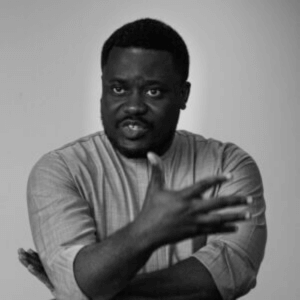
Bayo Akomolafe introduced the conversation:
One of the central themes of our work is we’ve come to the end of the world as we know it. But the end is not the Hollywoodesque ending we’re used to. It’s not spectacular. It’s not written in the major key. It’s not capitalized. It’s an invitation to change and challenge the postures that we’ve assumed as a dominant species.
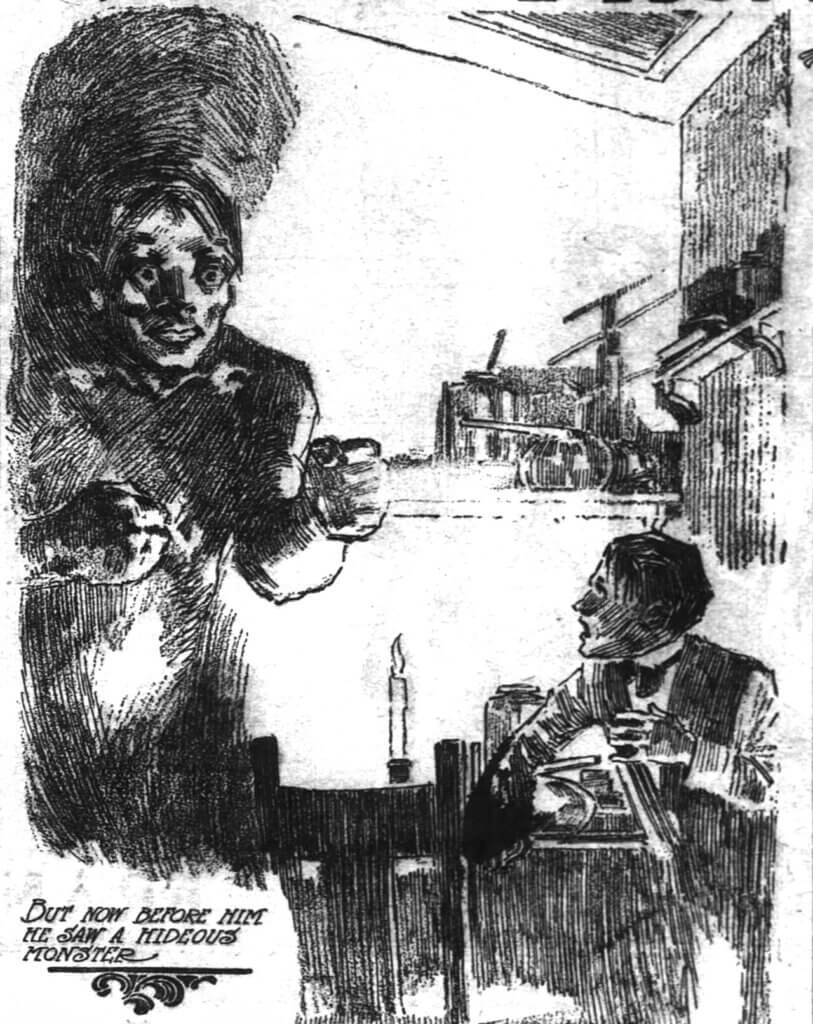
And it’s an invitation to think differently. That’s what informed the title of this exploration today taken from the indefatigable, eternal work of Mary Shelley’s Frankenstein. In the story the Monster accuses Dr. Victor Frankenstein, the young scientist who created him, of abandoning him:
“Remember, that I am thy creature: I ought to be thy Adam; but I am rather the fallen angel, whom thou drivest from joy for no misdeed.”
I think Nature is accusing the Anthropos these days. Nature is saying we will not be your road and your highway any longer. You will need to challenge your posture of supremacy and mastery. And you will need to think differently about what you are.
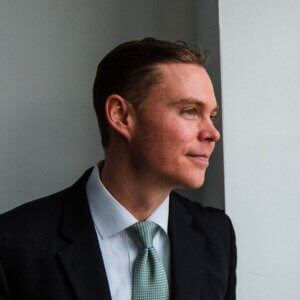
Alex then addresses Dougald:
You write that part of what it means to be born into these times is that “the music of your life will be threaded against a deep background roar of loss. To wake up to the world as we find it is to wake into grief.”
You also write, “The end of the world as we know it is not the end of the world, full stop. Unless we can inhabit that distinction, we will end up defending the world as we’ve known it at all costs, no matter how monstrous those costs turn out to be.”
Reading these passages, it sounds like you’re bringing up an important topic of how we might navigate what we call climate grief. That you’re inviting us to engage in a serious way with this grief, not to avoid it or deny it, and not to be tempted away from what this grieving process involves.
In the audience today are teachers and pastors and artists and farmers, doctors and more. Many of us are parents and for all of us there is this growing level of alarm about the future, a sense of urgency about the years ahead. What is this distinction that you’re asking us to make as we face our fears about the future?
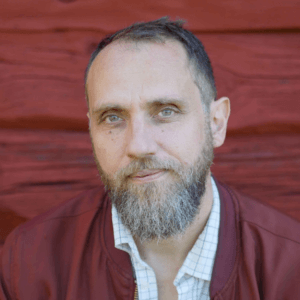
Dougald responds by quoting from T.S. Eliot’s poem 4 Quartets 2: East Coker:
“I said to my soul, be still and wait without hope, for hope would be hope for the wrong thing.”
We sometimes have to go through the dark night of the soul, that passage to the far side of despair. And the ticket for that passage does not guarantee the far side, because if it did, it wouldn’t be real.
But my experience has been of having walked that path more than once, that on the far side of it, we begin to see different shapes of hope that don’t look like the kinds of patterns of hope we were taught to look for in the world. That really resonates for me, that need to face this big, monstrous idea of climate change and get a little more nuanced about what it is that’s ending and what we may need to let go of. It’s the theme of the end of the world.
Alex:
A follow-up question is what happens if we don’t engage in a healthy way with our grief. Because you seem to point in the direction of where this might go if our grief, our holding climate change with grief, turns into an embrace of the climate emergency and what emergency means in politics. I’m wondering, can you say a little more about what you’re seeing here? What is this danger that we have to avoid around climate emergency?
Dougald:
In political terms, a political declaration of emergency means the suspense of normal process, normal rights, the normal functioning of democracy. When you declare a state of emergency as a government, you’re meant to name when it will come to an end. And so that was my question. If we’re going to ask our governments to declare a climate emergency, when do we think that declaration is going to come to an end?
And to the extent that I’m not simply wanting to put a fatwa on the kind of language of climate emergency, my invitation to my friends was to articulate a politics in which emergency spells more democracy rather than less, because if you use the language of emergency politically without doing that, the default course of events is that what you are inviting is less democracy.
Alex:
Catherine, you’ve written not one, but two books on the apocalypse. And so I wanted to ask you what does apocalypse actually mean?
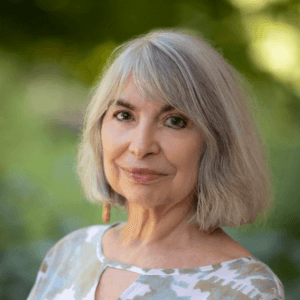
Catherine:
“Apocalypse” literally means “unveiling.” Its most original usage in the ancient world is very sexy — the unveiling of the bride on the wedding night.
It’s important to emphasize that this ancient intuition into unveiling is not unveiling the end of the world. There’s no such phrase as “end of the world” in the Bible, either Old or New Testament.
There is imagery of great violence and great destruction of systems human and nonhuman. But it’s never total ever and certainly not in the book of Revelations. It is so assumed that end-of-the-world talk comes from Revelations. But no.
Yes there’s a very hallucinatory image-rich vision. Very non-prosaic, especially poetic in the Greek, a vision of a spiral of increasing destruction driven by what? Well, by the Roman Empire. That’s what the beast is the code for in the book of Revelations. So the book is an anti-imperialist text that had to be written in code so its author could avoid execution. John is preaching about Caesar as the beast, a satanic figure, copulating with the Whore of Babylon which is his symbol for the global economy.
Revelations is all about the Roman economy — an early very mythic denunciation of a global imperial power in bed with the global economy. An economy that leads to great destructiveness of human and natural systems, a lot of violent warfare, a lot of confrontation, a lot of mass death. But finally, going through all of this, there is the emergence of hope for that new heaven and earth, that new Jerusalem.
Alex:
Thank you, Catherine. First of all, I think it’s just really helpful and really important, especially if you’re going to hear it from a theologian, that there’s no such thing as the end-of-the-world in the Bible.
At some point in the not too far future, the whole emotional climate of the conversation is going to switch. And we’re going to stop having public debates about whether climate change is real. All of a sudden, it’s going to be very, very, very, very real. The temptation will be to move into climate emergency and a form of authoritarianism that Dougald warned us against.
But like Odysseus navigating between Scylla and Charybdis, we have another danger. And it’s on the technology side, this techno utopianism, the dream and fantasy of transhumanism. It’s really a kind of techno messianism where we think, and in our darkest hearts we really kind of hope, that technology is going to save us.
And so I want to turn this to you, Bayo, especially since you invoked Frankenstein in the beginning, can you speak a little bit about technology and how it relates to what we need to let go of.
Bayo:
Thank you, brother. I remember chuckling as I started to read a recent article about how scientists have finally resolved the ancient riddle of which came first, the chicken or the egg. I was laughing because I don’t think the riddle is meant to be solved. It doesn’t lend itself to final declarations that we finally know which came first, that we’re very sure this time. The riddle, the spirit of the riddle itself, is an invitation to consider the provisionality of embodiment.
The question of the chicken or the egg is an invitation to be humble about where we draw the lines between this and that, object and subject, origin points and destinations.
As someone who was born in the Global South, was born in the streets of Lagos, there was this dream that you’re born into that one day, one fine transhumanist singularity day, we will finally look like the United States. We will have the technological mastery of the United States.
It was this glowing myth of a city set upon a hill, defined by its technological mastery. But traveling in the US over the past 10 years, I’ve seen the hidden conceit of development and sophistry and sophistication is that it forgets how to think in terms of relations and relationality. The conceit presumes that humans are the true makers and that they are entirely divorced from the things that they make. What that leaves behind, what that obscures is, of course, that the technologies we use and enact and deploy also shape our bodies and subjectivities in return. That is to say we are used by the things that we use.
There’s a sense in which we are becoming plastic. We’re becoming electronic objects.
We are called into a relationship that to use is to be used in return and to deploy is to be deployed in return. That’s the limitation of techno utopianism or transhumanism. Transhumanism is to be distinguished from posthumanism. Transhumanism is the faith that one day, if only we tried hard enough, if we put the smartest people in the room, we can act our way out of climate catastrophe. We can click our way out of this mess.
Modernity is the paradigm of the master sense vision. It’s that we can be in control.
I think we are experiencing the Fall to speak theologically. We’re experiencing the Fall again. We’re realizing that Eden isn’t available for us that way. The myth of mastery now has to be composted in some way.
Alex:
Dougald turning to you, because there’s actually a part of your book where you write “the end of the world as we know it is also the end of a way of knowing the world.” You write, “when a world ends, its systems and stories come apart — even the largest of them.”
One of the more counterintuitive parts of your book, Dougald, is the critique you raise about science and its role in our contemporary politics because you seem to portray our public discourse about science almost as a type of political mythology. Can you say a little about what you mean here? What’s the danger that you are seeing in the way that we are engaging science in this way of knowing the world?
Dougald:
We are gathered here today at the invitation of the Schumacher Center. And in this context, it’s important to remember the history of environmentalism because the environmentalism of Schumacher, the era in which Small is Beautiful made its impact, was different than the environmentalism of today. The early 1970s flowering of environmentalism was on the one hand informed by science. It was scientists like Rachel Carson who sounded the alarm that opened this new political space outside of the left-right spectrum as we’ve known it. But that environmentalism of the 70s was also not afraid to ask the questions that science on its own can’t ask, to engage in cultural critique in the questioning of our ways of living, our assumptions, our ways of inhabiting the world.
Then in the 90s, there was a turn to repeat this pattern of using calculation and measurement to replace the work of judgment and politics. As environmentalism attempted to grow up and to say, “Look, the authoritative form of knowledge in modern societies is science. We don’t need to be making these cultural arguments about our ways of living. We just need to present the evidence of how deep the trouble we’re in is and then everyone will listen to us.”
And once again, that dream that we can replace the work of judgment, of living with mystery, of frail and fragile and fallible human working out how we share a common world – that we can replace it with measurement and calculation – once again that promise failed.
So that’s the invitation in my book – to stop asking too much of science and instead, yes work with scientists, but also with those who don’t write under the name of scientists. We need to find ways forward to bring the practices of science with us into a world on the far side of the ending of that world of modernity.
Alex:
That’s a great way to turn to Catherine. I think it is very, very helpful to have the voice of a theologian in this conversation. Because the role of religion in our world is not currently felt to be particularly positive. There’s a question from the audience about what the role of faith and spirituality and even religion itself in these times ahead, is supposed to be. Can there be a positive role, one that would contribute to healing?
Catherine:
Well, I think that it is important in a gathering like this to affirm that religion has a place. Just because there is such a profound influence of religion on our civilization, it’s important for some of us who have the stomach for it to get in there and to fight the malignant effects of religion. Feminism first motivated me – specifically its challenge to patriarchy in structured religions. So it was that sense of being able to fight an inside battle that got me into it.
But then, once in, I began to realize what deep and prophetic sources those early feminist theologians, like Rosemary Radford Ruth, were dealing with. They had a whole history of prophetic figures who stood up against the Christian doctrinal authorities and often were martyred for it (not always as colorfully as Joan of Arc).
It became increasingly important to me to understand the prophetic voices. I got really interested in the subversive power of the religious voice. But of course, that subversive power only worked, because there’s also something affirming in that power. There was something beautiful revealing itself, so beautiful that some were willing to die for it. And one can hardly name it because everything has been turned to a cliche, like the cliche of all cliches, love.
But the insight that love is the heart of the universe, that love is the source of creation. The notion that God is love has always sustained me because the little love moments in life sustained me through great childhood havoc.
So that was the affirmation that there is this beautiful and rewarding motive. Love is always like its own reward. It doesn’t just wait to be fully gratified. That positive possibility began to unfold. And this vision, it’s how our natural sciences could have taken us, but have failed to, through the 20th century into a universe that’s radically relational and open at every moment in every cell, every molecule, every electron to a certain spontaneity, that there is a spontaneous relationality in absolutely all creatures.
That expansion of love to the nonhuman and to all of those humans we treat as nonhuman, brought love into new, nonsentimental focus for me. And has kept me going and reminding me of that perpetually subversive power of faith, the fugitivity of faith.
Alex:
This whole conversation I have been kind of hovering on the edge of tears. There could not be a more tender subject, for me at least, than these questions that we are surfacing. I don’t know if you feel that way, but these are questions that we are holding collectively, individually, as families. Questions about how we engage children and how we influence culture. And these questions seem like part of where the field of the work is. It’s not in the boardrooms exactly. It’s not out on the streets exactly. It certainly is those things as well. But it’s also culture and it’s children. Bayo you speak so often of both, so I wanted to ask you to help us bring this particular moment to a threshold.
Bayo:
I’ve spoken in many places, like my siblings here. And sometimes people enter the room thinking we have to save the world. We have to save the planet.
At the end of the talk, they often swing the pendulum to the other extreme, where it’s, okay, we just surrender to whatever is. And I’m not sure that’s the point here. The salvific response versus the whatever happens, happens, feels too fatal, the fatalist, you know, too deterministic.
But there’s a space between. And I would venture to call that space “Selah.” “Selah” is a word that appears about 74 times in the book of Psalms. Every verse would end with “Selah.” Some theologians say that it means pause here or lift it up.
There are multiple theories about what it means. I take it to be a mark of apophatic entanglement. That it’s unsayable, it’s non-legible. But even further, I think of “Selah” as the immediate environment that sprouts when something new wants to be born.
Something new, monstrous, desensitizing, almost even violent, wants to be born. And when something bursts into the frame, that radius of explosion is what we call “Selah.” It’s negative space, but it’s space that invites us to create, to think together, to grieve together, to think about what good ruins might look like.
That’s “Selah.” It’s a call to create. It’s a call to fall together. It’s a call to let go and it’s a call to hold on tight. It’s a call to so many things. It’s a call to experiment with parenting, knowing that whatever small molecular thing we can enact is a cosmic thing already. And that we all have this morsel of the next. We don’t have the full picture. We’re not meant to, but just the homeopathic dose of what wants to happen is domiciled in the gestures, the minor gestures that we make.
A recording of the full conversation can be viewed here.
This event was made possible with support from the Kalliopeia Foundation and the Christopher Reynolds Foundation.