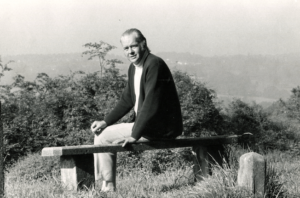
Honoring the 50th anniversary of E.F. Schumacher’s book Small is Beautiful in 2023, the Schumacher Center commissioned an updated study guide to this 1973 classic, turning to accomplished British author and Journalist David Boyle.
“Small is Beautiful Revisited…50 Years On” looks afresh at this 1973 landmark of the modern environmental movement. Chapter by chapter, this new study guide explains dated aspects that now seem a little obscure, while putting others in the context of what has been happening since the ’70s – and looking ahead about what could happen next.
Along the way, David suggests probing questions sure to make for fascinating, generative discussions in college classrooms, workplaces, and places of worship. All chapter guides are available on our site, plus a full downloadable PDF for easy use.
Over the coming months, we’ll progress through excerpts of each chapter’s guide in this enewsletter— starting with the Introduction. Do follow along with us.
Excerpt from the Introduction
One of the most fateful errors of our age is the belief that ‘the problem of production’ has been solved. Not only is this belief firmly held by people remote from production and therefore professionally unacquainted with the facts — it is held by virtually all the experts, the captains of industry, the economic managers in the governments of the world, the academic and not-so-academic economists, not to mention the economic journalists. They may disagree on many things but they all agree that the problem of production has been solved; that mankind has at last come of age. For the rich countries, they say, the most important task now is ‘education for leisure’ and, for the poor countries. the ‘transfer of technology’…
— E.F. Schumacher, Small is Beautiful (1973)
The book Small is Beautiful is also the story of how one man managed to stand in the way of a juggernaut – the stultifying series of errors in economics that stemmed, according to the author, from scientific materialism.
I accept, of course, that the juggernaut continues – but would we have made as much progress as we have against it without this short book of essays and lectures, pulled together by Dr Fritz Schumacher and published exactly 50 years ago this year?
The first chapter about production goes to the heart of the problem as Schumacher saw it – as first and foremost a spiritual mistake:
Modern man does not experience himself as a part of nature but as an outside force destined to dominate and conquer it. He even talks of a battle with nature, forgetting that, if he won the battle, he would find himself on the losing side…
Background
When Small is Beautiful was published in May of 1973, Schumacher had long since completed the shift he had made from conventional Keynesianism to a radical scepticism – almost a maverick anti-economics position.
He could so easily have been dismissed as a crank. But then, as he said, a crank is “a small element in a machine that makes revolutions.” This was a man about whom Keynes had once said his mantle would fall – because Schumacher could really make the words “sing”.
He had become radicalized after a visit to Burma in 1955, when he saw suddenly how few of his conventional economic measures were relevant to an economy, where the main product was Buddhist monks and their prayers…
He had planned to use the title Homecomers to reflect the spiritual theme – and because he had been received into the Roman Catholic church in 1971. He had always intended the famous subtitle ‘Economics as if people mattered’.
Conjunctions of events are hard to understand, but it so happened that the publication at the end of May coincided with the first so-called energy crisis. In October, the OPEC group of Middle Eastern oil producers decided to hike the price of oil – mainly in response to those nations which had backed Israel in the Yom Kippur war.
The price of oil leapt four times over within days. In the UK, this led to a miners’ strike and a three-day working week; in the USA it led to the emerging speed limit going down to 55 mph. It plunged the world into recession for the first time since the Second World War.
It was enough for people to start searching for other economic opinions and other kinds of solution – and they happened upon Small is Beautiful.
It seemed to synthesize and epitomize everything that people like Barbara Ward, and other ‘experts’, had been saying the previous year at the United Nations. It seemed to encapsulate the environmental anxieties of a whole generation…
Almost overnight Schumacher became famous throughout the world. He was idolized as a guru by the California counter-culture and by a rising generation of eco-warriors, yet at the same time, he was also recognized in the Queen’s Honours List, being awarded a CBE in 1974.
By 1977, his views had become so popular and so mainstream that he was invited by President Carter for a half-hour talk in the White House. Carter was keen to be photographed holding a copy of Small is Beautiful.
By the end of that year, he was dead – from exhaustion.
What happened next?
Schumacher died in Switzerland on 4 September 1977. Small is Beautiful is now a classic – picked in 1995 by the Times Literary Supplement as one of the 100 most influential books since 1945.
Nearly three months later, on 30 November, a requiem mass was celebrated for Schumacher at Westminster Cathedral. During the service, Jerry Brown, Governor of California and a friend and follower of his, described him as “a man of utter simplicity who moved large numbers by the force of his ideas and personality. He challenged the fundamental beliefs of modern society from the context of ancient wisdom”.
An address was also given by David Astor, a former editor of the Observer, and the High Commissioner for Zambia read a message from President Kaunda. Other dignitaries present included the High Commissioner for Botswana, the US Ambassador and members of both Houses of Parliament.
The next day, the Times described Schumacher as a “pioneer of post-capitalist, post-communist thought” and more than made up for its earlier alleged indifference by devoting its editorial to his work.
The trouble was that, without Schumacher to be the face and voice of a new economics, all these powerful people have been unable to stop the globalized economy juggernaut.
But there were by then a number of people who were determined not to let his message die. And so there is now a whole circle of institutions that he either founded or inspired so much that they borrowed his name to make the case again. The former include the Soil Association (where he was the chair for many years) and ITDG (now Practical Action) which he founded.
In the latter category is the Schumacher Center for the New Economics in Massachusetts – which now houses his library – and Schumacher College in Devon, the New Economics Foundation thinktank, and a number of others.
It wasn’t always easy to keep going in those difficult years under Ronald Reagan and Margaret Thatcher, when – in reaction to the failures of the old Keynesian arrangements – it sometimes seemed like the world was going backwards rather than forwards.
But debates change, and there has been progress – as we will see…
David Boyle is a journalist and author of a range of books and pamphlets about history, social change, and politics, including Tickbox (Little, Brown, 2020). Funny Money: In search of alternative cash (Flamingo, 1999), and Why London Needs its own Currency (2000).
He is co-director of the think tank New Weather Institute, policy director of Radix, an advisory council member of the Schumacher Center for a New Economics, and a fellow at the New Economics Foundation.