Below is a review of Edmund Noble’s Purposive Evolution: The Link Between Science and Religion written by Greg Watson, Curator of the World Game Workshop and World Grid Project at the Schumacher Center. Please enjoy.
The World Spreads Itself Out Before Us as If Shot Through with Mind
A Rediscovery of Edmund Noble’s Purposive Evolution: The Link Between Science and Religion (1926)
© 2026 Greg Watson
“Human planning of means to ends, as shown in the making of tools and machines, is accomplished consciously and through awareness of the ways in which ends may be reached; yet within the human, as within the sub-human organism there are tools – tissues, organs and processes, all of them means to ends – with the fashioning of which consciousness and “planning afterthought” have had nothing whatever to do, and in the actual working of which they play no part. It is here held that purposiveness is a principle rooted in things, not a value at some point in time and place added to things …The vital activities of the organism, internal and relational, unconscious and conscious, are seen to derive from the self-maintaining activities of the universe; their purposive character is traced to a cosmos which is end-reaching before the coming of life and “intelligent” before the advent of consciousness”
— Edmund Noble, Purposive Evolution: The Link Between Science and Religion
A Bookstore, a Pandemic, and Insight
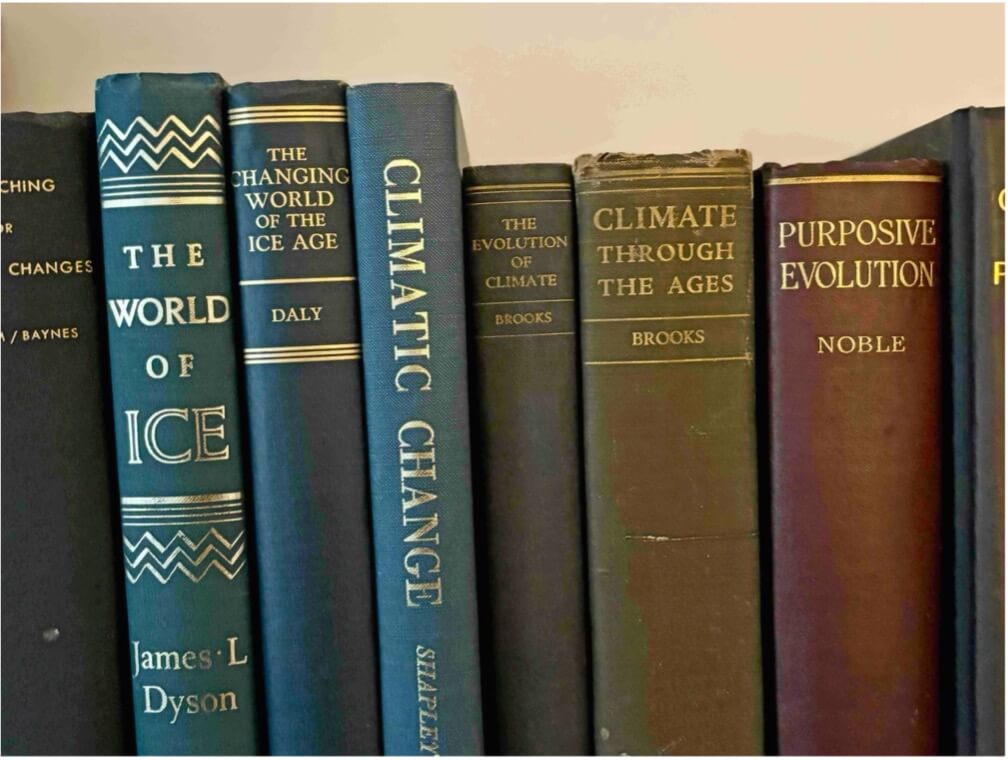
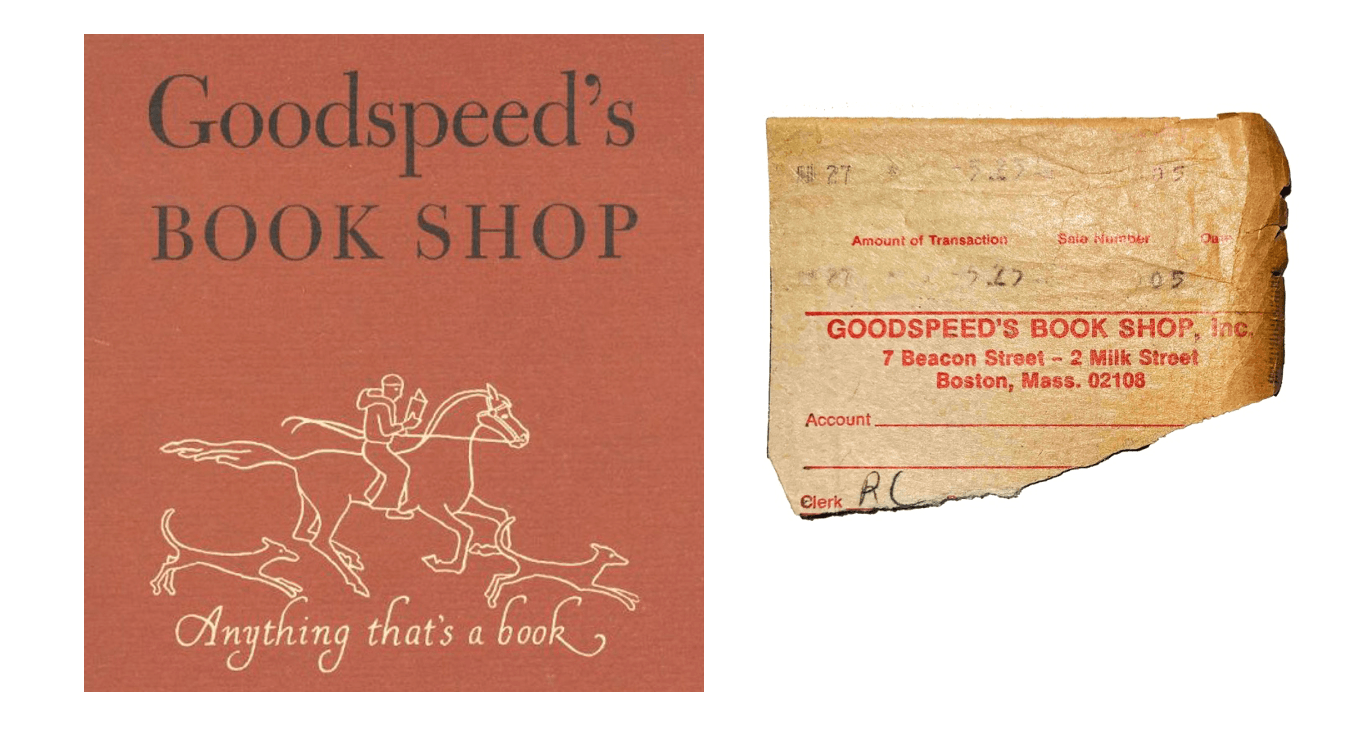
Goodspeed’s Book Shop occupied a corner of Boston’s intellectual life from 1898 to 1995. It was the kind of place where the right book waited on the right shelf for the right reader, sometimes for years. I was on a mission looking for books that would help me trace the evolution of thinking about the ice ages—major climate change events that had actually taken place on Earth. I thought this exploration into Earth’s climate change history might provide clues that might contribute to efforts aimed at averting a human-forced climate catastrophe.
Within a span of a couple of months, I discovered and purchased a number of climate-related books. As I read them, I noticed they all shared an identical feature: a very light “backward” check mark in pencil that highlighted passages the previous owner thought were noteworthy.
On one of my last visits to Goodspeed’s there were no more books on the ice ages in the spot where I had discovered my previous purchases. However, perched on a shelf was a book with the arresting title: Purposive Evolution: The Link Between Science and Religion by Edmund Noble. Thumbing through it, I noticed it had that same quirky backward check mark lightly inscribed in pencil.
So, I purchased it for $5.25.
The book sat on my shelf for over two decades. Then Covid hit, the world paused, and I finally opened it. I was, as the saying goes, blown away.
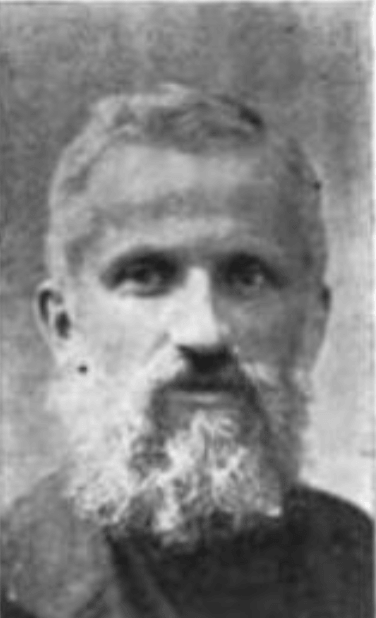
Noble was an Anglo-American journalist and self-described amateur philosopher, born in Glasgow in 1853, who spent most of his working life in Boston as a correspondent for the Boston Herald. He wrote extensively about Russia, contributed to the Atlantic, and published philosophical essays in the Philosophical Review and the International Journal of Ethics. He died in Malden, Massachusetts, on January 8, 1937 — his eighty-fourth birthday, to the day. Purposive Evolution was his magnum opus: 578 pages, published by Henry Holt, reviewed favorably by John Dewey and C. Lloyd Morgan, and then — almost entirely forgotten.
This posthumous review is an attempt to begin correcting that oversight. Noble was not ahead of his time. His time, I will argue, is now. Sadly, Purposive Evolution is out of print and difficult to find.
The Ether Meets the Isotropic Vector Matrix
No summary of Noble’s central argument can substitute for his own words. Here is the passage that stopped me cold — a mechanical analogy for the structured fabric of space that Noble offers as a model of the ether (challenging the conventional scientific wisdom at that time that questioned the very existence of the ether):
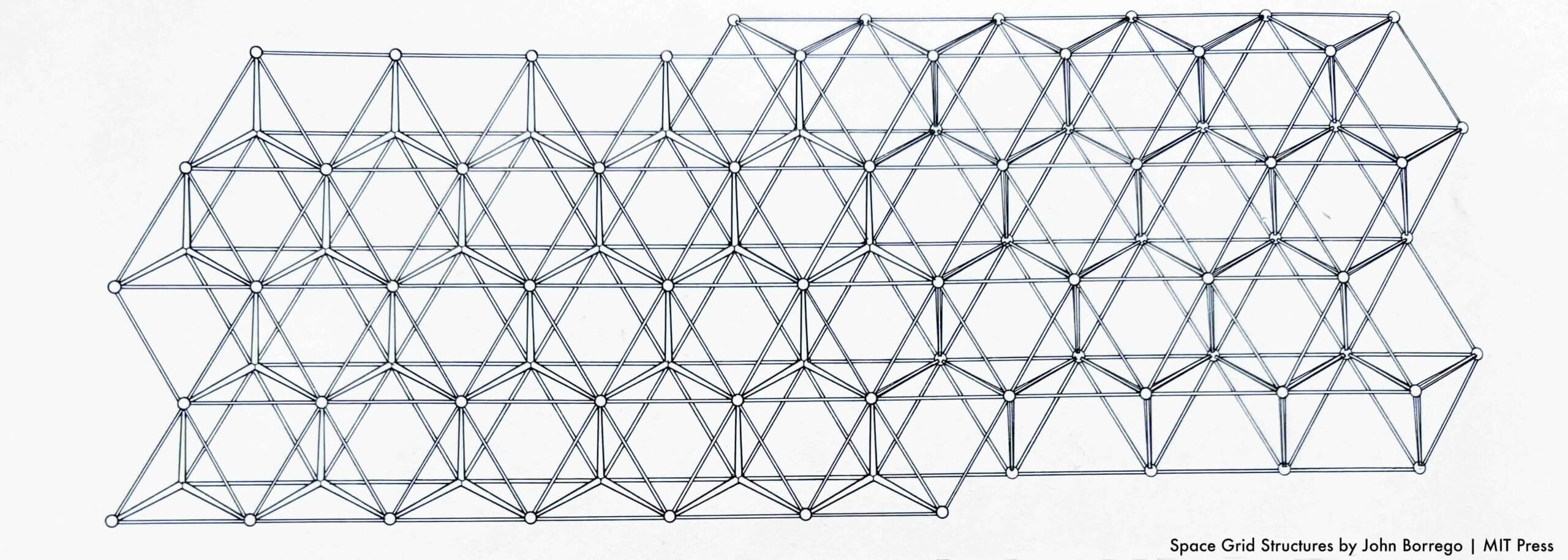
“Take a few wooden balls and distribute them symmetrically in rows over a large field. Observe the ease with which each of these units can be moved from its space. Connect two, four, six or a dozen of the balls by iron rods, and the difficulty of moving any one of them will be proportionately increased. Link all the balls together in the same way, so as to form an interrelated system, and the resistance to push or pull offered by each will be found insuperable… Unconnected with the rest, each unit yields easily; linked up with all the units, it resists not with its own power alone, but with the total power of the system… And out of this plurality and this interdependence, this contribution and cumulation, this subordination and this domination, there plainly emerges a function of maintenance — maintenance, that is to say, of each unit — an endowment of it with the power of change such as is not the power of any one unit, but the accumulated power of the system, refluent from all the units to each of them.”
— Edmund Noble, Purposive Evolution: The Link Between Science and Religion
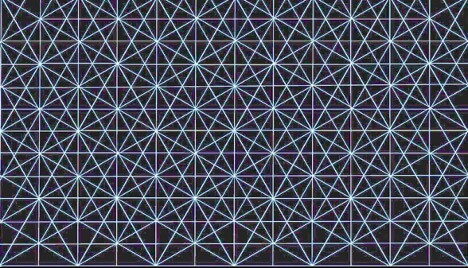
This passage was written in 1926. It will be immediately recognizable to anyone familiar with Buckminster Fuller’s Isotropic Vector Matrix (IVM) — the omnidirectional, closest-packed array of equidistant points generated by nested tetrahedra and octahedra that Fuller spent his life developing as the coordinate system of nature. It will also be recognizable to anyone who has worked with tensegrity structures, systems biology, quantum field theory, or complex adaptive systems.
Fuller published Synergetics: Explorations in the Geometry of Thinking in 1975, nearly fifty years after Noble’s book appeared. Neither appears to have known of the other. That they arrived at structurally identical conclusions from different directions is not coincidence. It is evidence that they were both seeing something real.
Here is Fuller’s description of the isotropic vector matrix:
When the centers of equiradius spheres in closest packing are joined by most economical lines, i.e., by geodesic vectorial lines, an isotropic vector matrix is disclosed — `isotropic’ meaning `everywhere the same,’ `isotropic vector’ meaning `everywhere the same energy conditions.’ This matrix constitutes an array of equilateral triangles that corresponds with the comprehensive coordination of nature’s most economical, most comfortable, structural interrelationships employing 60-degree association and disassociation. Remove the spheres and leave the vectors, and you have the octahedron-tetrahedron complex, the octet truss, the isotropic vector matrix…The isotropic vector matrix is four-dimensional, and 60-degree coordinated. It provides an omnirational accounting system that, if arbitrarily accounted on a three-dimensional, 90-degree basis, becomes inherently irrational. The isotropic vector matrix demonstrates the ability of the symmetrically and asymmetrically terminated, high-frequency energy vectors to accommodate the structuring of any shape.
— Buckminster Fuller | Synergetics: Explorations in the Geometry of Thinking | 1975
I find Noble’s poetic precision and Fuller’s engineering elegance to synergetically complement one another.
Shot Through with Mind
If the wooden balls passage is Noble’s most striking physical intuition, Chapter XIII contains his most philosophically arresting sentence:
“The world spreads itself out before us as if shot through with mind. How are we to explain the bond of common process which everywhere links the purposive adaptations of Nature with the consciously wrought contrivances of man? Why should the Universe, like the intellect, segregate and classify, bringing likes together and separating unlikes? What is it that matches the rounded boulder with the sphered planet? that relates the spiral of the nebula and the shell to the volute of the Ionic capital, and these to the curl of the wave as it breaks on the shore? That passes from regularly spaced ether pulses to regularly spaced airwaves…”
— Edmund Noble, Purposive Evolution: The Link Between Science and Religion
Noble is asking the deepest possible question: not merely whether nature is purposive, but why human intelligence and natural process exhibit the same structural patterns. Why does the mind classify in the same way the universe classifies? Why does the nautilus shell rhyme with the spiral galaxy? Why does the breaking wave echo the Ionic capital?
Fuller’s answer is geometric: because both mind and nature operate within the same underlying coordinate system. The 60-degree IVM is not a human invention imposed upon nature. It is nature’s own organizational logic, which human intelligence rediscovers when it thinks clearly enough. Noble reaches for the same answer from a different direction, through his concept of the structured ether as the common substrate linking physical form, biological adaptation, and conscious design.
What Noble calls “ether” we might today call the quantum vacuum, the zero-point field, or the relational structure of spacetime. The terminology has changed. The intuition — that there is a structured, active, connective medium underlying all phenomena — has not.
The Relational View
Noble’s most sustained philosophical argument appears in Chapter XIV, where he articulates what he calls “the relational view”:
“In the relational view, the solving of Nature problems yet unsolved is nothing less than a process of reaching out from the individual object, the individual process, to the system which is to elucidate both — a passing from the local and superficial characters which most easily affect the senses to those fundamental and universal characters which appeal to the intellect — a process of universalization which, demanding fundamental likeness as the condition of its possibility, implies a universe of one kind throughout whose units, everywhere system-contributing and system-determined, exist only as they are constitutively interdependent… Its task is that of completing the unitary account of Nature, and of doing this by revealing the Cosmic oneness which the accumulated facts of science*, when relationally interpreted, already disclose.”
*Fuller defined science as “the attempt to set in order the facts of experience”
Every sentence here is load bearing. “The system which is to elucidate both” — the whole does not merely explain the parts; it illuminates itself and the parts simultaneously. “Units, everywhere system-contributing and system-determined, exist only as they are constitutively interdependent” — individual existence is not primary; relational existence is primary. Things are not first things and then related. They exist through and as their relations.
And then the most audacious claim: “the accumulated facts of science, when relationally interpreted, already disclose” the cosmic oneness Noble is pointing toward. He is not asking science to become something different. He is saying the data already in hand, already verified, already published — when read through the relational lens rather than the mechanistic lens — already reveals what we need to know. The problem is not insufficient evidence. The problem is an insufficient coordinate system for interpreting it.
This is still true. We now have vastly more accumulated facts of science than Noble had in 1926. The argument for the relational interpretation has only grown stronger.
Conflict as Constituent Element
Noble is not a naive harmonist. Chapter IX contains a sentence that deserves particular attention for its (brutal?) intellectual honesty: “As antagonisms are the very nature of power, so conflict is an inalienable factor in the cooperations, inorganic and organic, that make for progress.”
Conflict is not the opposite of cooperation. It is a constituent element of it. The ether-ball model is not a vision of frictionless harmony. The resistance that emerges from interconnection is precisely what gives the system its structural integrity. Without tension, there is no tensegrity. Without antagonism, there is no power. Fuller emphasized the co-variable operating principle of the Universe: inside/outside; hot/cold; day/night; tension/compression.
This is a more honest and more useful framework than either pure competition or pure cooperation. It describes how geographies of cooperation actually form — through the productive friction of actors with different interests, pursuing adjacent purposes, whose collective 90-degree effects precessionally generate emergent structures that none of them individually designed or intended. The pollinating honey bee.
The Preface and Purposive Design
The Preface establishes the book’s deepest theme, and it is one that resonates far beyond natural philosophy. A point Noble makes in it bears repeating:
“Human planning of means to ends, as shown in the making of tools and machines, is accomplished consciously and through awareness of the ways in which ends may be reached; yet within the human, as within the sub-human organism there are tools — tissues, organs and processes, all of them means to ends — with the fashioning of which consciousness and ‘planning afterthought’ have had nothing whatever to do, and in the actual working of which they play no part.”
This is precession — Fuller’s term for the tendency of systems to produce their most important effects at 90 degrees to the direction of effort — stated in biological terms. The organism’s tissues do not know they are sustaining life. The honeybee does not know it is pollinating. The farmer’s market organizer may not be aware of how she is reshaping agricultural policy. The grid engineer need not be interested in the fact that he is playing a role in rewiring the geopolitics of energy dependency.
Noble’s insight is that this is not a deficiency. It is a design principle. The most fundamental functions of living systems — and, by extension, of cooperative human systems — are performed by agents who have no idea they are performing them. Purpose is real. It is built into the structure of the system. It does not require a conscious agent to intend it.
I would argue, however, that when purpose equates to concepts like maximizing profit or uninhibited economic “growth,” the precessional effects emerge as “unintended consequences,” i.e., pollution, ecosystem destruction, economic inequality, climate change. That’s because “modern industrial societies” operate in accordance with the Cartesian coordinate system that views numbers in terms of quantity. Fuller’s comprehensive anticipatory design science is based on Nature’s 60-degree coordination where numbers describe regenerative patterns of transformation. It aligns with Noble’s ether.
The Contemporary Convergence
In 2023, Raymond Noble and Denis Noble (no relation to Edmund) — professors at University College London and Oxford respectively — published Understanding Living Systems, in which they argue that “agency and purposeful action is a defining property of all living systems.” They do not cite Edmund Noble. As far as can be determined, they are unaware of his work.
The same observation applies to the five scholars who reviewed Purposive Evolution in 1927: the marine biologist William E. Ritter, the sociologists Floyd N. House and Seba Eldridge, the philosopher George P. Conger, and the emergent evolution theorist C. Lloyd Morgan. All took the book seriously. None were able to give it the longevity it deserved. The consolidating mechanistic orthodoxy of the late 1920s closed the window before Noble’s ideas could take root in the institutional soil of any discipline.
The window is open again. Complexity theory, systems biology, quantum field theory, and relational physics are all, in their different ways, doing what Noble called for: reading the accumulated facts of science through the relational lens rather than the mechanistic one. The cosmic oneness he believed those facts already disclosed is coming into focus across multiple disciplines simultaneously.
Biomimicry has emerged as an important expression of ecological design, i.e. understanding and applying Nature’s “technological” innovations to improve the human condition. Here again Noble exhibits an uncanny prescience writing with a level of detail that leaves no room for doubt that he had found synchronicity with the Universe.
In human contrivance and in nature contrivance the details may differ, the degree of elaboration may not be the same, but a single process links all the examples together: in many cases the likeness of both result and method is unmistakable.
It is this which joins the unconscious fashioning of organs with the conscious making of tools, bridging the gap, as it were, between the earth-trap of the native African and the pitfall of the ant lion, between the web of the spider and the fisherman’s net, the foot of the mole, the digging stick of the Australian and the spade of the navvy, the boatman’s single oar and the sculling tail of the fish, the kayak of the savage and the floating pupa skin of the gnat, the scale armor of the armadillo and the soldier’s cuirass, the climbing hooks of the tiger beetle and the grappling irons of naval warfare.
Man economizes both power and material by the resort to hollow tubes for the handles of tools and in the construction of bicycles and the building of bridges: Nature used them millions of years earlier in the fashioning of grasses, corn stalks, innumerable plant stems, in the bamboo and in quills of feathers; the long bones of animals are little more than cylinders, “which grow more solid towards the end only because special stresses of function require the thickening.
The shells of mollusks, under the combined action of the organism and its environment take the shape which wastes power the least. The form of the limpet gives great strength with but small expenditure of material…Even where the simple, uncoiled form of the shell has been departed from, there has in innumerable instances been a retention of the general external shape, that the minimum resistance shall be offered to the waves.
In his work on ” Entomology ” Alpheus S. Packard cites from Graber a statement to the effect that the body of the dyticus, or swimming beetle, has been developed in a wedge-shape form so as to offer the minimum of resistance to motion. The fish long anticipated the care which naval designers take in moulding the lines of ships into least resistance forms. Its very shape has been recognized by engineers as a practical solution of the most theoretical problems of curves and displacements in relation to submarine motion.
A study of the lines of typical fishes has revealed the fact that the entering angle of many and very different fishes terminate regularly at the plane of the greatest cross-section of the body – at 36 per cent of the fish’s total length. (“Fishes, Living and Fossil” by Bashford Dean) The skin of the fish is also developed to the end of securing conditions of least resistance: under a microscope it is seen to consist of overlapping layers of scales, with small projecting horns or points on the outer end of each scale, leading to the presumption that “the particles of water in most immediate contact with the fish are passed on from scale to scale, like the rain running off a slated roof, without pausing to adhere to any individual scale, and that their disengagement without adhesion or friction arising from molecular attraction is facilitated in some way by the projecting row of points.” (“Scientific Problems of the Future,” by H. Elsdale, Smithsonian Report for 1894, p. 678.).
Combined lightness and strength have been secured for the bird in a manner that, even were it the result of conscious planning, would command our unqualified admiration. The body is made large, as compared with the head, to the end of yielding a large surface for the attachment of muscles capable of raising the bird from the ground, the union of lightness with bulk being rendered possible by the distribution of air cells through the body via tubes connecting the lungs with cavities in the bones, themselves much lighter than the bones of quadrupeds. Not only is the bird’s body so shaped as to offer the least resistance to the air; the mechanism of flight itself combines the minimum weight to be lifted with the maximum of lifting power. The wing feathers possess an ideal lightness and strength not approached in these respects by any consciously contrived appliance of man; the shape of the wing is itself determined in the interests of economy, the upper surface being convex so as to minimize resistance in the upper stroke, the lower surface concave to the end of accumulating the pressure through which the bird is enabled to ascend. To this pressure the disposition of the primary feathers powerfully contributes, since, being made to overlap each other, they open out somewhat when the wing is being raised, and close up into a continuous membrane in the downward stroke.

Why Noble Now
Stephen Greenblatt’s The Swerve tells the story of how a single surviving manuscript of Lucretius’ De Rerum Natura, rediscovered in a German monastery in 1417, helped catalyze the Renaissance. Greenblatt’s deeper argument is that certain ideas are so aligned with how reality actually works that they cannot be permanently suppressed — only temporarily mislaid. They keep resurfacing until the moment is right.
I am not comparing Noble to Lucretius. But the structure of the situation is similar. A serious thinker working outside institutional channels produces a work of genuine philosophical reach. The timing is wrong. The book falls between categories. It collects dust. Its ideas are independently rediscovered by others who have no idea the earlier work exists.
And then a lifelong student of Fuller’s synergetic geometry finds it in a used bookstore during a pandemic.
Noble was a a journalist, an amateur, a man who believed that serious thinking was not the exclusive property of universities. He wrote beautifully. He asked the right questions. He arrived, through the power of careful observation and honest reasoning, at structural truths that the specialists of his day were not ready to receive.
The world, Noble wrote, spreads itself out before us as if shot through with mind. What he meant was that the relational structure of reality is not hidden. It is not esoteric. It does not require special instruments or advanced mathematics to perceive. It is visible to anyone willing to look at the whole rather than the parts, at the connections rather than the units, at the system rather than the object.
Ninety-nine years after its publication, that invitation remains open.
A Note on Availability
Edmund Noble died in 1937. Purposive Evolution is out of print and in the public domain. The full text is available as page images through the Internet Archive. Physical copies are extremely scarce. The book has never been reprinted.
Contemporary reviews appeared in: Philosophy (C. Lloyd Morgan, 1927); Journal of Philosophy (George P. Conger, 1927); International Journal of Ethics (DeWitt H. Parker, 1927; William E. Ritter); Philosophical Review (1928); and reviews by Floyd N. House and Seba Eldridge. The book was also positively reviewed by John Dewey.
Edmund Noble’s Wikipedia entry provides a useful biographical summary. His 1925 article “The Ways of Nature Beyond Darwinism,” published in the Philosophical Review (Vol. 34, No. 4), serves as a direct precursor to the book and is accessible through JSTOR.
Purposive Evolution: The Link Between Science and Religion
By Edmund Burke
New York
Copyright 1926
Henry Holt And Company
578 pages
Review by Greg Watson
gregwatson@
https://worldgameworkshop.org/