Assumptions about human nature have long shaped the way we think about economics and, in turn, how we structure our economic systems. Among these assumptions, competition has repeatedly been presented as the defining law of both nature and human society.
Consider a few examples: the rational, self-interested actor remains central to conventional economic theory; Garrett Hardin’s “Tragedy of the Commons” has profoundly influenced debates over land use and natural-resource governance; and Ayn Rand’s philosophy of Objectivism, which supplied a moral defense of individualism, helped popularize the case for neoliberalism in the late 20th century.
Yet these ideas do not tell the whole story. Through her study of forests, fisheries, pastures, and other common resources, Elinor Ostrom demonstrated that communities are often capable of creating durable systems of collective governance—developing shared rules, responsibilities, and methods of accountability that allow a commons to flourish.
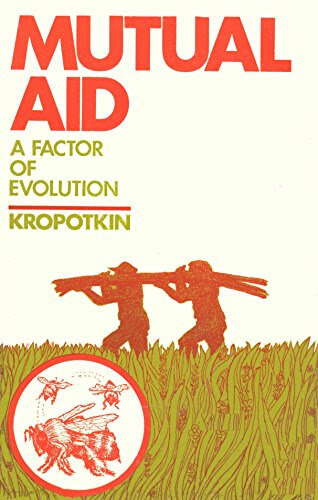
And a century before Ostrom won a Nobel Prize for her work, Pyotr Kropotkin offered his own influential account of the forces that shape life. In his 1902 book, Mutual Aid: A Factor of Evolution, Kropotkin looked across the animal world and throughout human history to argue that cooperation is not an exception to the struggle for existence, but one of the principal means by which life endures and flourishes.
Among animals, Kropotkin observes, the species most capable of cooperation are often the most resilient:
“The animal species, in which individual struggle has been reduced to its narrowest limits, and the practice of mutual aid has attained the greatest development, are invariably the most numerous, the most prosperous, and the most open to further progress.”
Kropotkin does not deny the violence and competition found in nature. Rather, he argues that our attention to conflict has often prevented us from recognizing the equally pervasive—and perhaps more consequential—practice of cooperation:
“As soon as we study animals—not in laboratories and museums only, but in the forest and prairie, in the steppe and in the mountains—we at once perceive that though there is an immense amount of warfare and extermination going on amidst various species…there is, at the same time, as much, or perhaps even more, of mutual support, mutual aid, and mutual defence.”
Moving from the animal world, Kropotkin traces this principle through human history. Villages, federations, cities, religious communities, and other forms of association arose from the need to share resources, practice a common craft, and provide mutual support and defense. Human civilization was not created by isolated individuals acting alone, but through ever-widening networks of cooperation.
These practices also became the foundation of our ethical life. The impulse to help one another, Kropotkin argues, preceded formal systems of law and morality:
“In the practice of mutual aid, which we can retrace to the earliest beginnings of evolution, we thus find the positive and undoubted origin of our ethical conceptions; and we can affirm that in the ethical progress of man, mutual support—not mutual struggle—has had the leading part.”
This vision remains deeply relevant to the work of building economies and communities rooted in reciprocity, collective stewardship, and justice. As Kropotkin reminds us, mutual aid is not merely an ideal to which society might aspire—it is one of the oldest and most enduring capacities of the living world.
We invite you to read the selected excerpt from Pyotr Kropotkin’s Mutual Aid, along with other selected works, in his Decentralism File entry.
Warm Wishes,
Staff of the Schumacher Center