Our celebration of the 50th anniversary of Small Is Beautiful continues in February with a focus on the theme of “Making Reparations: Seeding a Just Future.” The Schumacher Conversation on this topic will take place virtually Thursday, February 16th at 2 PM EST. Registration is free.

Register here
In anticipation, we revisit two relevant touchstones from our archives. These pieces represent calls for reparations and solidarity with both Native and Black American struggles for land. Together, they connect E.F. Schumacher’s profound vision of human and ecological harmony with today’s ambitious social movements and the challenges they face.
Voices from White Earth: Gaa-Waabaabiganikaag
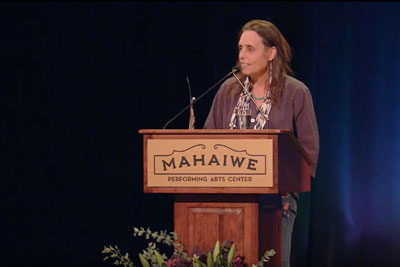
Winona LaDuke’s 1993 E.F. Schumacher Lecture remains a poignant account of Indigenous Americans’ long struggle for recognition “as full human beings with human rights, with the same rights to self-determination, to dignity, and to land…that other people have.”
To convey this, Winona recounts the experience of her people, the Mississippi band of Anishinaabeg of the White Earth Reservation — land reserved by treaty in 1867 in return for relinquishing a much larger area of Minnesota. Yet, due to a long history of settler-colonial dispossession, she explains, 93 percent of the reservation had been lost to non-Indian private ownership by 1980.
This land is called “the medicine chest of the Ojibways” for its life-supporting biodiversity. Traditionally, the careful tending of these resources was not managed through private land tenure, but through forms “similar to those of a community land trust: the land is owned collectively, and we have individual or, more often, family-based usufruct rights…”
As Winona explains, Anishinaabeg calls for land back imply ecological stewardship as well as a transition to collective forms of wealth. Describing these traditional life-ways, her lecture invites non-Indigenous audiences to reconsider received ideas of economics as zero-sum competition, thinking instead in terms of shared abundance:
Our struggle is to get our land back. That’s what we’ve been trying to do for a hundred years…in not controlling our land we are unable to control what is happening to our ecosystem…
It is absolutely crucial… that our struggle for territorial integrity as well as economic and political control… I ask you to shake off your fear…
A “Black Commons” for Land Reparations
The Schumacher Center’s 2018 proposal toward a “Black Commons” considers the role the Community Land Trust model can play in a national movement for land reparations. Grounded in a history of cooperative land management among Black communities, this discussion paper harkens back to the Community Land Trust movement’s roots within the struggle for Black economic self-determination during the 1960s.
Author Susan Witt, Schumacher Center Executive Director, recounts the story of New Communities, Inc., the first CLT in the U.S. based in Albany, Georgia in 1967:
Robert Swann, a pacifist and builder who later founded the Schumacher Center for a New Economics, joined Slater King, President of the Albany Movement and a civil rights activist, out of a common concern to provide access to land for Black farmers in the rural South.
An alternative mode of land tenure designed to address the root causes of inequalities inherent in private land speculation, the CLT model combines permanent community trusteeship of land itself—given by God or nature—with owner-equity in improvements on the land, such as housing and production facilities, via long-term inheritable leases.
Having expanded widely since the 1960s, CLTs are now a proven alternative for land tenure: a tool in helping prevent displacement and secure affordable housing, local farming and other activities in perpetuity. Serving as a national vehicle for land gifting into a Black Commons, a CLT structure could facilitate “low cost access for Black Americans hitherto without such access. In short creating one piece of a Black Reparations Movement.”
The creation of a Black Commons…and the leasing of that land with equity rights in improvements, can provide some justice to a people that have been systematically excluded from ownership opportunities…
Donors would be assured that their one-time donation of land would not again enter the market, but would remain a permanent part of a Black Commons.
In this way, the proposal details a path toward “freeing the land as well as the people,” thereby helping usher forth a just and regenerative economic future.
Allied Organizations for February’s Theme
Each month, we shine a light on aligned organizations and initiatives that are championing social and economic transformation in their respective fields.
Those recognized within February’s theme, “Making Reparations: Seeding a Just Future,” are those at the forefront of efforts to publicly reckon with past systemic injustices and repair their harms— including groups that accept gifts of land for reparations. Below are just a few highlights—explore the full list here.


FirstRepair is a not-for-profit working across the U.S. to educate and equip leaders, stakeholders, and allies who are advancing local reparations policies that remedy historic and ongoing anti-Black practices. The organization’s founder, Robin Rue Simmons, was the architect of the nation’s first government-funded reparations program.
Soul Fire Farm is an Afro-Indigenous centered community farm committed to uprooting racism and seeding sovereignty in the food system. Working on 80-acres of land historically stewarded by the Stockbridge-Munsee Band of the Mohican Nation, Soul Fire Farm uses regenerative and carbon sequestering farming practices. They have a sliding scale CSA and provide no cost doorstep delivery to people in need in the Albany-Troy area.
The White Earth Land Recovery Project (WELRP) facilitates the recovery of the original land base of the White Earth Indian Reservation while preserving and restoring traditional practices of sound land stewardship, language fluency, community development, and strengthening spiritual and cultural heritage.
As the year unfolds, we will continue to highlight organizations working in each of our twelve 50th anniversary themes — together bringing renewed resolution to the causes of justice and healing.
Do join us Thursday, February 16th, for the next Schumacher Conversation.