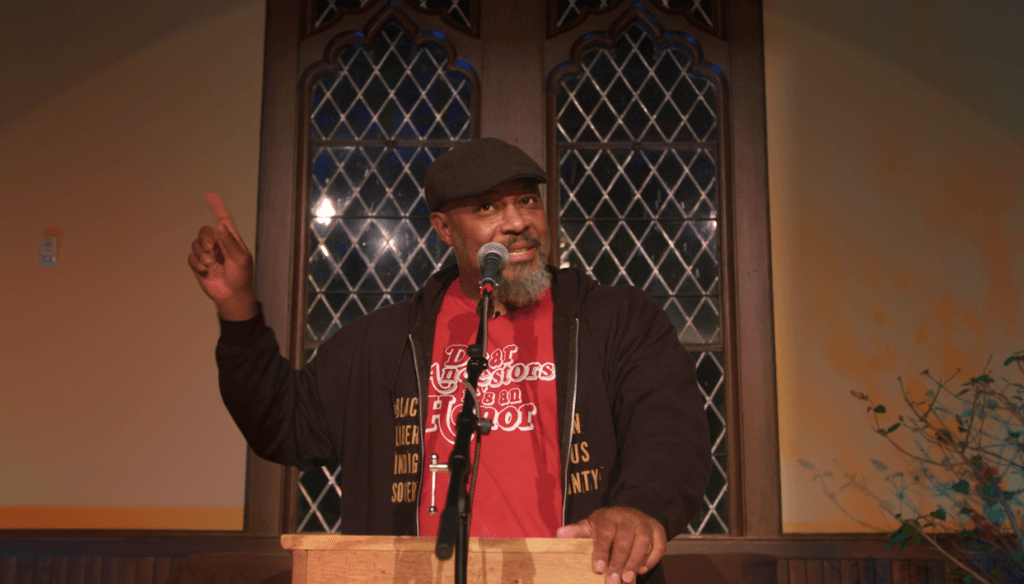
On the 26th of March, the Schumacher Center hosted Kali Akuno, co-founder of Cooperation Jackson, as our inaugural Robert Swann Lecturer. Kali addressed “Shifting Focus: Organizing for an Ecosocialist Future” to a local Southern Berkshire audience, and his underlying message is appropriately local in orientation. “Look around in this community,” he says, “and figure out how you’re going to work together.”
You can now watch a full recording of the lecture and subsequent Q&A.
Highlights from Kali Akuno in the Inaugural Swann Lecture
“Dear Ancestors, It’s an Honor”
In the recording, Kali begins his address by acknowledging Robert Swann on the occasion of what would have been his 105th birthday. The shirt he chose for the occasion aptly reads: “Dear Ancestors, It’s an Honor.”
“I do wanna give due props to the history and the foundation laid by Swann,” Kali says, referring to Swann’s pioneering role with Community Land Trusts and the broader movement for regional self-reliance. “I do consider him a movement ancestor and have for quite some time…”
“Draw from the collective experience that’s been practiced in this community.”
Kali describes the state of Cooperation Jackson’s efforts toward economic self-empowerment in the capitol of Mississippi.
“…We are still struggling to figure out how to build an alternative currency to fit into our particular context…
For us, we’re trying to get ourselves out of having to sell our time and labor, point blank. And to utilize the assets that we have…an abundant level of abandoned resources in our community which, if we can re-articulate its ownership…to being held in common…we can do some fundamental things to shift the quality of life…”
Kali then relates these efforts to the history of local experimentation with the Berkshire Community Land Trust and BerkShares local currency. “…do take stock of what you actually have done, and what foundations have been laid, and what it’s inspired others to do,” he tells the audience gathered.
Rethinking Our Relationship to Land
Throughout the lecture, Kali returns to the idea of “shifting focus” as a way to reframe what may typically be considered challenges for organizing for economic justice as potential opportunities. The advance of global warming renders the typical conception of universal property ownership, in the case of land for instance, increasingly problematic.
“Instead of looking at our relationship as ownership, say, to land, put ourselves in a situation [where] we’re just stewards, and we have a particular relationship to it.
Think about how weird of a concept it is [to] think about owning land. How can you own something that you are dependent upon? You are dependent upon it, it will do fine if you are not here…”
Taking a local or regional view, Kali suggests, land use is just one example where decisions will need to be mediated in a more holistic, deliberative manner. The sooner communities begin to establish such institutions and practices, the better a position they’ll be in to navigate change with justice at the center.
Organizing at “small-but-beautiful” scale
Kali concludes on a note of pragmatism. With a sober view of the limits of top-down institutions, Kali encourages communities everywhere to organize locally, and to take a long view of changes precipitating from our climate and ecological crises.
“One of the things I’ve been sharing everywhere I go: look around… look around to the people that you’re in a room with. That’s who you’re going to have to find a solution with…
“It’s broad, democratic practice, patient struggle and debate that’s going to make this work. So, look around in this community and figure out how you’re going to work together. That’s the critical piece of shifting focus.”
Organizing at human scale, he reminds audiences, can open up new possibilities for the support of flourishing individuals and resilient ecosystems in an uncertain future.
“Think about a ‘small-but-beautiful’ scale to your organizing, and build relationships within that of a deep nature—that’s what the next 3-4 years has to be about: so that when the next round of mass spontaneous disruption jumps off…we will be in a different position…”
If you find Kali’s message timely and inspiring, we hope you’ll share generously.