Our chapter-by-chapter reading of David Boyle’s study guide, “Small is Beautiful Revisited…50 Years On” continues, revisiting Schumacher’s 1973 landmark text in light of our own time. The guide has been sparking animated discussions given the current political climate. (Each chapter guide is available on our site in addition to a full downloadable PDF.)
In Chapter 16, Schumacher brings his critique of ‘gigantism’ in organizations into contact with the complex realities of modern economic life. Seeking to integrate the virtues of human scale within the existing system, he derives five principles to optimize small-scale units of cooperation and decision-making within larger organizations.
The effort to holistically calibrate levels of scale within complex systems resonate with the work of contemporaries— such as A. Stafford Beer, Gregory Bateson and William Thompson — who adopted the term ‘cybernetics.’
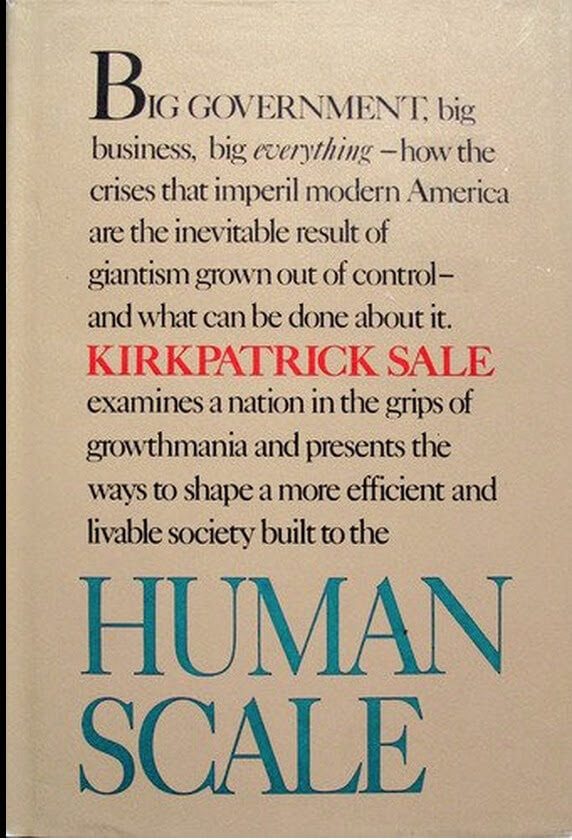
In 1982 Kirkpatrick Sale explored these issues further in his popular book Human Scale.
ACCESS THE GUIDE
Excerpt from the Guide to Chapter 16
“We all recognize, I think, that these are times of rapid change when we need to welcome innovative, better ways of doing things… All central planning is at odds with multiple and diverse experimenting. To be sure, small bureaucracies can be as brain-dead as big ones, but at least if they are multiple, when one says no or just doesn’t get it, the old saying applies; not all the eggs are in that basket.”
— Jane Jacobs, author of The Death and Life of the Great American Cities in the 25th anniversary edition of Small Is Beautiful, (1999).
“As the world enters its third millennium seemingly afflicted with ever-larger institutions, has the Schumacher legacy been repudiated? Not at all. True, Bigness seems to be on the march. But operating underneath galloping globalism, men and women in thousands of local communities are acting bravely in his tradition to create human scale institutions, appropriate technology, community land trusts, environmental improvement, local currencies, cooperatives, alternative health care, new energy technologies, home food production, rewarding self-employment, and entrepreneurship…”
— John McClaughry, Vermont politician, speech-writer and author of The Vermont Papers, in the 25th anniversary edition of Small Is Beautiful, (1999).
Chapter 16 takes a logical and step-by-step approach to the problem of massive, inhuman organizations. As such, it may be the chapter that most closely fits the title of the book. It first appeared in the fall of 1967 in London’s Quarterly Review of Management Technology as ‘Management Decision’.
What the Chapter Says…
“Almost every day we hear of mergers and takeovers: Britain enters the European Economic Community to open up larger markets to be served by even larger organizations. In the socialist countries, nationalization has produced vast combines to rival or surpass anything that has emerged in the capitalist countries. The great majority of economists and business efficiency experts support this trend towards vastness…
In contrast, most sociologists and psychologists insistently warn us of its inherent dangers – dangers to the integrity of the individual when he feels as nothing more than a small cog in a vast machine and when the human relationships of his daily working life become increasingly dehumanized; dangers also to efficiency and productivity, stemming from ever-growing Parkinsonian bureaucracies.”
Northcote Parkinson had written Parkinson’s Law because, as a naval historian, he famously noticed that there had been around 2,000 civil servants working at the British Admiralty at the outbreak of the First World War in 1914 to administer a navy of 146,000 seamen. By 1928, just fourteen years later, that figure had grown to 3,569 civil servants to manage 100,000 seamen.
Schumacher appears to have noticed Parkinson’s efforts to get his ‘law’ discussed (that the work expands to fill the time available). Yet even though he has mentioned Parkinson in three chapters so far, he doesn’t call him in aid or support – instead he calls on fans of Franz Kafka.
“Modern literature, at the same time, paints frightening pictures of a brave new world sharply divided between us and them… torn by mutual suspicion, with a hatred of authority from below and a contempt of people from above. The masses react to their rulers in a spirit of sullen irresponsibility, while the rulers vainly try to keep things moving by precise organization and coordination, fiscal inducements, incentives, endless exhortations and threats. Undoubtedly this is all a problem of communications. But the only really effective communication is from man to man, face to face…”
“Yet, it seems,” said Schumacher, “large-scale organization is here to stay. Therefore it is all the more necessary to think about it and to theorize about it. The stronger the current, the greater the need for skilful navigation. The fundamental task is to achieve smallness within large organizations.”
“Once a large organization has come into being, it normally goes through alternating phases of centralizing and decentralizing, like swings of a pendulum. Whenever one encounters such opposites, each of them with persuasive arguments in its favour, it is worth looking into the depth of the problem for something more than compromise, more than a half-and-half solution. Maybe what we really need is not either/or but the-one-and-the-other-at-the-
same-time.”
Then he introduces the five principles with which he plans to find a way forward for big organizations.
“This very familiar problem pervades the whole of real life, although it is highly unpopular with people who spend most of their time on laboratory problems from which all extraneous factors have been carefully eliminated. For whatever we do in real life, we must try to do justice to a situation which includes all so-called extraneous factors. We find we always have to face the simultaneous requirement for order and freedom.”
1. The Principle of Subsidiarity
This means that people need to be governed by decisions taken as close as possible to them. Schumacher borrowed this idea from Catholic social doctrine, under Pope Leo XIII. It was never quite clear where the idea derived from, though persistent rumours suggested that it came from John Ruskin, via Cardinal Henry Manning (see Chapter 18).
In fact, Schumacher quotes the papal encyclical ‘Quadragesimo Anno’, from 1931 – drafted in this case by two German Jesuit theologians and published by Pius XI.
The main function of ‘Quadragesimo Anno’ was to condemn socialism and capitalism equally, and develop the idea of subsidiarity:
“The opposites of centralizing and decentralizing are now far behind us: the Principle of Subsidiary Function teaches us that the centre will gain in authority and effectiveness if the freedom and responsibility of the lower formations are carefully preserved, with the result that the organization as a whole will be ‘happier and more prosperous’…”
But how can it be achieved, given that so many vast organizations now dominate our lives? Answer: by splitting the big organizations up into as many local divisions as possible, with the maximum of leeway and the minimum of control.
CONTINUE READING
David Boyle reviews Schumacher’s remaining four principles for scale within economic organizations. Then, in “What Happened Next?” he raises the question of why giant, bureaucratically run entities have, by and large, “stayed vast and unresponsive” — whether publicly and privately-owned. Parkinson’s Law, he concludes, still seems to apply: “the number of officials and the quantity of the work are not related to each other at all.”
To explore more deeply the themes put forward in Small Is Beautiful, visit our Decentralism File assembled by John McClaughry and featuring 120+ heuristic selections of decentralist thought spanning 2,500 years.
In Community,
Staff of the Schumacher Center