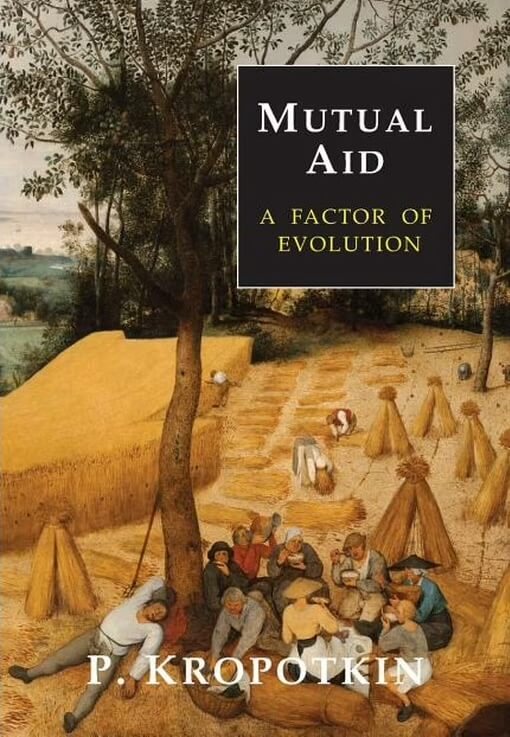
 The Spring 1985 Newsletter of the E. F. Schumacher Society (now the Schumacher Center for a New Economics) began with Peter Kropotkin’s theory of change and then went on to describe our commitment to an economics informed by place and our work to put theory into practice. Excerpts are copied below for your review.
What we wrote in 1985 still describes the Schumacher Center today. We have been consistent:
- Collecting, cataloguing, and celebrating the rich history of decentralist economic thought stewarded in the Schumacher Center’s research library.
- Widening the application of practical programs here in the Berkshires in partnership with Berkshire Community Land Trust, BerkShares Local Currency, and others.
- Sharing stories of implementation in communities around the world and facilitating networking via our Community Land Trust Directory and Local Currencies Directory.
- Recognizing the diverse cultural and spiritual traditions that are informing the development of new economies as highlighted by speakers in the Schumacher Lecture series and at other public events.
Over the next two years the Schumacher Center’s board will explore a bold expansion of our multi-faceted educational programming. They are pondering the question, “What form of education is called for in the future?” Some early indications: place-based/place-informed while simultaneously deepening collaboration with other regions; training and accrediting a whole community in a bioregional approach to regenerating their economy, rather than focusing on formal certification of individuals; highlighting the role of song and dance and ceremony in shaping thriving communities and economies.
Consistency sustained by dynamic reimagining. Please join in leveraging the Schumacher Center’s forty-five-year legacy programs into effective agents of change for times ahead.
Checks should be mailed to Schumacher Center, 140 Jug End Road, Great Barrington, MA 01230. To donate stock or crypto, email requesting transfer instructions: accounting@
It is hope, not despair, which makes successful revolutions.
Many good wishes,
Susan Witt, Executive Director
Board of Directors: Kali Akuno, Agatha Bacelar, Jodie Evans, Paul Fletcher-Hill, Alex Forrester, Tony Hernandez, Brooke Lehman, Alice Maggio, Matt Stinchcomb, Severine von Tscharner Fleming, and Sebastian Wood
Advisory Board: Peter Barnes, Wendell and Tanya Berry, Merrian Boregson, David Boyle, Eric Harris-Braun, Michelle Long, Otto Scharmer, and Judy Wicks
From the Spring 1985 E. F. Schumacher Society Newsletter
Socialist papers have often a tendency to become mere annals of complaints about existing conditions. The oppression of the laborers in the mine, the factory, and the field is related; the misery and sufferings of the workers during strikes are told in vivid pictures; their helplessness in the struggle against employers is insisted upon: and this succession of hopeless efforts, related in the paper, exercises a most depressing influence upon the reader. To counterbalance that effect, the editor has to rely chiefly upon burning words by means of which he tries to inspire his readers with energy and faith.
I thought, on the contrary, that a revolutionary paper must be, above all, a record of those symptoms which everywhere announce the coming of a new era, the germination of new forms of social life, the growing revolt against antiquated institutions. These symptoms should be watched, brought together in their intimate connection, and so grouped as to show to the hesitating minds of the greater number the invisible and often unconscious support which advanced ideas find everywhere, when a revival of thought takes place in society. To make one feel sympathy with the throbbing of the human heart all over the world, with its revolt against age-long injustice, with its attempts at working out new forms of life — this should be the chief duty of a revolutionary paper. It is hope, not despair, which makes successful revolutions.
— Peter Kropotkin, MEMOIRS OF A REVOLUTIONIST, 1899
BIOREGIONAL ECONOMICS
Fritz Schumacher argued that from a truly economic point of view, the most rational way to produce is “from local resources, for local needs.” Jane Jacobs, speaker at the Third Annual E.F. Schumacher Lectures, re-emphasized Fritz’s point through her analysis of a healthy region as one creating “import replacing” industries on a continuing basis. A fully developed regional economy, producing for its own needs, is only possible, however, when control of resources and financing lies within the region itself. At present, ownership of land, natural resources and industry, and determination of conditions for receiving credit, have become increasingly centralized at the national level. As a result, all but a few large urban areas find that major control of their economic resources is foreign to the area.
This situation calls for a reorganization of economic institutions so that they are responsive to regional needs and conditions. These new economic structures will, by their very form, decentralize access and control of land, natural resources, industry and financing in an equitable manner among the people living in an area, so creating the infrastructure to facilitate full local production for local needs.
These considerations constitute the economic rationale for the development of community land trusts, worker owned and managed businesses, non-profit locally-controlled banks and regional currencies. Regional economies cannot be expected to flourish until all of these new, broadly democratic forms are implemented within each region, and the old centralized forms are in decline.