Our reading of the study guide, “Small is Beautiful Revisited…50 Years On“, revisiting Fritz Schumacher’s 1973 landmark text in light of our own time, draws to a close. The guide is a reflection of the deep affection its author, David Boyle, had for Schumacher and the new spirit he brought to the field of economics. (Each chapter guide is available on our site in addition to a full downloadable PDF.)
Chapter 19, the book’s final chapter, outlines a path of gradual reform for the ownership of industry. Contrasting against the polarities that predominated the early 20th century—private ownership versus public ownership—Schumacher is instead interested in a plurality of means of transforming ownership beyond a narrow focus on profits. The Chapter upholds the Scott Bader Commonwealth from the U.K. as a model for a transition of ownership from shareholder supremacy to democratic governance and stewardship.
Excerpts from the Guide to Chapter 19
J. K. Galbraith has spoken of private affluence and public squalor. It is significant that he referred to the United States, reputedly, and in accordance with conventional measurements, the richest country in the world. How could there be public squalor in the richest country, and, in fact, much more of it than in many other countries whose Gross National Product, adjusted for size of population, is markedly smaller?”
— E.F. Schumacher, the opening lines of the final chapter
“We do not yet know what combination of social forces brought down the Berlin Wall, and the de-legitimatized communist structures in Eastern Bloc countries. Maybe similar forces will de-legitimatize the unacceptable faces of capitalism and exploitation. I would like to believe that the forces developing trusteeship principles will be paramount in transforming industrial society in the next century.”
— Godric Bader, Scott Bader Commonwealth, in the 25th anniv. edition (1999).
This final chapter is far more practical than the rest of them – because it looks at one proposal which Schumacher believes has the capacity to change the world for the better: the Scott Bader Commonwealth.
What the Chapter Says…
Schumacher starts the chapter by posing a number of rhetorical questions:
“If economic growth to the present American level has been unable to get rid of public squalor – or, maybe, has even been accompanied by its increase – how could one reasonably expect that further ‘growth’ would mitigate or remove it? How is it to be explained that, by and large, the countries with the highest growth rates tend to be the most polluted and also to be afflicted by public squalor to an altogether astonishing degree? If the Gross National Product of the United Kingdom grew by, say, five per cent… could we then use all or most of his money, this additional wealth, to fulfill our nation’s aspirations?”
“Assuredly not,” he says explaining that all the wealth, as it arises, gets snaffled off privately by the owners. So much so that their public authorities have hardly any income of their own:
“Wealth, as it arises, is immediately reduced to extracting from the pockets of their citizens monies which the citizens consider to be rightfully their own.”
The rest of the chapter is concerned with making this distinction clearer:
“…In this matter of private ownership the question of scale is decisive. When we move from small-scale to medium-scale, the connection between ownership and work already becomes attenuated; private enterprise tends to become impersonal and also a significant social factor in the locality; it may even assume more than local significance. The very idea of private property becomes increasingly misleading.”
This leads to what he calls an “endless battle of wits between tax collectors and citizens, in which the rich, with the help of highly paid tax experts, normally do very much better than the poor. In an effort to stop ‘loopholes’ the tax laws become ever more complicated and the demand for —and therefore the income of — tax consultants becomes ever larger…”
Schumacher is at least clear-sighted enough to understand that “’More taxation for more public expenditure’ would not be a vote-catching slogan in an election campaign, no matter how glaring… the discrepancy between private affluence and public squalor.”
He also sees clearly that a great deal of public spending helps business in particular:
“It is not merely a question of public squalor, such as the squalor of many mental homes, of prisons, and of countless other publicly maintained services and institutions; this is the negative side of the problem. The positive side arises where large amounts of public funds have been and are being spent on what is generally called the ‘infrastructure’, and the benefits go largely to private enterprise free of charge… The truth is that a large part of the costs of private enterprise has been borne by the public authorities – because they pay for the infrastructure and that the profits of private enterprise therefore greatly overstate its achievement.”
The Scott Bader Commonwealth
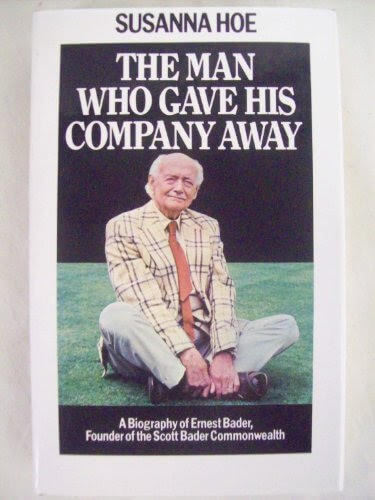
Originally Swiss, Ernest Bader launched Scott Bader Co Ltd in 1920, at the age of thirty, together with his wife Rose Scott. By 1951, he had a “prosperous medium-scale business employing 161 people, with a turnover of about £625,000 a year and net profits exceeding £72,000. Having started with virtually nothing, he and his family had become prosperous.”
The Scott Bader company was by then established as a leading producer of polyester resins and also other sophisticated products.
The young Bader had “resented the very ideas of a ‘labour market’ and a ‘wages system’, and particularly the thought that capital employed men, instead of men employing capital,” says Schumacher:
“Finding himself now in the position of employer, he never forgot that his success and prosperity were the achievements not of himself alone but of all his collaborators and decidedly also of the society within which he was privileged to operate.”
He knew that no major change could be made without two things:
- “A transformation of ownership – mere profit-sharing, which he had practised from the very start, was not enough.”
- “The voluntary acceptance of certain self-denying ordinances.”
For the first, he set up the Scott Bader Commonwealth in which he handed over 90 per cent of the company in 1951 (the final ten per cent he gave in 1963).
For the second, he agreed with his former employees to draft a constitution to define the distribution of the power which private ownership implies, and to impose the following restrictions on their freedom of action in the future:
- The company should not grow beyond 350 people. If it looked likely to do so, then they would set up new, independent units, organized along the lines of the Scott Bader Commonwealth.
- The pay gap between the highest and the lowest paid should never go beyond a ratio of 1:7, irrespective of age, gender, function or experience.
- Since members of the Commonwealth are partners and not employees, they can’t be dismissed by their co-partners for any reason other than gross personal misconduct.
- The Board of Directors of the firm, Scott Bader Co Ltd, should be fully accountable to the Commonwealth. Under the rules laid down in the constitution, the Commonwealth has the right and duty to confirm or withdraw the appointment of directors and also to agree how much they should be paid.
- A maximum of 40% of the net profits of Scott Bader would be taken by the Commonwealth — at least 60% would be kept by the company for taxation and self-financing. The Commonwealth would devote half of its share for paying bonuses to members, and the other half to charitable purposes outside Scott Bader.
- None of their products would be sold to anyone known to use them for war-related purposes.
Schumacher then tells the story:
“When Mr Ernest Bader and his colleagues introduced these revolutionary changes, it was freely predicted that a firm operating on this basis of collectivized ownership and self-imposed restrictions could not possibly survive. In fact, it went from strength to strength, although difficulties, even crises and setbacks, were by no means absent.”
Between 1951 and 1971, it had increased its annual sales to £5 million and net profits had grown to nearly £300,000 a year. By then staff had also increased to 379 and they had set up a number of new companies.
“And yet… although Mr Bader’s quiet revolution should be ‘generally acceptable to the private sector of industry’, it has, in fact, not been accepted. There are thousands of people, even in the business world who look at the trend of current affairs and ask for a ‘new dispensation’. But Scott Bader —and a few others— remain as small islands of sanity in a large society ruled by greed and envy.”
CONTINUE TO “WHAT HAPPENED NEXT?”
In “What Happened Next?” David Boyle brings us up to date on the success of the Scott Bader Commonwealth since 1973. Then, he adds another story, that of Ricardo Semler, who turned the struggling manufacturing firm Semco “upside-down” through worker self-management, resulting in it becoming among Brazil’s most successful companies.
To explore more deeply the themes of this chapter in our own time, revisit our 2023 Schumacher Conversation Rethinking Ownership & Work: Shared Responsibility & Reward.
Many good wishes,
Staff of the Schumacher Center

Please join us in Great Barrington, MA on November 22nd at 3PM for the 45th Annual E.F. Schumacher Lecture, “The Promise of Bioregional Economies.” Samantha Power and Tyler Wakefield, key leaders in the contemporary Bioregional movement and Co-Founders of BioFi Project, will discuss strategies for financing the New Economy with Schumacher Center board member, Alex Forrester.