The Schumacher Center is pleased to share an update on our colleague Greg Watson’s work with the World Grid Project.
EIGHT BILLION SUSTAINABLE BILLIONAIRES
We are all denizens of the Universe—born from stardust forged in the aftermath of the Big Bang nearly 18 billion years ago. In that first moment, all matter was compressed into a infinitely tiny dense space called a singularity that triggered a spectacular expansion of spacetime. This unleashed unimaginably hot gases, which expanded outward, forming stars—the elemental forces of Nature’s “minimum inventory/maximum diversity” toolkit.
Our Sun, an unremarkable star in terms of size and luminosity, formed from a collapsing cloud of gas and dust. As it condensed and spun, a protoplanetary disk spread outward, eventually giving rise to our solar system. Earth, now 4.5 billion years old, emerged with its abundance of metals and other unique features shaped by its optimal distance from the Sun.
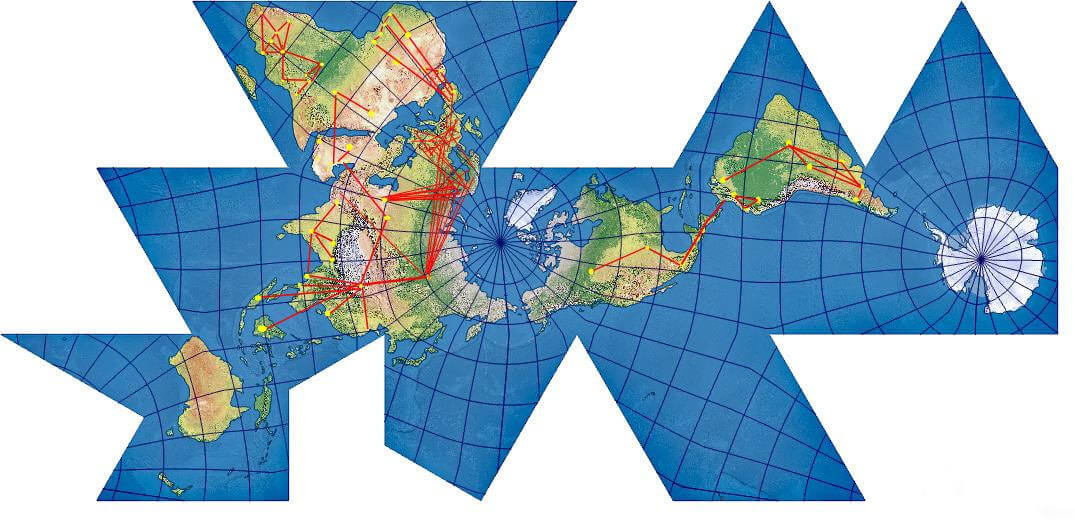
In its early days, Earth’s elements were concentrated within a single landmass—Pangea—surrounded by a vast ocean. Over eons, tectonic forces fractured this supercontinent, scattering resources around the globe. This random distribution laid the foundation for human ingenuity. Buckminster Fuller’s Dymaxion Map reveals what the conventional Mercator projection conceals: a single “island” of land encircled by one world ocean.
Life is thought to have emerged on Earth between 3.8 and 4.2 billion years ago. Since then, it has co-evolved with the geosphere, hydrosphere, atmosphere, and biosphere in complex, interdependent ways. Many of these synergetic interactions remain poorly understood—due in part to the compartmentalized structure of modern education. Geology, biology, oceanography, atmospheric science, and chemistry have long been taught in isolation, separated by the artificial walls of academic disciplines.
This fragmented approach frustrates efforts to grasp how Earth’s systems actually work—and obscures the options available to meet humanity’s collective needs. The origins of this obfuscation can be traced to early authoritarian regimes, where knowledge of Earth’s dynamics was closely guarded by elites. Real power resided not just in weapons, but in understanding the invisible architecture of nature.

These early “systems thinkers” were not concerned with serving the whole of humanity, but with preserving control for their rulers. Divide and conquer became their modus operandi.
And so, for most of human history aboard Spaceship Earth, most human passengers have struggled—largely unsuccessfully by today’s standards—to meet their basic needs.
A core assumption of this worldview was that resources were inherently scarce. Life was a zero-sum game: my survival at the expense of yours. Rulers, armed with privileged knowledge, became apex predators atop pyramids of social and material power—propped up by the labor of the many, harvesting Nature’s bounty for the few.
The formal theory of resource inadequacy was codified in the late 18th century. In 1798, Thomas Malthus, a professor at the East India Company College, published An Essay on the Principle of Population, based on his global travels sponsored by the Company. He observed that while population grows exponentially, food supply increases only linearly—a mismatch destined to produce famine, poverty, and social unrest.
Malthus’s grim calculus would later influence Charles Darwin, who drew from it the idea of a “struggle for existence,” forming a key tenet of natural selection in On the Origin of Species (1859). Together, Malthus and Darwin helped embed into modern consciousness the fear of inevitable scarcity.
Economists, following in their wake, tethered human well-being to the concept of economic growth. There remains, to this day, no chapter in mainstream economics devoted to “doing more with less.” The idea of ephemeralization—of increasing performance while reducing material input—remained largely unrecognized.
As Buckminster Fuller noted:
“There is no energy crisis. There is only a crisis of ignorance.”
In a 1974 New York Times op-ed, he elaborated:
All biological life on Earth is regenerated by star energy—overwhelmingly, by the Sun.
The Sun radiates omnidirectionally, and though Earth intercepts only two-billionths of its energy output, that sliver equates to approximately 66 septillion kilowatt-hours per year. If all humans consumed energy at the level of the 1973 United States standard (200,000 calories/day), only a tiny fraction of that solar income would be required.
Fuller concluded that humanity was aboard a spaceship powered by more than enough energy income to support every person as a billionaire— all eight billion of us.
Indeed, most incoming solar energy is reflected back to space or absorbed into non-human systems, such as ocean and atmospheric circulation. Only a tiny percentage is harnessed by humans—a sign, perhaps, not of inefficiency but of untapped potential.
Energy, Materials, and Human History
Humanity’s relationship with energy has been shaped by a mix of scientific insight, available resources, technological innovation, and environmental limits. Past energy transitions—such as from wood to coal—share familiar patterns.
A 1970 Scientific American article on the biosphere noted:
In England, the consumption of charcoal nearly exhausted the supply of trees before the technique of making coke from coal was developed. The blast furnace, fueled by coke, enabled iron production on an unprecedented scale.
This coal–iron synergy gave rise to the Industrial Revolution and transformed the global economy. Yet the transformation came with a hidden cost: vast quantities of climate-forcing gases released into the atmosphere. Political leaders, focused on short-term growth, deferred payment to future generations.
That bill is now due. Earth’s life-support systems are showing signs of stress.
Unbearable heatwaves. Record-breaking floods. Tornadoes carving paths through countrysides and cities. Forests ablaze for months on end. A pollinator crisis unfolding. An anthropocentric-driven mass extinction underway.
The transition to clean, renewable energy is no longer optional—it is imperative. This is the overwhelming scientific consensus. Tragically, it is not yet a political one.
Skeptics often point to the intermittency of solar and wind energy as a fatal flaw. But two parallel, emerging solutions offer a compelling response.
The World Grid Vision
Buckminster Fuller, as early as the 1960s, proposed a globally interconnected electric grid—powered by renewables and spanning the planet. Inspired by his Dymaxion Map, which depicted Earth as one island in one ocean, Fuller saw such a grid as a pathway to world peace and shared prosperity. The final engineering hurdle was the Bering Strait—a gap he believed could be economically bridged by high-voltage cable.
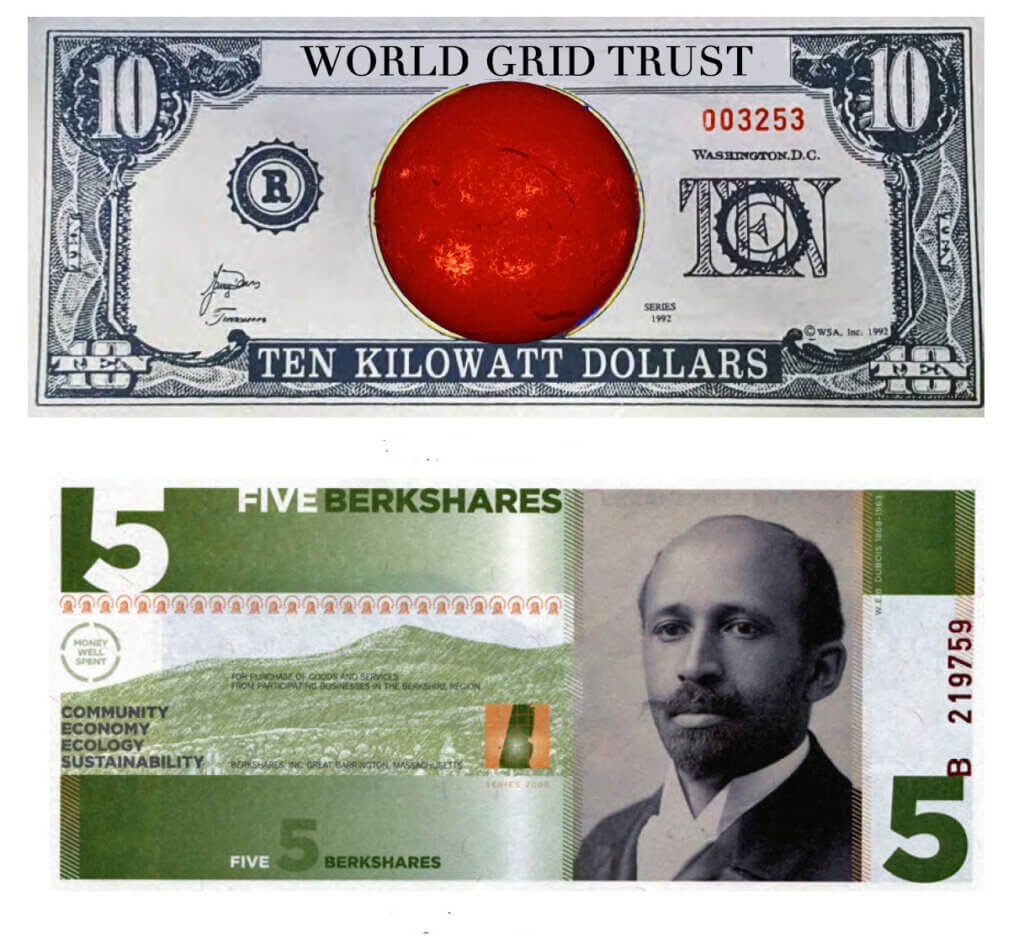
A global grid, he argued, would lead naturally to a world currency based on energy. This energy-based global currency, in tandem with local scrip, would render national currencies obsolete. With all regions interconnected, supply and demand could be balanced globally. Operationally, it would then be accurate to say:
The sun is always shining, and the wind is always flowing.
At the regional level, cross-border electric trading is already taking shape. Countries are beginning to connect their grids—not as acts of altruism, but as tangible, practical steps toward energy security, sustainability, and economic fairness.
These regional partnerships may not identify as part of a “world grid,” but they are laying its foundation. For this vision to materialize, shared construction standards and cooperative governance frameworks must emerge. Unfortunately, most of these efforts are taking place almost entirely under the radar of both the traditional and social media platforms. Even in the countries where truly revolutionary and inspiring partnerships are being formed, reporting on them is often confined to industry trade journals and websites.
This is what inspired the creation of the Geographies of Cooperation — a global atlas highlighting the formation of energy collaborations around the world in response to the climate crisis. I’m committed to exposing this silent revolution both as a source of inspiration but also to prepare the public, elected official and policy makers for what is at stake. How the world will be changed when the energy transition is in full swing.
Many of the partnerships defy conventional geopolitical wisdom and suggest that the old way of conducting business and building alliances are no longer relevant. Indeed, it is not an exaggeration to suggest that the climate crisis – and its solutions – are in the process of shaping a new world order. One in which an emerging infrastructure networks and nodes are poised to significantly redistribute energy and political power in truly revolutionary ways.
Defenders of the status quo do not accept this vision/scenario and, instead espousing the virtues of energy independence and isolationism supported by policies designed to revise and grow the legacy fossil fuel and manufacturing industries within their borders. This includes the United States that, under the leadership of the current U.S. Administration has been withdrawing financial and institutional support for and participation in activities having anything to do with the Paris Agreement.
Meanwhile, “middle power” countries in Africa, Europe, South and Southeast Asia, the Middle East, and South America are filling the vacuum and taking the lead in advancing cross-border electricity trade and electric grid integration as part of their commitment to reduce greenhouse gas emissions and – in the process — create vibrant 21 st century economies that provide every citizen with access to clean electricity – a critical step towards eradicating poverty while restoring climate stability. They are convinced that success can be realized without the participation of the United States. But there are, of course, no guarantees.
With this Atlas we hope to contribute to informing the public, policymakers, activists and elected officials of these historic displays of “spontaneous cooperation” driving the energy transition – what’s working and what challenges they face — and support their efforts as if our lives depend on it.
Greg Watson
World Game Workshop
World Grid Project