John McClaughry was an original incorporator in 1980 of the E.F.Schumacher Society, now the Schumacher Center for a New Economics. John’s personal friendship to Robert Swann, our co-founder, goes back even further; he was instrumental in securing a planning grant in 1967 from a federal agency for New Communities in Albany, GA, the first Community Land Trust.
John was described in Politico as “a key player in Vermont political circles, a conservative thought leader…[and] a thorn in the side of the left — and, on occasion, the right.”
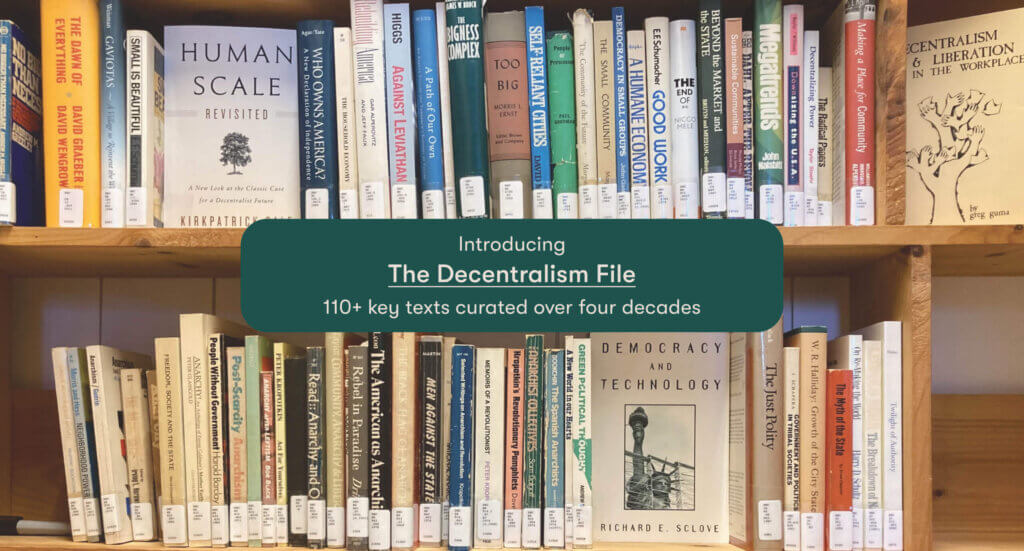
For over four decades, John has been curating key texts on the concept of decentralism: making broadly representative selections, soliciting input, and introducing each piece within in the body of literature. Many of the names included—Hume, Huxley, Madison, Kohr— are canonical. Many others, spanning the mid-twentieth century to our present day, are little-known gems unearthed for due appreciation.
With over 110 entries spanning the classical world to our present decade, this body of work now has a permanent home with the Schumacher Center. The texts are accessible to readers and researchers on our website. The message below is excerpted from the Foreword, provided by John.
View the Decentralism File.
From the Foreword
In 1973, the Anglo-German economist E.F. Schumacher popularized the idea of “decentralism” in his seminal book Small is Beautiful: Economics as if People Mattered. Following his untimely death, organization of a Schumacher society in the UK followed in 1978, and a US counterpart in 1980. The aim of both was to sponsor a series of lectures by thinkers and writers whose work related to Schumacher’s theme. The US society was the work of Robert Swann, Susan Witt, David Ehrenfeld, Kirkpatrick Sale, Ian Baldwin and myself…
From the mid- Seventies, I had discovered in my reading numerous works that I thought fell under the broad title of “decentralism”. I noted the titles, put together summaries on cards, and carelessly tossed articles into file boxes to be dealt with later on…
For over 25 centuries, the idea of a peaceful human-scale, ecologically respectful society has persisted in the face of a long train of conquerors, monarchs, god-kings, despots, war lords, and other authoritarians committed to the consolidation of many or all of the functions of human communities under their centralized management and control. Unfortunately, much of this history has been written about the centralizers, while the more humane voices of the decentralists have been ignored or lost.
The purpose of the Decentralism File is to bring to the modern reader a selection from the writings of advocates in the decentralist tradition, beginning in Lao-Tzu’s China of 550 BC, and continuing through a wide range of cultures and eras into the present day.
The expected appeal of this work is to the people who are developing a consciousness of and desire for a decentralist model for creating a good, peaceful, secure and just society…
The File presents a large number of relatively brief selections— an heuristic guide, rather than an encyclopedia. Selections have been chosen to illustrate a wide range of approaches, issues, subject matters and— within the limits of availability in English —world cultures. Each selection includes a brief explanatory introduction about the author and his or her career and circumstances. The references will guide the interested reader to the original works of those authors (many of which may be found in the Schumacher Center’s Library collection).
My working definition in this Decentralism File is this: “Decentralism” describes a mindset or belief system that favors reversing the centralization of power from institutions or systems grown too big, too oppressive, too costly, too unresponsive, too environmentally dangerous, and too inefficient for the creation and preservation of a good, peaceful, secure, sustainable and just society. At the core of decentralism is the principle of maximizing, so far as possible, the sense of belonging and efficacy among a population: the feeling that “what I do, in cooperation with others, can make a positive difference”, whether in governance, economic activity, human welfare, technology, environmental protection, or spiritual renewal.
We invite you to explore the Decentralism File and make use of this new resource. View the Decentralism File.
John formally handed stewardship of the Decentralism File over to us this Saturday at our Annual E.F. Schumacher Lecture in Great Barrington, featuring Alfa Demmellash and Alex Forrester.