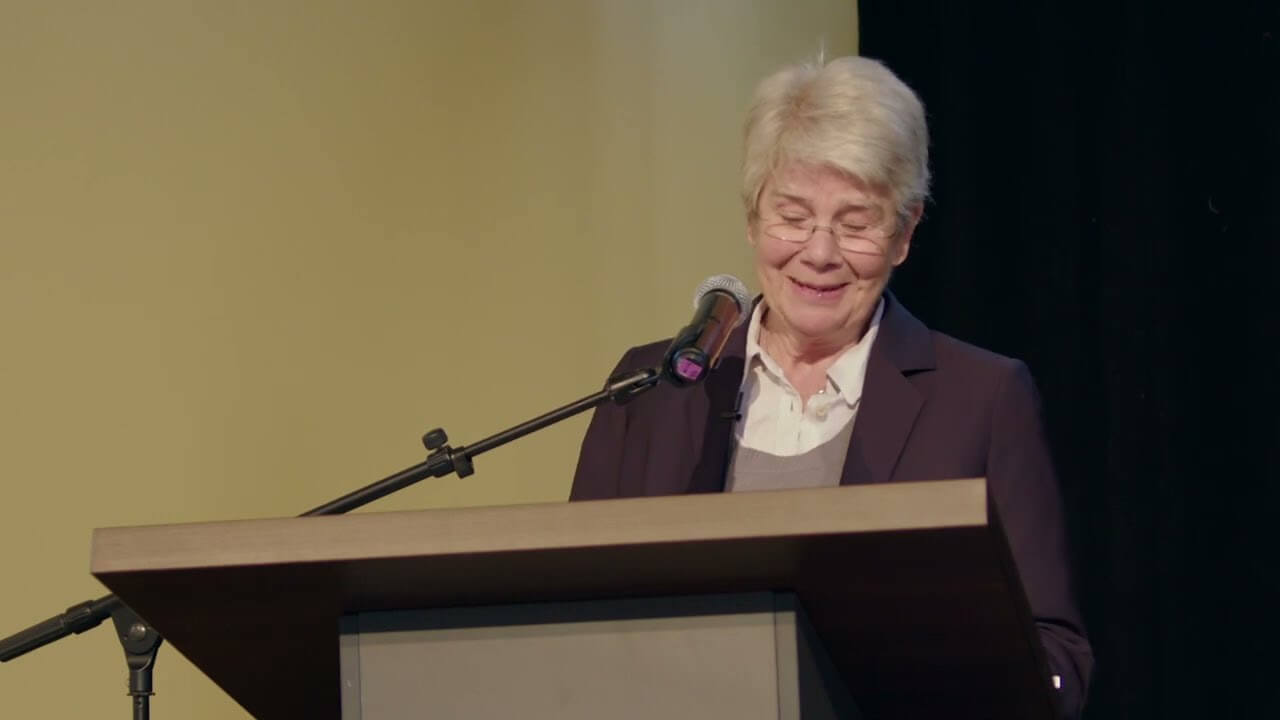
We are pleased to share a newly published lecture on our website: “Schumacher Revisited: Challenge, Courage, and Change.”
In her Annual Robert Swann Lecture, Barbara Wood, E. F. Schumacher’s daughter, revisits her father’s life and work through the lens of his final book, A Guide for the Perplexed.
While Small is Beautiful remains Schumacher’s best-known work, Wood’s lecture invites us to see A Guide for the Perplexed as the spiritual and philosophical foundation beneath the earlier work. Before his death, Schumacher himself described this late book as “what my life has been leading up to.”
Wood begins her remarks with an intimate family memory: Schumacher’s final days, his last words to his children, and the challenge his daughter felt in trying to understand why he considered A Guide for the Perplexed the fulfillment of his life’s work. From there, her talk turns into a broader reflection on the inner work required if we are to build economies “as if people mattered.”
She writes:
“Many people have said that Small is Beautiful expressed things that they were feeling but were unable to articulate.”
She goes on to suggest that Small is Beautiful cannot be fully understood apart from A Guide for the Perplexed. The first offers a practical vision for economics, technology, work, and community. The second asks the deeper questions that make such a vision possible: what does it mean to be human? What kinds of knowledge are needed to live rightly? What happens when scientific and material knowledge are treated as the only forms of truth?
“A Guide for the Perplexed is concerned with the inner work we need to do so that we can clearly understand what it means to be human.”
One of the most powerful themes of the lecture is that Schumacher did not arrive at these convictions easily. As a young man, he was a scientific materialist, a conventional economist, and a believer in large-scale organization and international trade. The devastation of World War II forced him to rethink everything.
Schumacher later wrote of that turning point:
“New possibilities of knowledge (and experience) have been opened to me of whose existence I had no inkling. I feel as men during the Renaissance must have felt. All the conclusions I had come to have to be thought through again.”
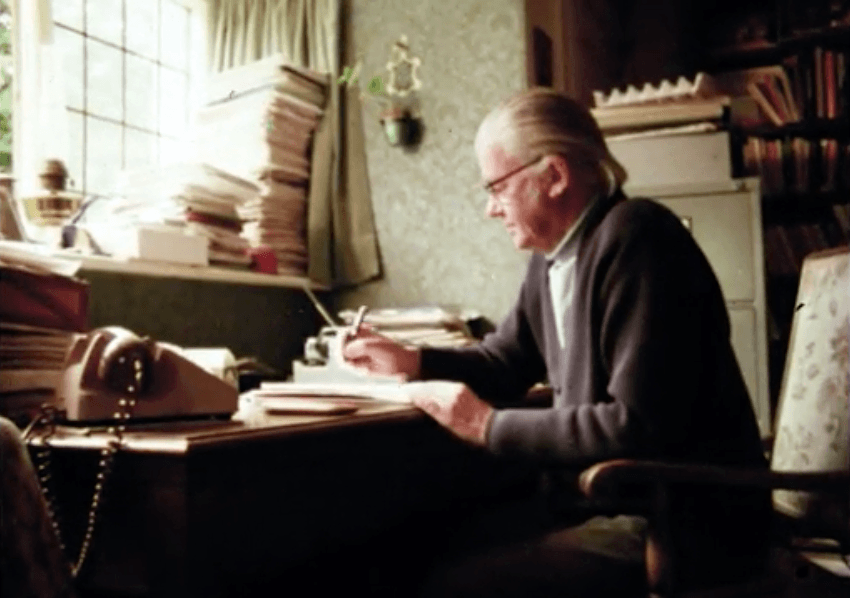
Wood presents this willingness to rethink everything as an act of courage. Schumacher’s later work emerged not from theory alone, but from a difficult process of change–a movement from the intellectual toward what he came to understand as the wisdom of the heart.
This is why, for Schumacher, economics, education, technology, and spiritual life could not be separated. As the lecture explains, Small is Beautiful is rooted in the belief that “human life has meaning and that the purpose of human life is to become fully human.”
The lecture ends by returning to one of the most enduring questions in Small is Beautiful: what can we actually do? Schumacher’s answer was simple:
“We can, each of us, work to put our inner house in order.”
We invite you to read Barbara Wood’s full lecture and through it come to understand E.F. Schumacher not only as an economist, but also as a father, a spiritual practitioner, and a man with the courage to change.
Read the lecture here.
Warm Wishes,
Staff of the Schumacher Center