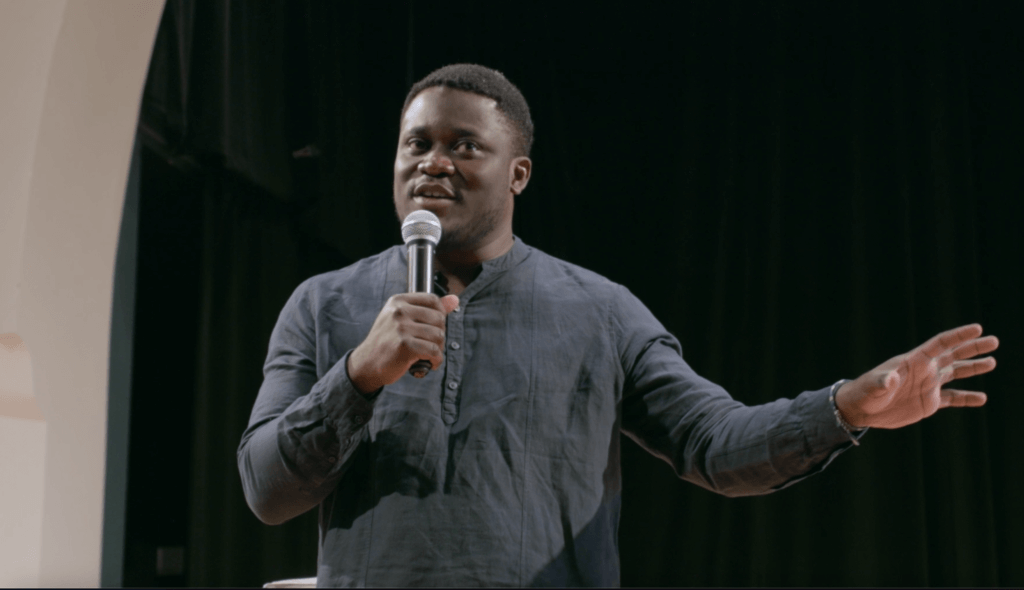
On the 28th of April, the Schumacher Center hosted Bayo Akomolafe, author, activist and Executive Director of the Emergence Network, for a talk in Great Barrington. From the outset, as he invited this Berkshire audience to “grace and ritualize” their beginning by sharing hugs with those around them, it was clear that Bayo meant to lead them on an unconventional journey. Over a spell-binding 90 minutes, the speaker did not disappoint.
A recording of the lecture and subsequent Q&A was made available earlier this year, and is now accompanied by a full transcription on our website.
Highlights From the Talk
A few memorable quotes offer glimmers of Bayo’s ruminations on racial justice, freedom, and the search for a different kind of politics in the anthropocene.
On the Meaning of Post-Activism
What I mean by post-activism, long story short, is the flashing up of loss and the space it opens up…..there’s a sense in which as our senses get expanded and as our bodies take on new shapes, and as things stream into our spaces that we’ve once defined as private, the thing to do is to share it with others, and create a commonwealth of bewilderment together where we fall apart together. And somehow that opens doorways, I suspect.
Pandemic, virus… Suddenly new questions just came up. I don’t know what it did for you, but there is a flashing up of loss. That flashing up of loss is the loss of white stability, and it’s inviting us to bow to the ground.
In our stories in Yoruba land, when a god passes, you don’t challenge the god, especially the god of the storm, Shango. You fall down and you prostrate yourself to the ground. It’s a form of surrender. We don’t have a politics of surrender. We have a politics of victory and we need politics that is designed to enable us to cultivate surrender together.
On “Whiteness” as a Worlding Process
Let me just take a step back, literally, and say when I speak about whiteness, I don’t speak about white people…Whiteness is not ‘white people’ because ‘white people’ were also captured by whiteness. Whiteness is a social material arrangement that also took bodies, and takes bodies, and uses those bodies for a worlding process…
What we’re inviting here is to break away from those ideas and, in the Rumian sense, to meet ourselves in fields that are beyond right or wrong, and are doing other things with the world.
On the Emancipatory Potential of Surrender
Whiteness renders things useful, instrumental to its aims. Whereas we’re looking for a non-legible politics, a politics that is not defined… Where we have to gather together as guerilla actors of a politics that has not yet had a name. We’re all midwifing something and we don’t know what it is, but we stay together in the unspeakability of that moment… And then we can meet each other for the first time.
Finally, whiteness offers hope. Think about what hope is to those ants in the cycle. Just keep going, just keep going… And then we get stuck.
There is a sidling, emancipatory, fugitive logic to surrender that hope has no way to articulate. There is something that wants to happen when we say, “I don’t know if we’re going to make it.” And then we’re met differently
… If we take it for granted that there are other worlds possible, then I’m not speaking about a bypass. I’m speaking about an invitation to disturb what we already know and to do something else with the world.
If you find Bayo’s message timely and inspiring, we hope you’ll share generously.