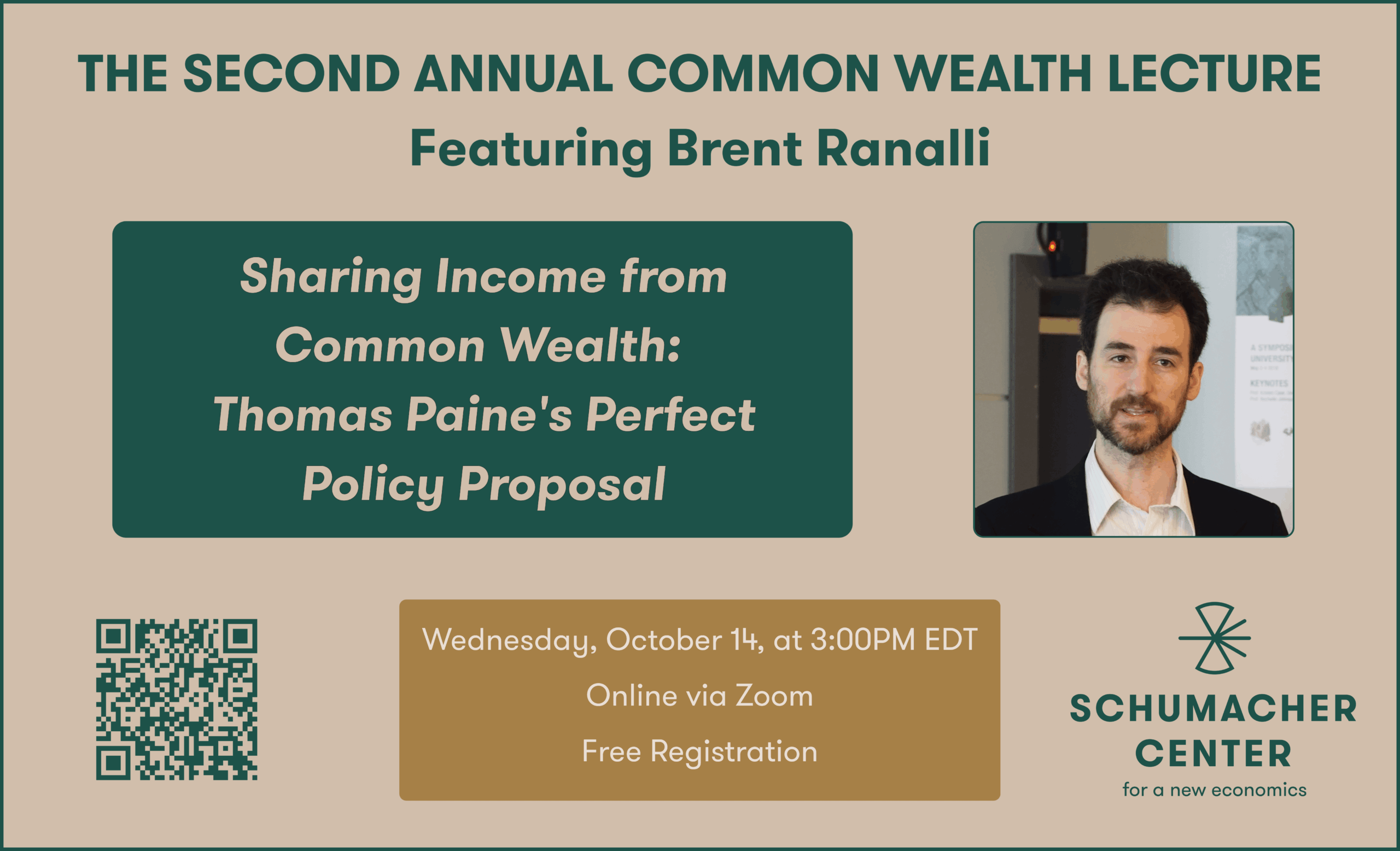
On Wednesday, October 14th at 3PM EDT, Brent Ranalli will deliver the 2nd Annual Common Wealth Lecture, titled “Sharing Income from Common Wealth: Thomas Paine’s Perfect Policy Proposal.” The event will take place online via Zoom and is free to join.
WATCH THE RECORDING
About the lecture:
In 1797, Thomas Paine, hero of the American and French revolutions, published his last major pamphlet, Agrarian Justice. For thousands of years, sedentary societies had been racked by poverty, discontent, and violent upheaval thanks to unequal access to land. Redistribution of land had been a common cry of reformers and revolutionaries throughout that history—but even when such reforms succeeded against odds, conditions always deteriorated again. In this short essay Paine offers a simple and brilliant solution. It is not necessary to redistribute the land itself, he says. It is sufficient to redistribute wealth that flows from the land. Paine proposed a tax, a trust, and universal dividends. Common wealth dividends would ensure that every citizen can enjoy a fair share of the bounty of the Earth that is their birthright.
Paine’s pamphlet fell on deaf ears in the 1790s and then fell into obscurity. But his solution was too good not to be rediscovered or reinvented by others—and it was, at least three times. In the late 1800s, American journalist and political economist Henry George came up with a very similar program of land reform. In the 1970s, Governor Jay Hammond led the creation of the Alaska Permanent Fund to share Alaska’s oil wealth with all residents of the state. In the 1990s, entrepreneur and futurist Peter Barnes envisioned a Sky Trust to cap carbon emissions and share the wealth generated by permit sales—and invented the concept of carbon dividends that is central to climate policy debates today. Each of these three schemes was developed independently, but each of them recapitulated Paine’s logic. And each one, arriving at Paine’s solution from a different angle, offers us new insight into what makes Paine’s proposal so advantageous. This talk offers a tour of the many lives of Paine’s perennial, and quite nearly perfect, policy proposal.
Brent Ranalli is an environmental policy professional and an intellectual historian who has written extensively about Paine’s Agrarian Justice and common wealth dividends. His 2021 book Common Wealth Dividends: History and Theory (Palgrave Macmillan) was awarded an honorable mention in 2023 by the Rutgers Institute for the Study of Employee Ownership and Profit Sharing, and the book has been translated into Korean.
About the Common Wealth Prize
By Peter Barnes
The two giant, tragic flaws of capitalism are that it inexorably destroys nature and widens inequality among humans. More than a century of attempts to fix these flaws through public policy have not succeeded. The purpose of the Common Wealth Prize is to spotlight another way to make markets work for nature, future generations, and all living persons together. That way is to protect and properly manage the multiple assets we inherit together and have a responsibility to pass on, undiminished, to future generations. In other words, it is to protect and share our common wealth at all scales.
E.F. Schumacher was one of the first economists to identify natural and social capital as massive but unrecognized contributors to human well-being. Common wealth is the sum of those two large troves of capital. What unite all these assets are two important qualities: they are gifts from either nature or our ancestors, and they rightfully belong to everyone together, to be held in trust for future generations. Which is hardly the way markets treat them today.
What is to be done about this?’ Schumacher didn’t answer that question fully, but he pointed in the right direction. “The market represents only the surface of society,” he wrote in Small is Beautiful. “Neither buyer nor seller is responsible for anything but himself.” What’s missing, he said, is a set of ‘goods’ that have ‘not been privately appropriated, but are nonetheless essential to all human activity.’
Practically speaking, this means we need new property rights and ownership structures that assure that our common inheritances are priced properly in markets and that their benefits flow to everyone equitably. This may not sound like a big deal, but if it were done at scale it would have massively beneficial effects. Most notably, we’d wind up with science-based limits on human disturbance of nature, along with a steady stream of income for all humans.
Fortunately, there’s a small but growing group of visionaries that is pointing the way along this path. The Common Wealth Prize will recognize these visionaries and promote their ideas in the coming years, starting today. I thank E.F. Schumacher for lighting the torch and the Schumacher Center for carrying it forward.
We hope you will join us to learn about this innovative proposal for stewarding our collective commons.
Warm Wishes,
Staff of the Schumacher Center