We are pleased to share a newly published lecture by economist James K. Boyce, introduced by entrepreneur, author, and environmentalist Peter Barnes. The lecture was delivered on the occasion of Boyce receiving the inaugural Common Wealth Prize, established by Barnes to recognize thinkers who are developing practical ways to protect our shared inheritance.
Barnes begins with a question that has guided much of his life: What is wrong with capitalism, and how can we fix it?
His answer is simple:
“To fix capitalism, add common wealth. The more the better.”
By “common wealth,” Barnes means the assets that we inherit collectively: the air, water, forests, and ecosystems that sustain life, as well as our legal and political systems, scientific knowledge, customs, and arts. Their value, he argues, far exceeds that of all private and government wealth. Yet because markets cannot readily see or measure this shared inheritance, they often treat it as if it were worthless.
On the other hand, he explains:
“If we treat our common wealth with respect and with legal protection…then markets would work differently. They would work much more as Schumacher and many others here would like markets to work.”
Barnes introduces James K. Boyce as one of the few economists in the U.S. to seriously explore the idea of common wealth at this time, specifically as it relates to the atmosphere.
Boyce begins his lecture with an insight from E. F. Schumacher’s Small Is Beautiful. Schumacher was critical not only of concentrated private ownership, but also of overcentralized state ownership. Drawing on the historian R. H. Tawney, he proposed another possibility: “the decentralized ownership of public property.”
Boyce asks whether this principle might allow us to imagine forms of property that are large in scope but widely and equally owned.
“Not big and centralized, but big and decentralized.”
Boyce argues that what is commonly called the “tragedy of the commons” is more accurately understood as a tragedy of open access. As David Bollier’s expansive work has long demonstrated, commons themselves can be governed carefully and successfully. The real danger arises when no meaningful structure of rights and responsibilities governs access to a shared resource.
This produces two connected tragedies. Nature is overused, and those with the greatest wealth capture a disproportionate share of its benefits.
Climate destabilization is perhaps the most pressing example. As Boyce argues, the atmosphere’s limited capacity to absorb greenhouse gases has been treated as an open-access resource, allowing fossil fuel companies and consumers to use it without paying the full ecological and social costs.
Yet efforts to correct those costs face what Boyce calls the price conundrum. Fossil fuels appear cheaper than they really are because their environmental costs are excluded from their market price. Raising their price, however, places pressure on regular households and can provoke strong political opposition.
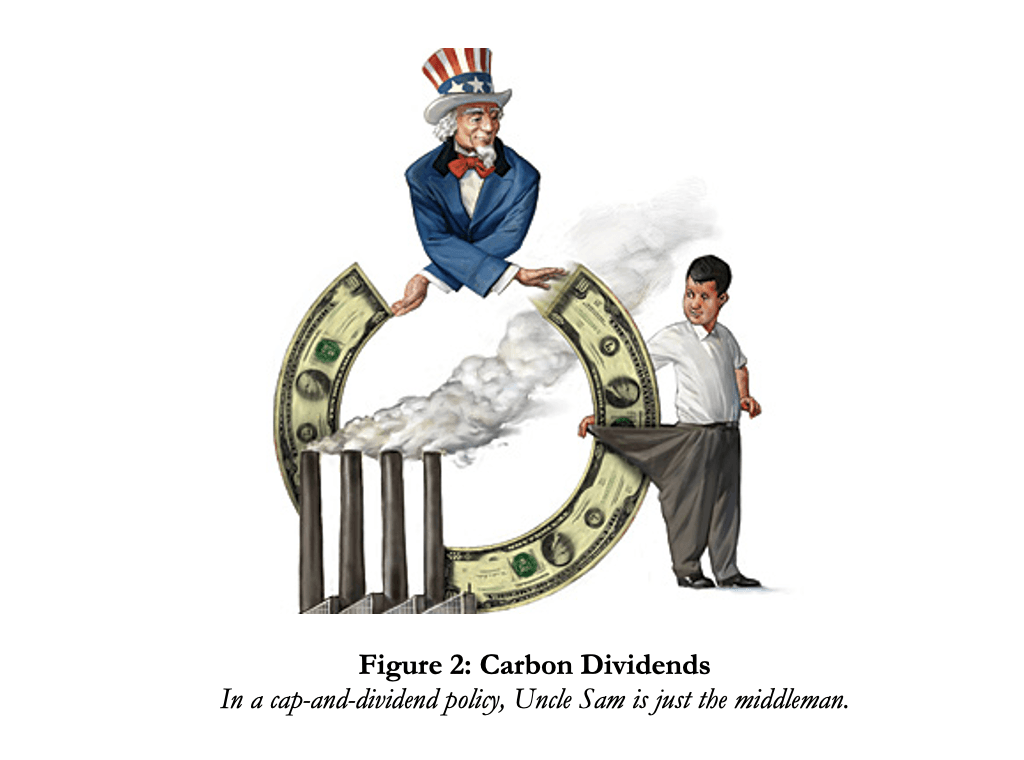
Boyce proposes carbon dividends as a way through this dilemma. Under such a policy, the supply of fossil fuels entering the economy would be steadily reduced. Permits would be auctioned to fossil fuel suppliers, and all of the revenue would be returned directly to the public in equal per-person payments.
The principle is simple:
“The limited carbon absorptive capacity of the biosphere belongs to us all in equal and common measure. It does not belong to corporations. It does not belong to the government.”
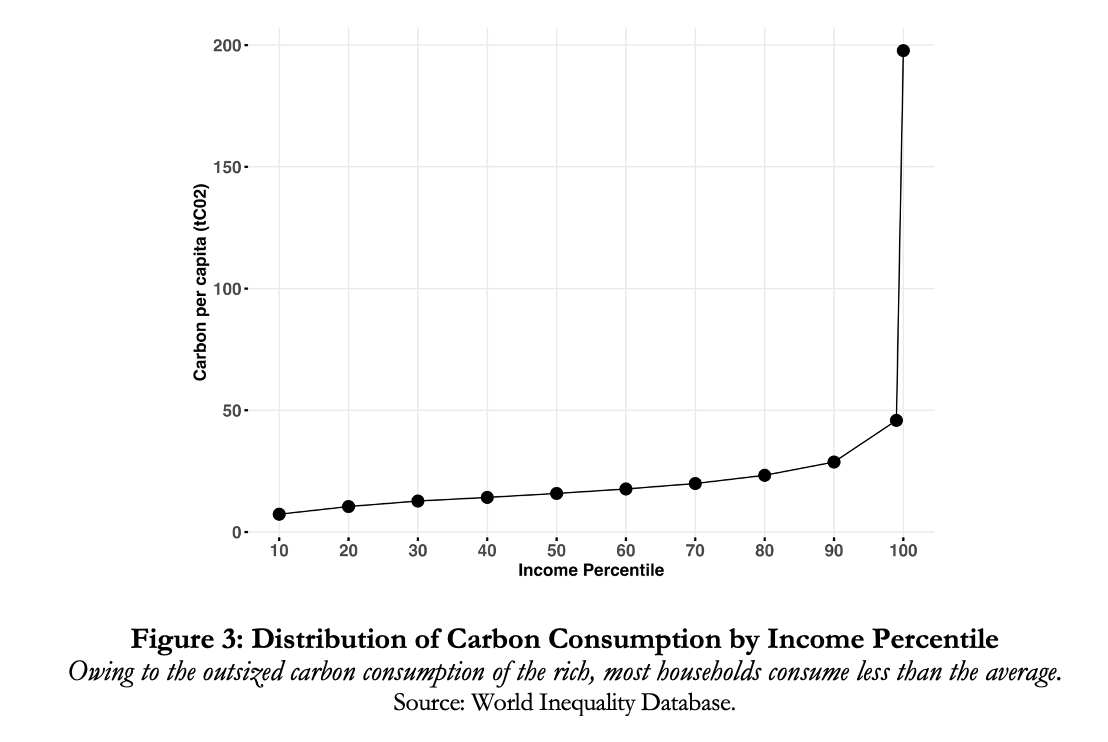
Because wealthier households generally have larger carbon footprints, most working families would receive more through the dividend than they would pay through higher fuel prices. The policy would therefore reduce emissions while also distributing income progressively.
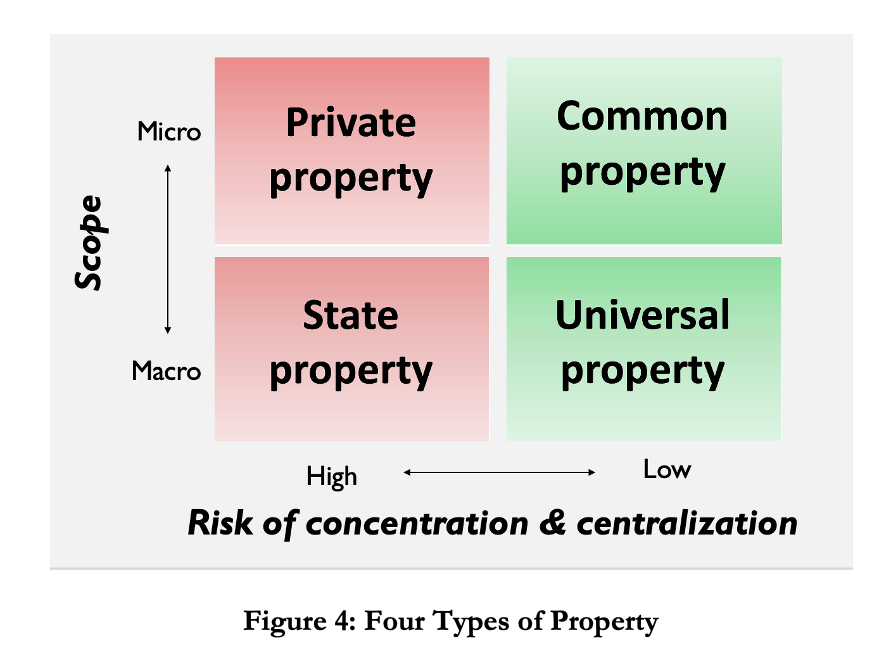
The lecture then places carbon dividends within a broader concept Boyce calls universal property. Universal property has three defining qualities. It is owned by individuals rather than corporations or governments; it is an inalienable birthright that cannot be sold; and it is perfectly egalitarian, with every person holding an equal share.
Universal property, Boyce argues, fills a missing space alongside private, state, and common property. It operates at the scale of society as a whole without concentrating ownership and power at the center.
This leads to another of Boyce’s key insights in the lecture. Our politics are generally described along a left-right axis, defined by the balance between state and market. Boyce suggests that another axis may be even more relevant: the continuum between democracy and oligarchy.
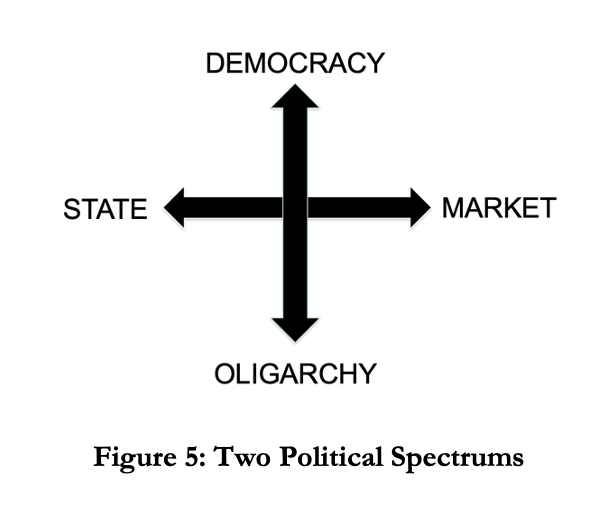
“The key issue is: are wealth and power concentrated in the hands of a few, or are they widely dispersed among the people?”
Universal property, Boyce proposes, could help build democracy directly into our system of ownership, protecting the natural world while ensuring that the benefits of shared assets flow equitably to everyone.
We invite you to read the full introduction and lecture on our website, or watch the live recording here.
Warm Wishes,
Staff of the Schumacher Center