We are pleased to share that the 45th Annual E. F. Schumacher Lecture, “The Promise of Bioregional Economies,” is now available to read, for free, on our website.
Delivered by Samantha Power and Tyler Wakefield of the BioFi Project, the lecture offers both a sobering reality check and a hopeful, generative vision for the future. Beginning from the complexity and confusion of the present moment—ecological breakdown, institutional decline, and technological acceleration—Samantha and Tyler ask what it might mean to respond not with panic, but with presence and place-based commitment.
At the heart of the lecture is a renewed argument for bioregionalism: the idea that economies, culture, and governance should be reorganized around the living systems of particular places. Drawing on E. F. Schumacher’s work on appropriate technology, the speakers expand the concept beyond tools and machinery to include the social, financial, educational, and spiritual “technologies” that shape human life.
As they write:
“We believe that bioregions are the right scale, bioregional economies are the right context, and bioregionalism is the right practice for developing and distributing the appropriate technologies that can catch us in periods of disruption, and serve as the soil from which life-affirming cultures grow.”
The lecture is especially powerful in its insistence that the work ahead is not simply technical. It is relational, cultural, ecological, and spiritual. Samantha and Tyler invite us to consider how food systems, land ownership, finance, healthcare, and work might all be redesigned to serve life within a bioregion.
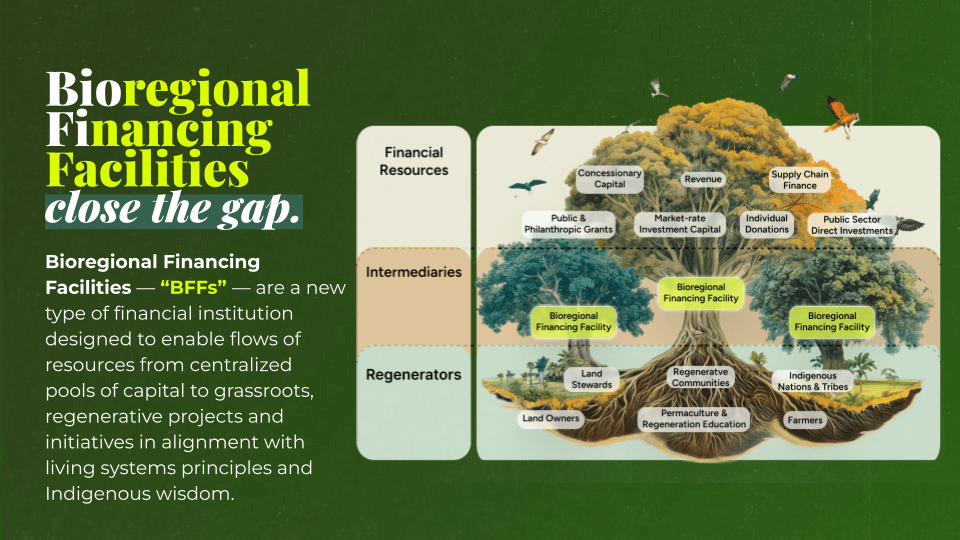
They also offer a practical survey of emerging tools and experiments already pointing toward bioregional economies, including Bioregional Financing Facilities, bioregional hubs, mutual credit systems, local currencies, community land trusts, Indigenous land return efforts, cooperative ownership structures, import replacement, gift economy hubs, and mutual aid networks.
Yet the lecture does not present bioregionalism as a finished blueprint. Instead, it frames the work as a practice of tending possibility. In a time of breakdown and transition, the speakers call for careful attention to the relationships, rituals, and forms of cooperation through which new worlds are made.

As the lecture closes:
“So let us be careful, very careful, not to assume we have the design blueprints all figured out… Rather, may we tend to possibility, together.”
We invite you to read the full lecture and gain inspiration for how you can tend to a more regenerative, equitable future in your bioregion.
Warm Wishes,
Staff of the Schumacher Center