I. Our Why?
Samantha
What an honor to be here. Thank you so much to Susan and the Schumacher Center for inviting us and all the organizing you did to make this day happen. We also want to thank our colleague Felix who worked over time this week to get us some very cool slides..
We are so happy to see so many friends, colleagues, and folks we haven’t met yet whom we look forward to meeting.
We’ll dive into the content of our lecture shortly, but before we do, we want to share ‘our why’ with you and all hold that together throughout our time today.
Our why is LIFE! We are here today in service to life on this sacred garden planet that all of us have been blessed to be born into at this crazy moment in time.
Our scientific understanding of life has been deeply informed and inspired by the work of the scientists Lynn Margulis, James Lovelock, Fritjof Capra, Humberto Maturana, and Gregory Bateson—among many others.
They describe life as a self-organizing, self-maintaining network of relationships that continuously transforms energy, matter, and information. They show us how life exists as a dynamic, interdependent process that thrives through cooperative symbioses that weave individuals into larger living systems across scales of space and time. They show us how it is creative, regenerative, and very mysterious..
We have chosen to dedicate our lives and the lifeforce flowing through each us—and our relationship—to birthing a life-aligned culture and life-aligned economies.
And THAT is what we will be sharing about with you today! However, we’re first going to take you on a bit of a journey that mirrors our own journey being with all the complexity, confusion, beauty, and possibility of the world today..
II. Reality Check—What is going on?
Tyler
This afternoon, we gather amidst a global, civilizational context that I believe many of us in this room have been working hard – perhaps over decades, perhaps in the past few years – to try and come to terms with – probably many, many terms actually. These might include:
- Polycrisis
- Metacrisis
- Breakdown
- Collapse
- Release phase of Holling’s Adaptive Cycle
- Runaway
- Decoherence
- Compost Heap
- Kali Yuga
- Pachakuti
- The Great Turning
- Summer’s end
- Nepantla
- Consequence
- Prophecies of the:
- Rising Waters
- Shifting Earth
- Spider Woman’s Web
- Seven Fires
- Time of No Fish
- White Buffalo
Anthropologists and bioregionalists alike can sometimes be heard saying that western English speakers, Americans in particular are so culturally impoverished! How we lack the dozens of words for snow like the Inuit, or all those the Hopi have for varieties of corn, or the 96 words for love in Sanskrit.
Yet, to this dismissal of our culture I say: Look at how creative, nuanced, and observant we are in precisely describing our time of peril! This must be a brilliant example of our unique form of cultural wealth, right? This must offer us some form of intimate clarity with which we can better navigate the particularities of daily life?
I wish it were so. Sometimes it seems that the more terms I digest, the further I feel from any trustworthy comprehension of what is actually occurring, what might be helpful ways of holding it all, and exactly who is the “I” doing such holding.
Let me tell a brief story. A little over a month ago, Samantha and I received a very simple email from the legendary Susan Witt, Co-Founder and executive director of the outstanding Schumacher Center for New Economics. “Would you two like to give the 45th Annual E.F. Schumacher Lecture?” she plainly asked.
At this time however, I was staring ahead in some form of low-grade terror towards my 30th birthday, which was soon to arrive in mid November. Terror, because in gazing towards this milestone, a milestone I always imagined would demarcate some threshold of clarity, of arrival, of confidence in who and what I am, what the world is, and how it all works… I was realizing I had absolutely no clue, and I felt like clarity was melting each day that I grew closer.
Thus, I hope you can understand that receiving Susan’s simple invitation to speak to you all today felt like a brilliant practical joke from the cosmos. You want me to do what?! Offer Promises of Bioregional Economies? At a time like this? I may have completed my Saturn Return Susan, but I’m not sure Saturn Returns work like they used to! Not in a Metacrisis!
Knowing that I couldn’t possibly let Samantha or Susan down by backing out, I did what any reasonable person would do in my position. I anxiously, urgently, zealously streamed all 12 hours of Bayo Akomolafe talks that The Schumacher Center has on their Youtube channel.
Oh how seductive you are, brother Bayo! How you trick me, again and again into thinking I might be able to find something useful to grab ahold of in your erudite swagger. Instead, you leave me perplexed and puzzled – pondering how I might be able to find a post-human somewhere and convince Samantha and Susan to let them give this talk instead of me.
I’m half-joking, I only listened to a few hours, not 12, but the result was the same. Boy was I lost. In this soup of egoic disorientation, I reached one more time for help. Now to Schumacher! E.F. Schumacher himself. I loved Small is Beautiful back in college – I figured he must have other gifts of clarity for my moment of desperation. Low and behold, what did I find? His 172-page book, A Guide for the Perplexed. Now I was really saved. Or so I thought…
While the Daily Mail’s endorsement may be right that Schumacher’s Guide was “the most exciting philosophical book for ages” I remained, despite my frantic read, perplexed.
Samantha, on the other hand, bless her heart, had a little more clarity about what she wanted to say..
Samantha
I come to this work as part of my dharma. From a place of deep gratitude to and devotion to Gaia. Gratitude waking up each morning to be alive in THIS wild and crazy time. And to be in community with so many of you..
Like a lot of you, I have tried a range of different paths in an attempt to support healing in this broken world. And one thing that often differentiates me from other folks working on new economics or bioregional economics, is that I have worked in some legacy institutions rooted in, built out of ,and continuing to uphold a neoliberal, globalist paradigm rooted in a mechanistic and reductionist worldview. Namely the World Bank where I spent more than 5 years working on climate and nature finance.
After some time trying to shift where money was flowing through my work with Ministries of Finance, Central Banks, some of the world’s largest institutional investors, various UN bodies, the G20, and more, I realized the change I long for was not going to happen from changing where money was flowing from the top down. I realized the importance of working with place-based teams coming together to regenerate whole bioregions over decades or centuries. I realized I wanted to support them to build transformational synergistic portfolios of projects and to resource them in a way that eventually allows those projects – and the whole bioregion – an off-ramp from the global capitalist system.
I am now blessed beyond my wildest dreams to run a think and do tank called the BioFi Project with Tyler by my side. While so many significant changes have taken place in the world since the Project launched, my clarity that the creation of Bioregional Financing Facilities and Bioregional Economies is my work to do in this moment has only sharpened.
While, I don’t hold doubt about the what, I do have doubts about whether what we’re doing will be enough or fast enough or whether those are even questions worth asking. More on that later..
In our work and romantic partnership, when there are tensions in our views or a gap in our shared clarity I trust that there’s intelligence present. And it informs the work we do, deepens our relationship, and brings us into more rigorous inquiry together – and from all of that we evolve. And hopefully are of better service as a result..
Life with Tyler is an adventure and I knew writing this lecture would be too!
Tyler
So, how does one person itching to share a clear vision and one confused puddle of primordial soup find a way to create an intelligible lecture together? With hardship, frustration, fear, pain, tears… but also with apologies, forgiveness, laughter, hugs, encouragement, and celebration – and – now don’t tell anyone about this, because we don’t want folks to find out there is some real eros feeding this work – there were kisses too!
Beyond the care of holding each other through cycles of death and rebirth, as well as clarity and confusion, we found our task was to let go. To let go of all we assumed we knew – the terms, the data, the books, the news headlines – and begin again. To look as clearly and non-reactively as we could, at what this world seems to be, what seems to be happening in these times, and piece by piece, day by day, attempt to formulate some story – some true, yet partial gesture of meaning that allows us to relate to it all.
This is a full-bodied process – made flexible and spacious by deep grieving, and curious and courageous by listening to the visionary wisdom of heartbreak. And it’s a many-bodied process. We are privileged to be in cooperative relationship with so many brave and brilliant souls serving their communities and openly sharing their evolving sensemaking and wisdom. Any temporary clarity we’ve pieced together is thanks to heartfelt connections of trust with friends, colleagues, and mentors – including many of you in this room.
We hope our talk this afternoon can invite you into a similar process and inspire many conversations with those you trust.
So let us begin. In looking at the world and economy with fresh minds, Samantha and I gathered a reality check – data and graphs that might inform our understanding of where, as a global civilization, we’ve been traveling, where we are now, and where we might be headed. For some of you, none of this will be new information, for others, it may bring surprise and challenge.
Regardless, I invite us to practice greeting this information from a beginner’s mind. Can we bring a quality of awareness that creates more spaciousness and possibility than our usual patterns of reaction? Can we stay curious about the emotions that arise and the meanings our minds automatically make from lines and numbers on a screen?
I don’t know what is going on in this world, exactly, but I do know our ability to be together in presence and non-judgmental curiosity amidst confusion and chaos is an invaluable resource that expands the precious possibility space for wise action. Let us practice.
We’re aware of a series of exponential curves indicating that throughout our Earth’s systems, we are depleting resources faster than ever. We are polluting faster than ever. And the trends just keep growing:
- We know that from the 1960s to now, we’ve steadily increased our consumption of toxic pesticides.
- Our fertilizer consumption has done the same.
- We’ve crossed seven out of nine planetary boundaries that the Stockholm Resilience Center has identified.
- Our plastics production continues to rise exponentially.
- The mass of materials made by man, made by humans, has now exceeded all living biomass.
- The Living Planet Index, which tracks populations of wildlife, has been steadily decreasing.
- And interestingly though, there are some parts of the world where at least the mammals seem to be making a comeback.
- Yet on the whole, we still know we’re in what some are calling a sixth mass extinction. You can see how the beginnings of this compare to what have been the previous five mass extinctions in Earth Earth’s history.
- We are consuming more energy than ever before.
- And despite the rise of renewables, we are still consuming more and more fossil fuels year-over-year.
- Our CO2 emissions continue to rise.
- We have crossed the 1.5 degree threshold outlined in the Paris Agreement as the point at which we need to stay under to avoid catastrophe.
- And we’re starting to see scientists predict the collapse of ocean currents that regulate the hydrological cycles and climate of the earth.
- The people (often Indigenous folks) defending land from extraction and theft are being killed and disappeared largely in the Global South.
- And the militaries of the world are spending more each year.
- Trust in the United States government and other governments is on the decline.
- Interpersonal trust in the United States (those who agree with the statement “most people can be trusted”) has been in a steady decline as well, now hovering about 35%.
- And while the share of people around the world who are undernourished has been decreasing over the last two decades, the overall population of folks who are food insecure continues to rise due to rising populations.
- We see a gradual increase in volume of conflicts and a recent spike in deaths.
- We see more people over the past 10 years becoming forcibly displaced.
- We see mental illness being diagnosed at rising rates in US undergraduates.
- Despite all of this, people seem relatively happy, according to this data. In the U.S. about 90% of people say they are very happy or rather happy, and that’s matched by many other countries both in the Global North and Global South.
Thanks for taking that in with us..
How’s our breath? Can we take a moment to honor ourselves and each other with a breath that nourishes our body and group body, given the intensity we may be experiencing in these times?
Can we find the best breath of the week—right now?
III. Storying Reality – What is our story about what’s going on?
Thank you for being here today with us. My and Samantha’s promise today is to offer you our best story of what we see going on, and what potential futures may lie ahead. And to give some big hugs at the reception to anyone who’s a hugger!
Let’s get to it. In recent months we’ve heard from friends and colleagues who have been carefully tracking the data, politics, financial and military chess moves, and technological R&D with much more patience than us. We’ve heard that:
- Nation states are losing legitimacy – slipping into authoritarianism and a race to the bottom.
- Ideology, data, and billionaire capital are converging into private empires uninhibited by the reins of nation states.
- Aspiring emperors are amassing not just financial fortune or military power, but ownership of the information systems on which those powers operate.
- The AI cat is out of the bag; coordination toward non-catastrophic AI has failed, and we are decidedly caught in a multipolar trap.
- The nuclear safety experts are more concerned than they’ve ever been.
Amidst my own existential crisis and confrontation with my beautiful smallness, I haven’t known what to make of these stories of existential risk and power asymmetry, or what to do with them, except allow grief to wash over me, turn me in its tides, and lay me on the shore to begin anew – where I can ask, what might be mine to do? Led by this question, I reached again for Schumacher—this time his 1979 book Good Work, in which I thankfully found some things to help me orient to these times.
In Good Work, he asks: “Why should industrial society fail? Why should the spiritual evils it produces lead to worldly failure?”
He answered that industrial society disrupts the organic relationships that once kept population and subsistence in balance, damages the very systems that sustain life through poison and adulteration, and rapidly drains nonrenewable resources. In doing so, it “degrades the moral and intellectual qualities of man while further developing a highly complicated way of life,” and “breeds a violence against nature which can at any moment turn into violence against one’s fellow men.”
He concluded that no political or economic reform, scientific advance, or technological progress could solve the life-and-death problems of industrial society.
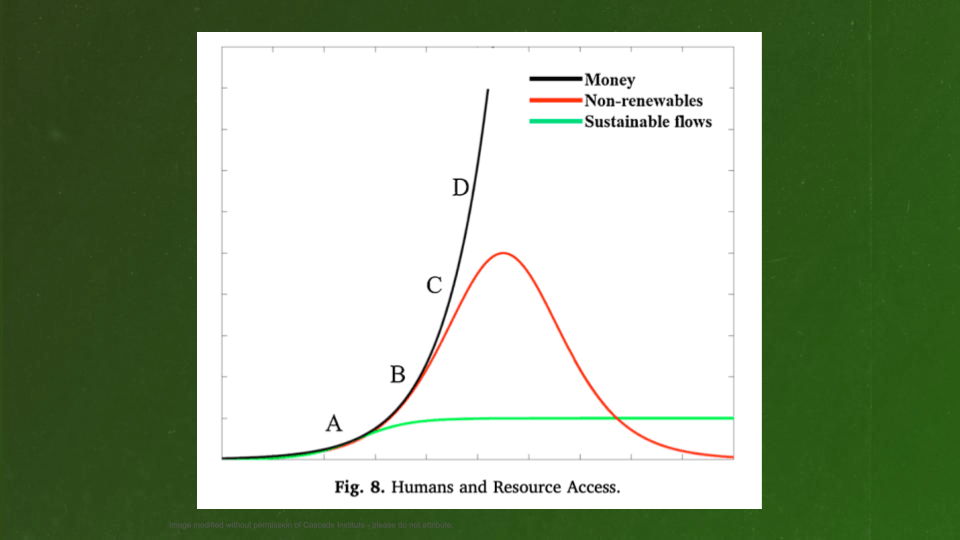
His view matches that of Nate Hagens, who in his sobering, yet playful 2020 paper Economics of the Future – Beyond the Superorganism, closely examines the pernicious relationship between abundant credit and fossil fuel extraction. He argues powerfully that our global economy races forward uncontrollably thanks to the illusory premise that ever increasing amounts of cheap credit will be able to flow into extracting ever increasing amounts of cheap, high quality fossil fuels and raw materials.
We, along with Schumacher and Hagens, believe that we have entered a form of runaway in which there is no conceivable strategy for wrestling back control. The question now is not if, only when and how we will return back home after our fantasy of energy blindness and infinite credit catches up with us and is integrated into our financial markets.
Hagens writes, “The real challenge will begin when growth ends. Eventually, we likely face a global depression and other challenging departures from our recent trajectory… The word ‘collapse’ imbues a finality. It also sounds binary—yes or no. Our situation is much more nuanced, geographically dispersed, and actionable…”
We agree with Hagens’ forecast of, and prescription for, what he calls the Great Simplification: In the coming decades, he says, “We need to physically and psychologically prepare for circumstances with less credit, complexity, energy & material throughput, and will need social support structures for those falling off the treadmill.”
To make sure we’re not jumping to conclusions too quickly, perhaps it’s wise to see what the hardcore complexity scientists think of this moment. Who are the PhDs innovating beyond the 1972 Limits to Growth study (and 2023’s 50 year update which doubled down on its findings)?
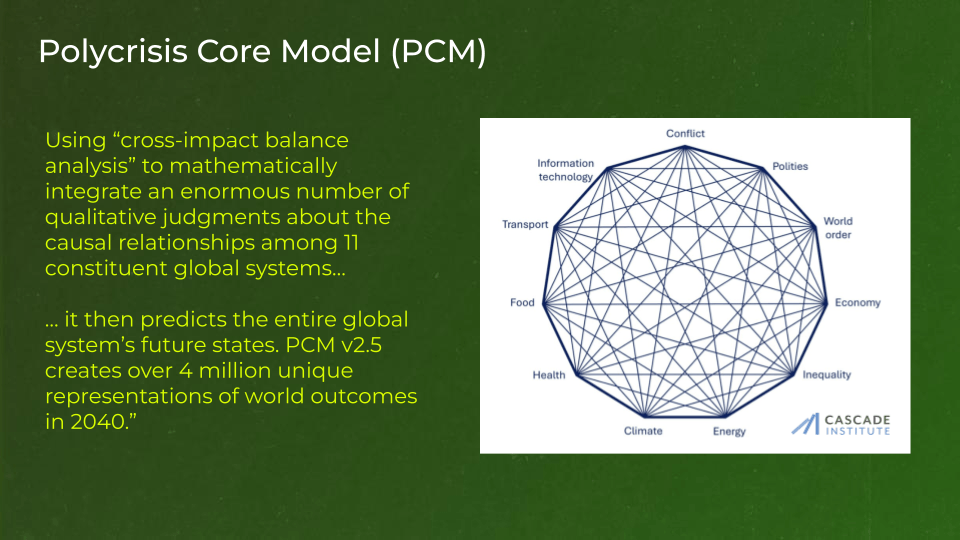
Enter Cascade Institute with their Polycrisis Core Model – the PCM for short.
Using cross-impact balance analysis, the model integrates thousands of qualitative judgments about causal relationships among 11 global systems to predict the world’s future states. It generates over four million possible outcomes for 2040, but only three form highly stable “attractors”—states with gravitational pull that draw in less-stable possibilities.
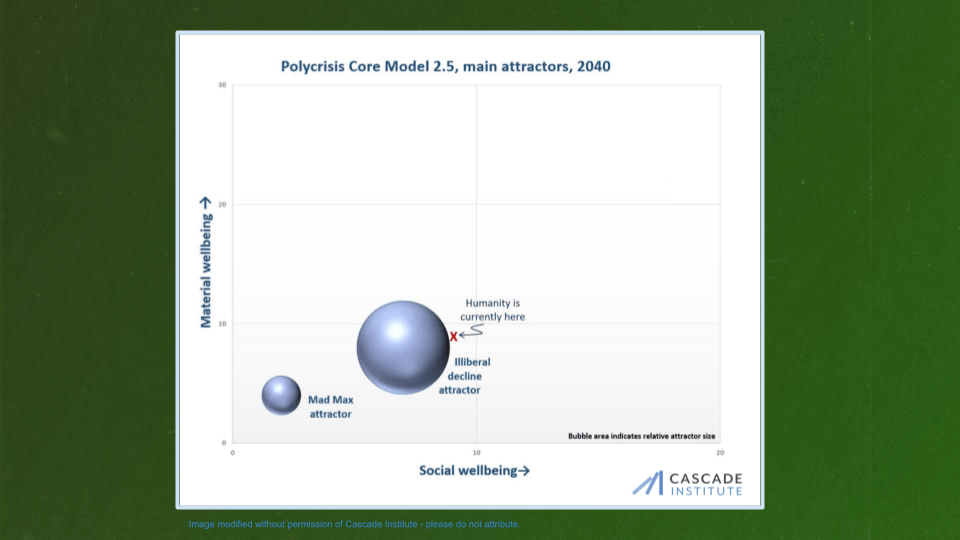
The largest, “Illiberal Decline,” represents what they describe as “a future of poverty, inequality, authoritarianism, violence, and environmental degradation, acting like a cosmological black hole absorbing over three million outcomes”. Another major attractor, “Mad Max,” reflects thoroughgoing social, economic, and environmental collapse and deeply entrenched human misery.
But wait, the story is not over! What about the third attractor? The one they deem “remarkably good,” and that in our conversations with them, have suggested “kinda seems like a bioregional future!”
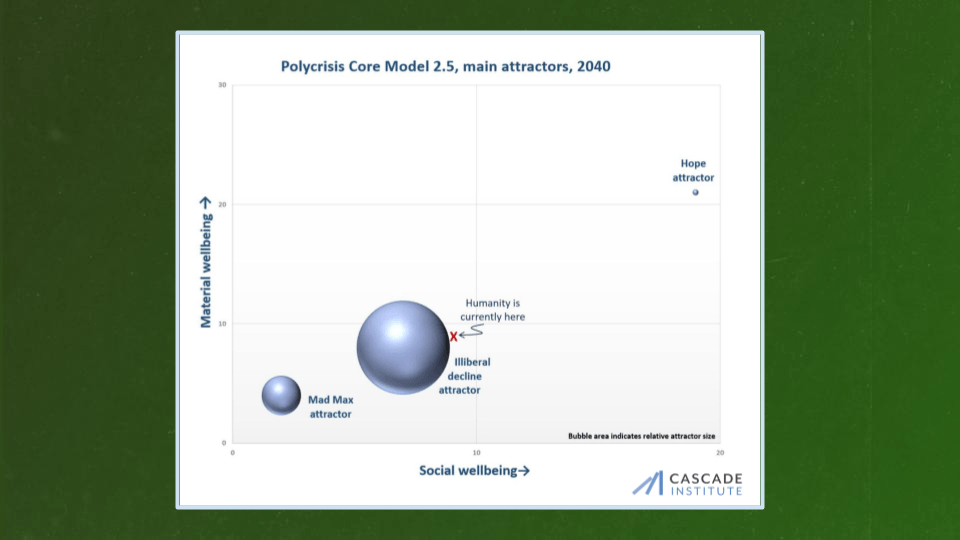
“It’s comparatively tiny, but highly stable,” they say. “it entails an enormous improvement in human wellbeing. It has strong democracy, competent governance, guided economic growth, relative economic equality, sustained technological innovation, and declining environmental impact.”
To this I say – what more evidence could you possibly ask for that the Kosmos is itself a drama, and that it too has a soft spot for a good underdog story? These are PhDs, folks.
Unfortunately though, I can understand why Cascade Institute marks us so close to the decline attractor, given how easy it is to find examples of death, decay, and decline around us already,
In our ecosystems and Earth systems, we can observe the death of countless species, old-growth ecosystems, coral reefs, and barely understood microbiomes and mycorrhizal networks. In our climate we can observe the decrease in stability and predictability of weather patterns, seasonal cues, and hydrological cycles – meaning how water moves around the Earth via the air, the ground, the seas, the rivers, the forests, and even mammalian bodies. In our social, economic, and political systems, we can see declining trust in decaying institutions.
But the fascinating thing is the irony. That as part of this death process, and culture itself becoming aware of this process, we also see the beliefs that brought us to this precipice are fraying, loosening, and unwinding.
Beyond stories of death, we’re also witnessing the death of stories themselves: modernity’s narrative of progress and techno-optimism; American exceptionalism; and what David Bollier and Silke Helfrich call the Modern West’s “OntoStory”—the isolated, autonomous individual, humanity’s separation from nature, and the market as life’s natural organizing principle. We’re seeing the collapse of Neo-Darwinian tales of hypercompetition, human exceptionalism, and even humanism, along with the wobbling of Western epistemologies, knowledge hierarchies, and mechanistic, Cartesian, reductionist metaphysics.
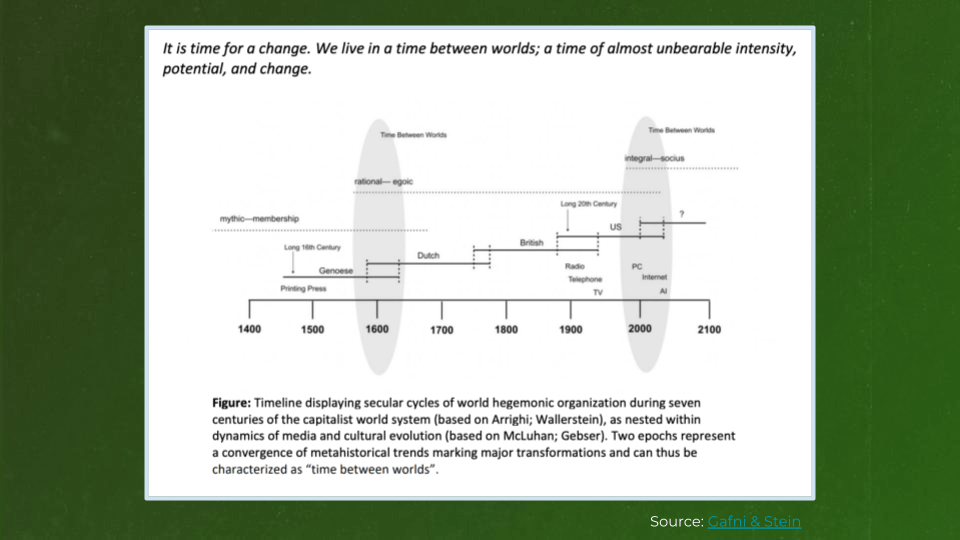
We are, as philosopher of education Dr. Zak Stein offers, in a time between worlds, perhaps also a time between stories. Zak and colleagues at the Center for World Philosophy & Religion frame this moment as a penetrable opening—a time of Kairos rather than the familiar linear clocktime of Chronos. They write, “On the ‘inside’ of Kairos are portals to new worlds and nonlinear influxes of creativity, disruptions, and opportunity. Kairos is the time within time… pregnant moments when the unimaginable is imagined and the impossible becomes actual.”
IV. Strategic Warning – Times are urgent. Let us slow down.
In this confusing, chaotic, yet extremely exciting time between worlds – where death seems to make space for life and where accessing portals to new worlds somehow feels more possible than ever – how are we to find clarity on what is wise action, knowing that we are still entangled in the very patterns and systems we are trying to move beyond?
As Dr. Vanessa Andreotti might remind us, this time calls not just for the creation of the new, but a careful, curious, and appreciative hospicing of what is dying. Let us not rush towards these portals to new worlds blinded by the ecstasy of believing ourselves capable of escaping that which we critique.
Before Samantha and I explore stories of a more beautiful future and how we might get there, we think it’s important to sit for a moment with just how compromised we are.
We are contextually enmeshed in technologies, systems, and cultures that have been the product of millenia-long civilization-building processes. In particular, over the past several hundred years of intensified civilizational design, the myth of the separate, autonomous individual seeking liberty and happiness has been both the primary design assumption and client. Our task is let go, not just of these design assumptions, but the project itself – to find our way back into a role of participating fully in the aliveness of this wondrous ecological web.
Yet, no matter how many times we can impressively slip the word ontology into our day, during that same day we will silently be designed, over and over, by the technologies and systems that we have surrounded ourselves with.
In Good Work, Schumacher describes this trap, saying, “Once a process of technological development has been set in motion it proceeds largely by its own momentum, irrespective of the intentions of its originators. It demands an appropriate “system,” for inappropriate systems spell inefficiency and failure.”
For our community of practitioners working hard towards systems transformation, what wisdom does this hold, especially knowing that so often our livelihoods are made possible, not by demonstrating our inefficiency and failure, but by demonstrating our efficiency and success! How often do we reach to pry open the doors of systems we are trapped in, yet watch our arms calcify into yet another tangled bar of that cage? Let us humble ourselves. Becoming aware of the myths we critique is not the same as becoming uninvolved in them.
Schumacher reminds us that the life-and-death problems of industrial society “lie too deep, in the heart and soul of every one of us. It is there” he says, “that the main work of reform has to be done—secretly, unobtrusively.”
V. Strategic Opening—Where does possibility grow?
And yet, it is impossible to stop producing new technologies. Like telling stories, it’s simply what we do as a human species.
It seems Schumacher recognized this as well, and saw that the path to betterment lay not with “attempts to change the “super- structure” – its rules, profit motives, agreements, taxes, education, etc..” but with technology itself. He says, “If there is no change in the base – which is technology – there is unlikely to be any real change in the superstructure.”
In this perilous historical moment, we believe Schumacher’s analysis of technology and his conception of Intermediate Technology – which later evolved into the term Appropriate Technology by its adherents – offers us vital guidance.
He argued that the dominant technological paradigm of industrial society is fundamentally misaligned with life. He observed that modern technologies, even when successful by their own metrics, tended to embody four design principles that not only undermined economic and ecological wellbeing, but produced a degraded human too.
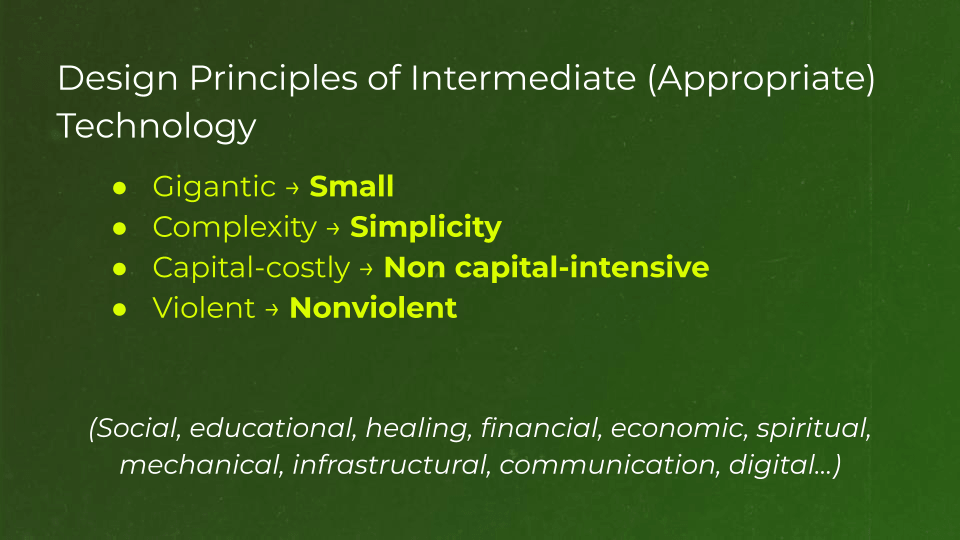
He was concerned by the design principles of:
- Gigantism and the assumption that bigger is always better
- Complexity that outstrips local understanding
- Capital-costliness that concentrates ownership and excludes participation
- Violence, meaning modes of production that force their way through natural systems in the conviction that unintended damage and unforeseen side effects can always be undone by the further application of violence.
In contrast, Schumacher proposed technologies that “fit the smaller places” — technologies that could be owned, understood, built, and repaired locally, and that embodied reverse design principles of:
- Small
- Simple
- Non–capital intensive
- Nonviolent, a principle which we believe Schumacher alive today would agree is embodied through our refusal to act our myths of separation, our myth of “away,” and the myth that we can harm other beings without simultaneously harming ourselves.
In his advocacy for appropriate technology, he was largely focused on the physical, industrial technology of tools, machinery, chemicals, and hard infrastructure. Now, more than 50 years after his writing, we’re compelled to reaffirm his vision for appropriate technology, yet this time, encourage a significantly expanded view of technology.
Don’t the same principles need to apply—not just to machines—but to our social, educational, healing, financial, economic, and spiritual technologies? To the tools, templates, rituals, and ceremonies with which we gather, govern, teach, coordinate, exchange resources, and even contact divinity and emptiness? Aren’t all of these producing us too?
I’m curious – beyond what is easy to recognize as technology, what are the technologies so ordinary, so commonplace that we cease to see them as technology? I’m thinking of:
- The line. The neat, well-mannered queue of first come, first serve?
- Retirement accounts?
- Weddings—that bind us to another human individual, and not the lands, waters, and multi-species families that give life to us?
- Old people’s homes?
- Trash bins, which leverage the disruptive breakthrough of “away” as an ontological category.
Do not all of these, and so many more need urgent disruption? With endless realms in which we could innovate more beautiful technologies, how are we going to focus our attention? Well, if we’re seeking to actually achieve widespread adoption of appropriate technologies, we might be wise to do what any cunning entrepreneur would do: develop a forecast of what the demand will be and design something compelling to meet that demand.
If we’re in need of a forecast, what about Nate Hagens’ view that, “societies need to physically and psychologically prepare for circumstances with less credit, complexity, energy/material throughput, and will need social support structures for those falling off the treadmill…
As he says, we will need “airbags, social cohesion, an ethos and prepared blueprints based on intelligent (and wise) foresight.”

In times of disruption, when the supply chains falter, energy costs spike and grids sputter off and on, and wild weather drives unprecedented catastrophe—suddenly the world gets a lot smaller. Suddenly the most important things in life become simple logistical questions. Can my hose with clean drinking water reach my flooded neighbors down the hill? Can the food in our regional distribution center reach the families before it rots? How are we going to make a circle big enough to hold all this grief?
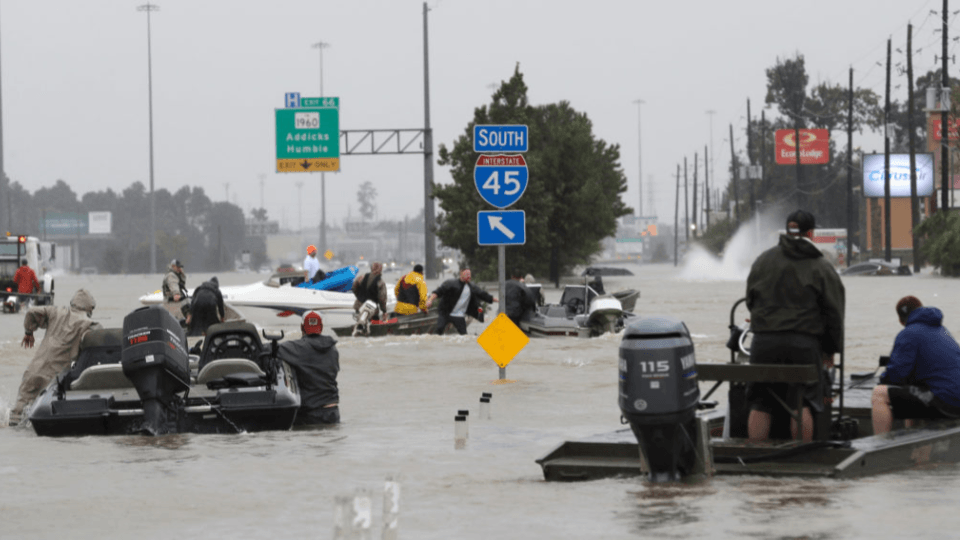
Amidst confusion, disruption, and distress, it will be the technologies, and systems—held by resilient relationships, networks, and organizations—that effectively supply basic needs (food, shelter, water, health) and offer beacons of social and psychological resilience that become most demanded for.
The issue is no longer merely what needs doing—the outlines of that are clear. The crucial design questions become:
- Where should this work take place?
- With whom should it be done?
- How should it be carried out — i.e. with what design principles beyond what Schumacher offers, and with what practices to help us fully embody these principles?
We believe that bioregions are the right scale, bioregional economies are the right context, and bioregionalism is the right practice for developing and distributing the appropriate technologies that can catch us in periods of disruption, and serve as the soil from which life-affirming cultures grow.
Let’s take a closer look at what we’re talking about when we invoke these terms.
VI. Initiation & Orientation to the Wisdom of Bioregionalism—How might we tend to possibility?
Samantha
If we’re going to design appropriate technologies for the future that are not reproducing the conditions of the past, we’ll want to orient to this process with as much wisdom as we can gather, and as much humble reverence for life that we can muster. We believe Bioregionalism, or what is now popularly being called Bioregioning, offers exactly the invitation we need: to practice inhabiting a different ontology, worldview, value system, scale of focus, and even relationship to time. And through this practice, we can become different people, who create different technologies, giving rise to different cultures, to create a different type of civilization…
A little bit about what bioregionalism is before we get into bioregions as the basis for technological development…
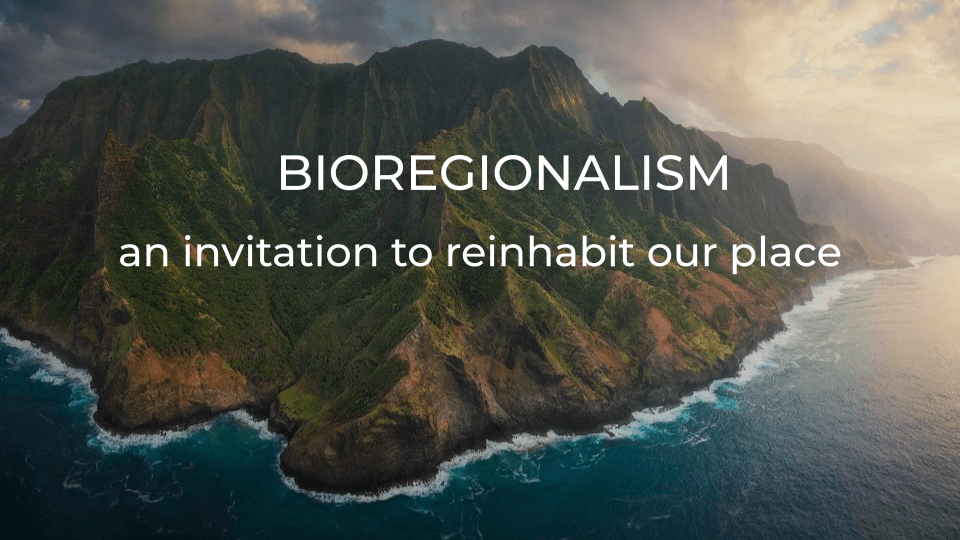
Bioregionalism, is a philosophy that advocates for societies to be organized around biocultural regions or “bioregions,” where economic activity, ecological management, and governance align with the region’s natural systems and cultures.
And bioregions – regions defined by hard lines, soft lines, and human lines or… their physical, ecological, cultural characteristics, and the interconnections – can be seen as the natural units of place-based regeneration.
Let’s hear from some of the bioregional elders about how they see it…
Author Judith Plant tells us:
“Simply put … bioregionalism means learning to become native to place, fitting ourselves to a particular place. It is living within the limits and the gifts provided by a place, creating a way of life that can be passed on to future generations.”
Another author Mitchell Thomashow says:
“Bioregionalism emerges as a response to the formidable power relations of global political economy … More than an alternative framework for governance … it represents a profound cultural vision addressing moral, aesthetic and spiritual concerns.”
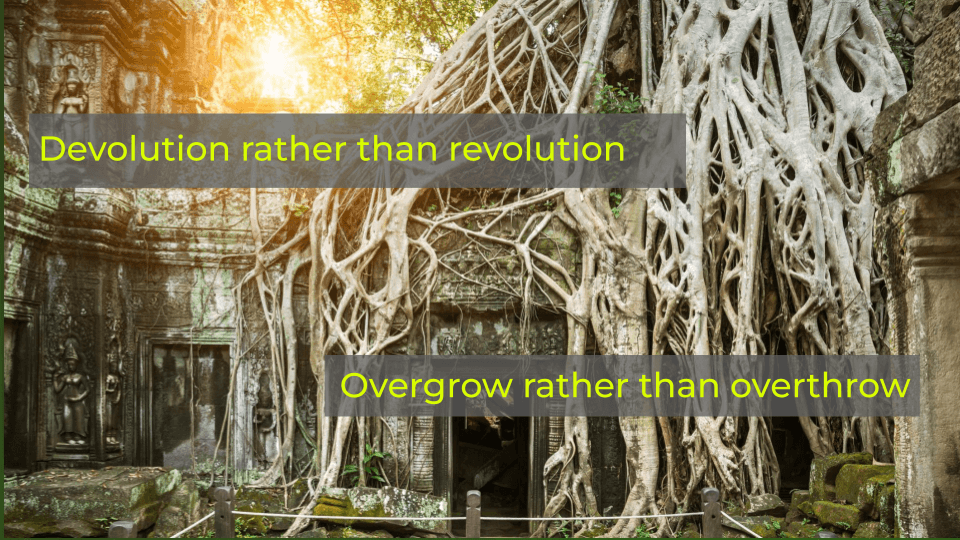
Many bioregionalists who have come before us have suggested bioregionalism is an approach of devolution rather than revolution that invites us to overgrow rather than overthrow.
In his 1983 Schumacher Lecture ‘Mother of All’ Kirkpatrick Sale described bioregionalism as “gradualism… steady and continuous” — “not revolutionary” but aligned with “the long and steady tenor of evolution.” An approach that in our view requires patience and alignment with Earth time rather than the pace at which modernity is running.
Some principles of bioregionalism that we are inspired by in our work include:
- Alignment with Living Systems Principles & Indigenous Wisdom
- Holism & Interconnectedness
- Integration of Human and More-Than-Human Communities – or a return to a kinship ontology
- Place-Based Identity & Responsibility
- Local Community Self-Reliance
- Culture & Practices of Commoning, Regeneration, & Stewardship
- Participatory Democracy (democracy much more broadly conceived than the supposed representative democracy we have in the US today)
- Bioregional Cooperative Economics
- And the Application of Appropriate Technology
There is so much depth and richness in the decades of work to articulate bioregionalism, since it kicked off in the 1960s. Our summary offers only a tiny fraction, and these principles are only a partial guide, but we believe they help orient us towards how we can best show up in this moment in service to life.
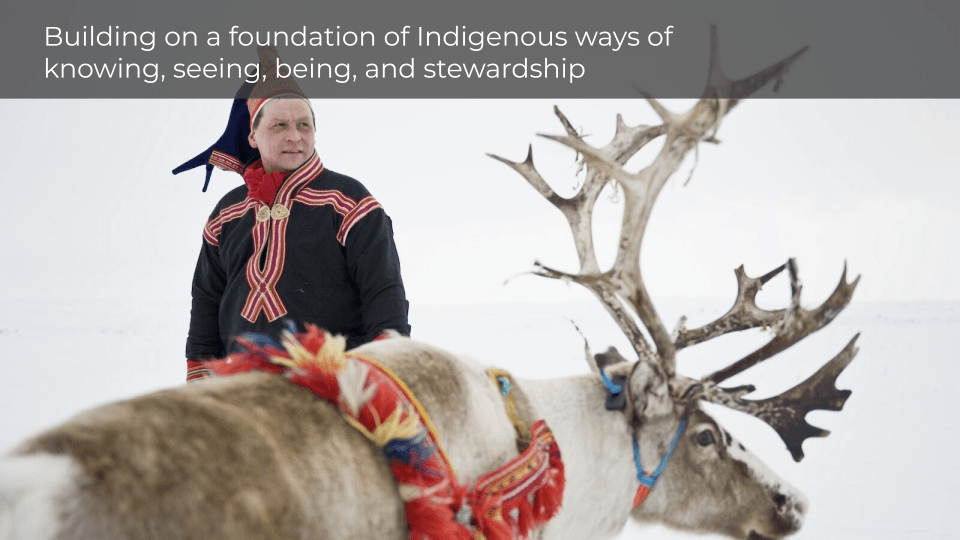
It’s important to say that in our view, bioregionalism could not have erupted into the psyche of 1960s North America without the deep determination of Native peoples on this continent and Indigenous communities around the world to persist – despite centuries of colonial violence, attempted genocide, and ongoing oppression – to live and openly share the instructions they have been holding for time immemorial.
To these communities, the proposition of bioregionalism is nothing new – except perhaps that its underlying ideas are now sometimes ironically communicated in the awkward language of academics who have become abstracted away from the rich tapestry of stories and relations that come from being people of, and in service to, place.
Yet for the minds and bodies that have been trained and forced so deep into the myth of separation, bioregionalism offers something critical. Something we think of as an ontological, epistemelogical, and ethical U-turn that arose out of necessity in the minds and hearts of people embedded deep within modernity who looked courageously towards its dead-end trajectory and decided it was not for them. Decided that we must start to see and design differently..
Given that the foundation of bioregionalism is Indigenous ways of knowing, seeing, being, and stewardship – as learned by those who had lost their indigeneity – the ongoing role of Indigenous leadership in this work – including in the creation and revitalization of appropriate technologies – cannot be overstated. Indeed, Indigenous technologies that have lasted are by definition appropriate technologies.
Building on the philosophy and frame of bioregionalism is a growing and recently re-energized body of work that is highly relevant to surfing the coming waves of the great simplification and responding to the broader metacrisis – work we call Bioregional Economics and Bioregional Finance. This is the space that we at the BioFi Project have been focused on. Both Bioregional Economics and Bioregional Finance advocate for appropriate financial and economic technologies that serve the well-being of all life in a bioregion. These two fields of work also chart the path to create a wide range of appropriate technologies and generate demand for them by building new appropriate markets.

VII. Practical process wisdom—What might tending to possibility look like?
Tyler
Before we share our vision, let’s have a word about vision itself. What it is, and what it offers us?
As I’ve learned from Nonviolence Teacher Miki Kashtan—a very practical visionary—vision is something we can access through “biological memory of our cells,” – particularly the memory of being “born into a world in which care for life is the foundation of human systems.”
Amidst so much ugliness in human systems today, being able to access vision provides the energetic pull, the courage, the energy to try practical baby steps towards a more beautiful world. And in seeing this world clearly, we can more fully allow ourselves to mourn the gap between here and there. Without this mourning, we can find ourselves numbing our grief and burning out – as we chase a rigid fantasy, rather than walking the mysterious path ahead in togetherness.
If you’re up for it, I’d like to offer a brief exercise to help us all access the vision living inside of us, perhaps kept alive in the biological memory of our cells.
- Stretch, wiggle
- Come into body, breath, stillness,
- Touch the tender parts of the heart – the wisdom is in the heartbreak. Scratches, tears
- “Born into a world in which care for life is the foundation of human systems”
- What does this look like?
- Childbirth, education, the structures we live in, how we feed each other, how we move throughout our days, what we pay attention to, how we die
- Thanks for courage I know this not easy—if something came, spend time later
Samantha
Thank you, Tyler. Thank you, all. These visions, I believe, are a part of what we are collectively creating in this moment. And now we’re going to let you in on what we hear and feel as our vision that guides us in this work.
In our listening we have been hearing of the birth of a future into this present that does not represent a final destination, but rather a future that is dynamic and unfolding with all of life on Earth—and with all of the cosmos. A future full of harmony and flourishing, but one that still has darkness and suffering. One where we rejoice in what has been created and where we continue to long for something more beautiful, so it can keep evolving.

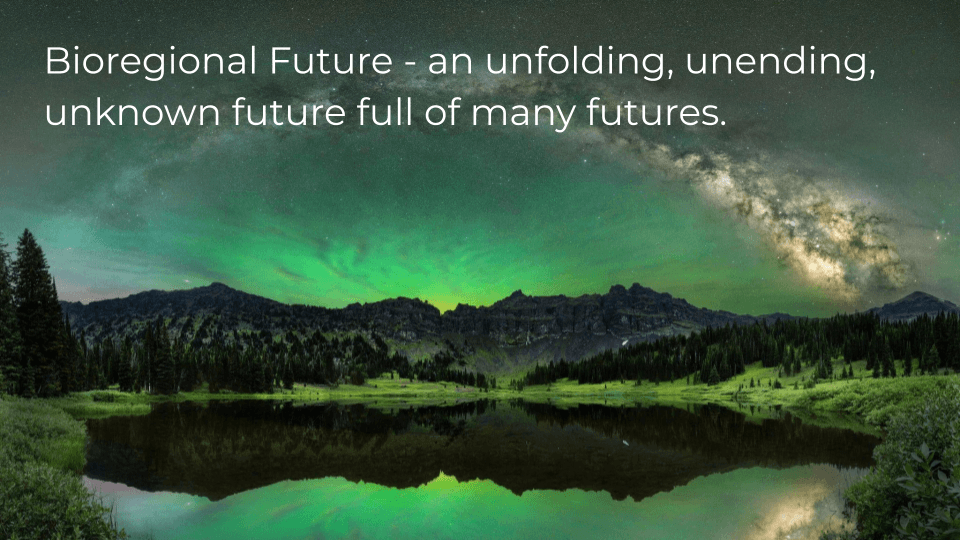
It is a future that is more aware, more honest, more alive, more connected, more complex… It’s often called a protopian future. For today we will call it a bioregional future. An unfolding, unending, unknown future full of many futures. It will be a future that thrives on biodiversity of life, cultures, languages, ontologies, cosmologies, ways of being, ways of knowing, ways of serving, ways of governing, and ways of flowing care. A future with its foundation in the bioregional economy and appropriate technology.
As the Zappastistas say, “In the world we want, everyone fits. In the world we want many worlds fit. The Nation which we construct is one where all communities and languages fit, where all steps may walk, where all may have laughter, where all may live the dawn.”
For the Zappatistas “the dawn” has represented the emergence of a new and just world beyond the one we occupy today. This is a vision that we share.
Now, I am going to move into sharing a more detailed vision for the future that Tyler and I hold, and I want to first acknowledge that this is a result of what we are learning from the relational web of people, the more than human life, and spirits that hold us. It has been inspired by our work walking alongside and supporting bioregional teams across the Americas and around the world working to regenerate the unique biocultures of their places.
At the most foundational, palpable, embodied level, we dream of a world in which we regenerate the:
Health of the Earth and Our Bodies
Our Vital Systems of Life:

In which we work to realize:
- Clean, alive air
- Free-flowing, swimmable rivers and drinkable streams teeming with life.
- Healthy, vibrant soils with thriving mycorrhizal networks.
- Rainbow cornucopias of nutrient-dense, poison-free food that heals bodies and ecosystems and reflects place-specific seasons and bioculture
- Living, natural and holistic medicines
- Local fibers grown regeneratively and returned to Earth without harm.
- Safe, clean shelter built from local, natural, regeneratively grown and harvested materials
- Technology that supports us in transparently and continuously monitoring the health of of bioregion and how that health links up with larger Earth systems
To realize this, we will need to create and reconnect with life-aligned cultures that support belonging, flourishing, and resilience.
Pathways we see to regenerating Life-Aligned Culture & Inner Resilience include
Restoring Relationality
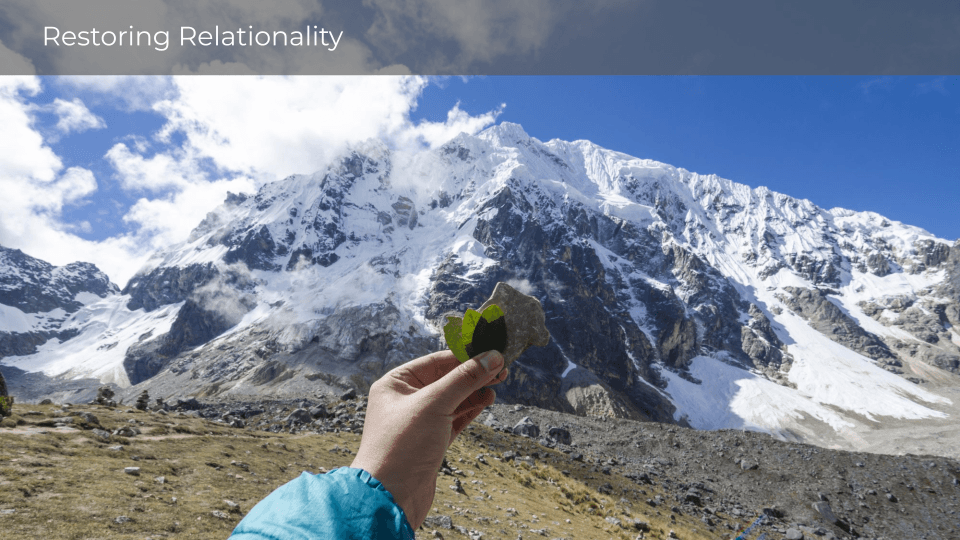
This might encompass:
- Ceremony and rituals of responsibility that remind us of our interdepdence—with each other, all of the more than human life, and spirit or the divine.
- A way of life that emphasizes slowing down and honoring seasonal rhythms
- Practices that shift consciousness and cultivate interpersonal capacities to help humans become a more harmonizing species on Earth
Next we imagine Spaces of Resilience & Expression
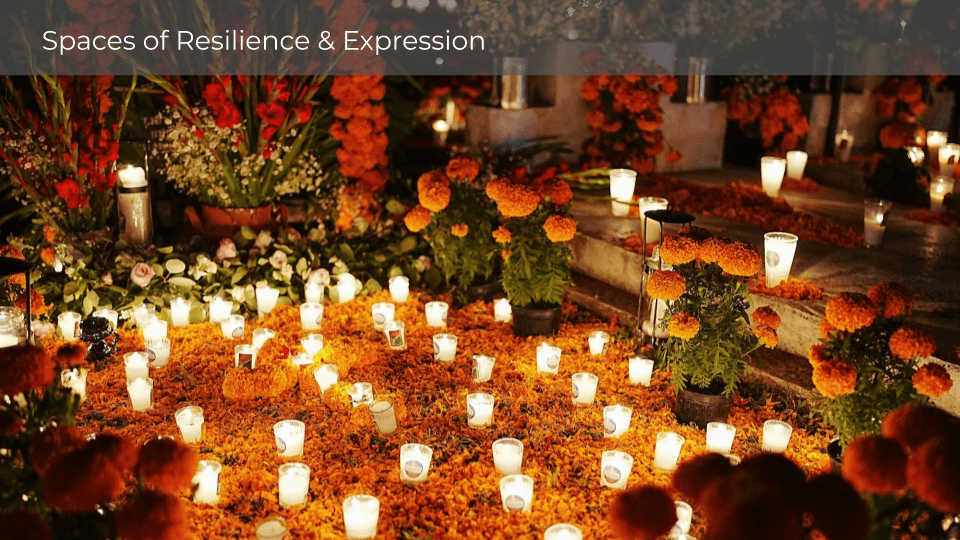
This might include:
- Spaces where rest, contemplation, and stillness are protected.
- Spaces to grieve in community
- Space for joy, laughter, and celebration.
- Art and beauty for their own sake, valued as essential to community health.
It also includes Collective Care Infrastructure:
- Community care for children, elders, and the vulnerable.
- And community structures that free us from feeling like we carry the world alone.
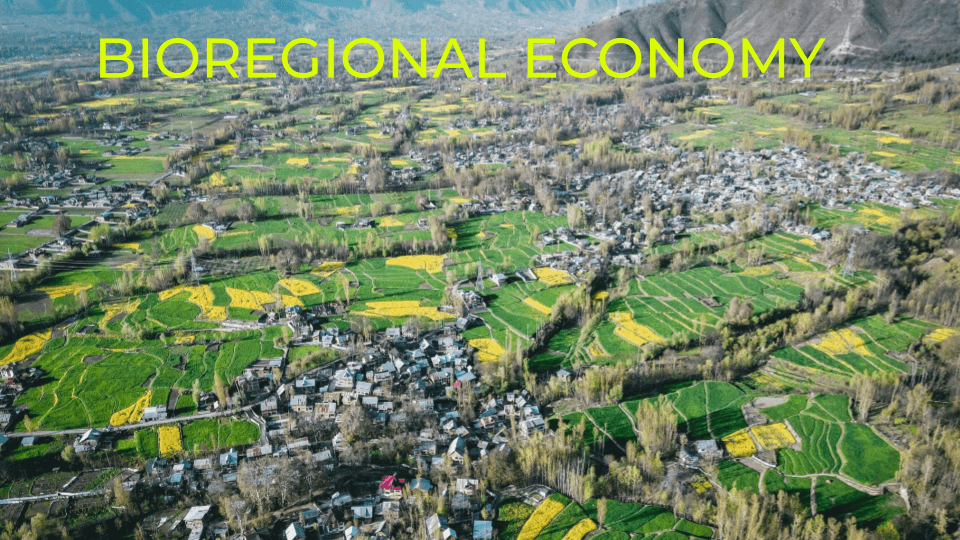
And critical in our view to catalyze the regeneration needed to move towards a healthy Earth, healthy bodies, and life-aligned cultures is a bioregional economy.
The Foundations of a Bioregional Economy we see include:
- That It centers care and reciprocity, the alignment with living systems and Indigenous wisdom, and the cultivation of nonviolence, healing, and liberation for all life in the bioregion
- It enables the development of appropriate technology
- It embraces simplicity and sufficiency – staying within bioregional carrying capacities, while matching each person’s gifts to community needs in a spirit of gratitude and reciprocity
- It recognizes the rights of nature
- It deepens and expands the commons
- It is anti-fragile – growing stronger with each coming shock
- It works across nested scales: household, local, and bioregional
- It invites all of its members into responsibility and sacrifice

It also includes the development of Local Knowledge, Building, Craft, & Medicine:
- Including an education system for all ages tied to place that cultivates ecological literacy, land-based skills, and relational intelligence
- Workforce training for building, repair, and maintenance of infrastructure
- Workforce training to support the transition to cooperatively owned structures
- Reinvigoration of artisanship and craft traditions using local materials
- Revitalization of medicine and healing practices focused on root causes and restoring wholeness
The Bioregional economy reconnects people to ways of living that regenerate. It reconnects people to flows of care to, from, and as place – and to technologies that enable those flows. It invites us to spiritually, culturally, ecologically, and economically reinhabit our place and to develop, evolve, and pass on technologies that support us in that.
We see the bioregional economy and the regeneration of health and culture connected in a toroidal flow. And that is why we chose a toroid as our logo. To remind us of the flows between economy and health, culture, and consciousness.
The bioregional economy we see exhibits more of the following qualities over time.
Becoming more:
- Circular
- Local, regional, and sovereign (less dependent on global supply chains)
- Symbiotic in the relationship between rural and urban areas
- Regenerative
- working within (and regenerating) carrying capacities of the bioregion
- Regenerating culture
- It will be increasingly commons-based and cooperatively-owned
- It will develop intentionally structured markets while decreasing its dependence on global markets, formal markets altogether, as well as its dependence on fiat currencies and debt
In practice, this often works fractally – developing different appropriate technologies at different levels..
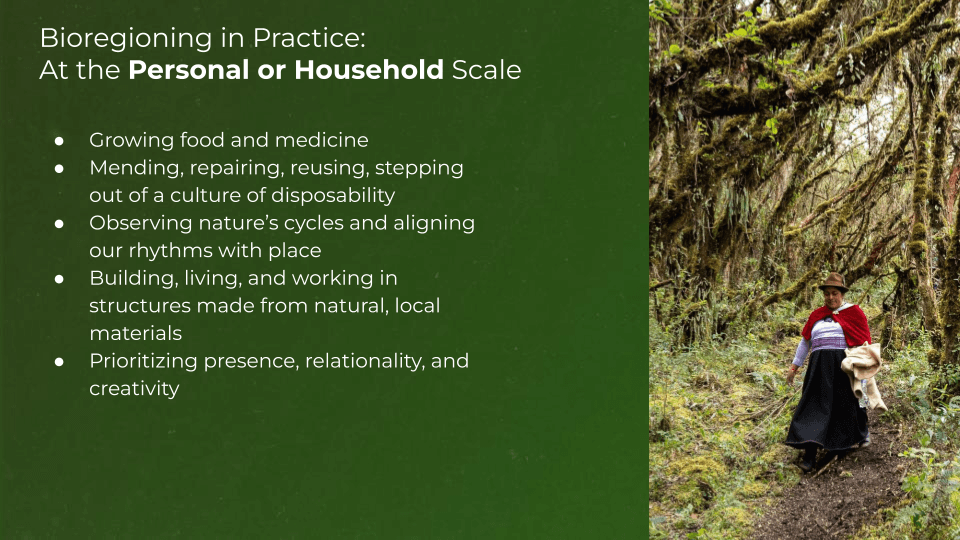
At the Personal or Household Scale
There are a variety of embodied practices and daily rituals we can all develop, some of which are listed here:
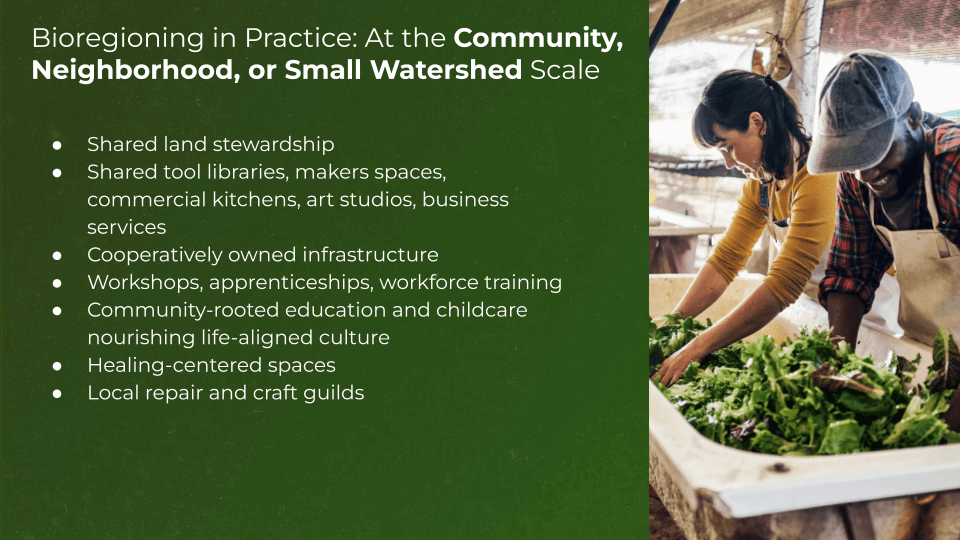
At the Community, Neighborhood, or Small Watershed Scale
Cooperation, stewardship, and shared culture can come alive with some of these practices:
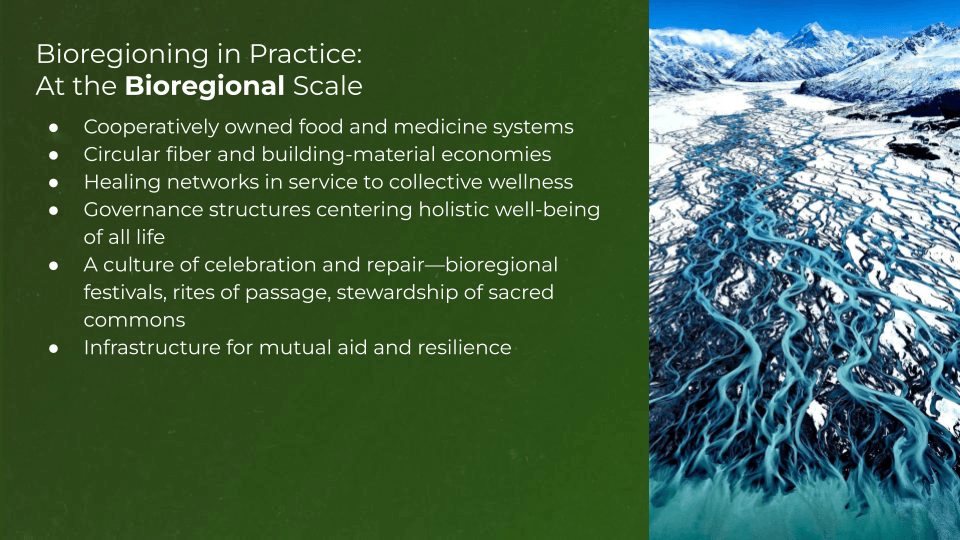
At the Bioregional Scale
We can really start to see more significant impact on Earth systems and human systems through some of these technologies and practices:
VIII. Strategy—What do we do once we feel the pull of vision?
Tyler
There’s a reason we start with vision. It provides the energy—or in the language of Commonland Foundation—the inspirational capital from which subsequent action flows. Yet, what do we do when we recognize and mourn the immense gap between here and the vision we’re inspired by?
That’s where strategy comes in: identifying and pursuing opportunities for coordinated investment of time, attention, money, and other resources into creating the appropriate technologies needed in the coming decades.
Through the practice of bioregioning, if we release our abstractions of separation and come into intimate contact with ecological reality, we are more likely to develop technologies—be they mechanical, agricultural, energy, financial, economic, social, governance, cultural, or spiritual—that truly fit our places in nonviolent ecological relationship. By embedding these technologies in networks of cooperation now, they will be the ones strengthened and demanded when inappropriate systems fail. As Schumacher said, “technology is not simply made by man but it also makes men,” and as Milton Friedman said, “Only a crisis—actual or perceived—produces real change. When that crisis occurs, the actions that are taken depend on the ideas that are lying around.”
What does this strategy-formation process look like? As described in the BioFi book strong bioregional regeneration strategies emerge when diverse actors devoted to their place come together in relationships of trust and shared bioregional ethos. From those with hands in the dirt planting seeds of possibility, to those holding hearts open in ceremony and educational spaces, to those donning a suit and tie to hospice legacy institutions—when these actors form a network of collective intelligence, they can share what they’re seeing, feeling, and attempting, and identify avenues for deeper cooperation and coordination.
A thorough bioregional asset-mapping process is essential for socializing knowledge about where existing wealth—in all its forms: culture, land, biodiversity, skills, knowledge, and financial capital—can be leveraged. Different people see different needs, opportunities, and technological interventions; this diversity of perspective is critical.
Equally important is the courageous mapping of risks facing the bioregion. We cannot overstate this: we have surpassed 1.5°C of warming and show no signs of stopping soon. Even if a bioregion is not yet experiencing severe climatic or geopolitical disruption, failures across distant regions will eventually arrive in the form of supply chain disruptions and the need to accommodate what is expected to be over a billion people fleeing unlivable conditions by 2050.
As part of asset and risk mapping, we recommend a material and energy flow baseline analysis to understand where food, water, housing materials, energy, and other essentials come from and where they go. How much waste is generated? What dependencies exist? Where are opportunities for circularity and resilience? As a starting point, take a look at the work of the consulting firm Metabolic, which has done this form of analysis for cities such as Toronto, Charlotte, and Boulder.
Finally, any Bioregional Regeneration Strategy should include both declarative plans and principles that support more emergent strategy. Culture isn’t created in documents; it is created through ritual and practice. Still, articulating the design principles and protocols that a bioregional community of practice wants to be guided by in their coordination and technology design can be grounding and clarifying.
Let’s now take a closer look at other components that might be included in a Bioregional Regeneration Strategy, such as economic transition pathways.
Out of the Bioregional Regeneration Strategy and Asset and Risk Mapping for a bioregion, we can begin to identify transition pathways for particular sectors of the economy and society that we see as catalytic and foundational for a more comprehensive transition to a bioregional economy. Some pathways we recommend as powerful entry points to broader economic transition and have seen various bioregional organizing teams we work with pursuing include:
- The Food system
- Building system
- Energy system
- Fiber system
- Land ownership
- Education
- Healthcare
- Culture
- Spirituality (catalyzing bioregional and Earth-based spiritual practices)
We are seeing a marked shift away from free‑market globalism toward protectionist nationalism, and in that—there is a huge opportunity for localization and building out bioregional production and cross-bioregional trade—particularly within North America.
Out of the Bioregional Regeneration Strategy we can start to identify relevant tools, interventions, & experiments that can support the transition to the bioregional economy—these might be considered appropriate technologies.
I am now going to share some examples of relevant tools, interventions, & experiments. Some of these are things we’ve created, some we’ve supported, some we are just admiring from afar and want to uplift! This is certainly not an exhaustive list, and I will go through each of rapid fire—so bear with me.
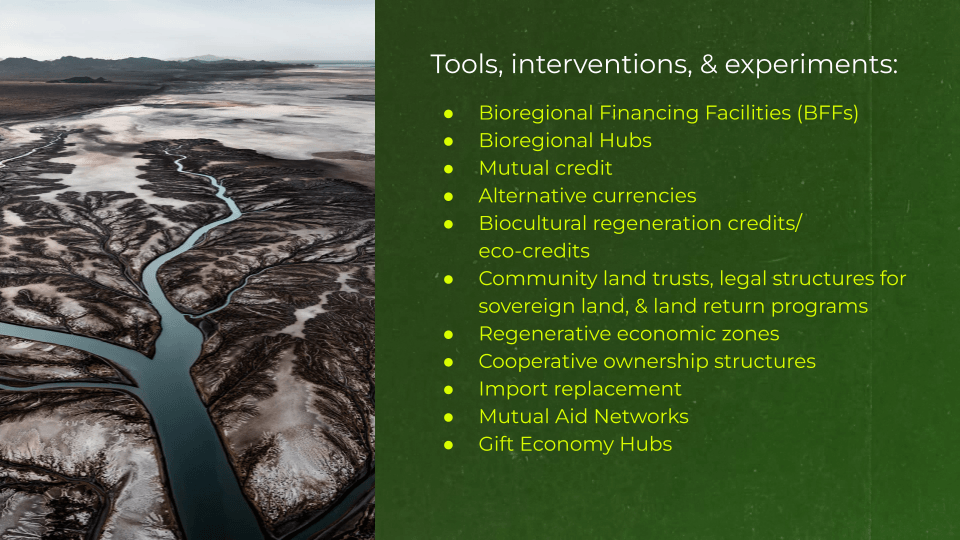
The first one is one we think is pretty cool! Bioregional Financing Facilities or BFFs.
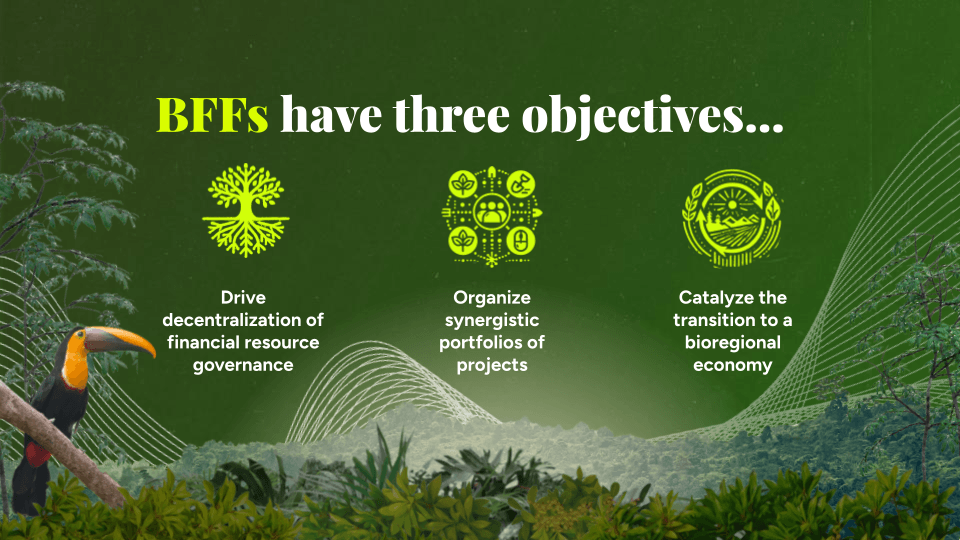
BFFs are a new type of financial institution designed to serve the bioregional movement.
BFFs aim to drive the decentralization of financial resource governance, the aggregation of synergistic portfolios of projects, and the transition to a bioregional economy—becoming the connective tissue between financial resources and on-the-ground regenerators. They do this by enabling capital raised from a variety of sources to flow to aggregated portfolios of systemically coordinated regenerative projects in rigorously designed, community-determined ways that support emerging bioregional economies applying fundamentally different economic logic and value systems. Rooted in the uniqueness of place.
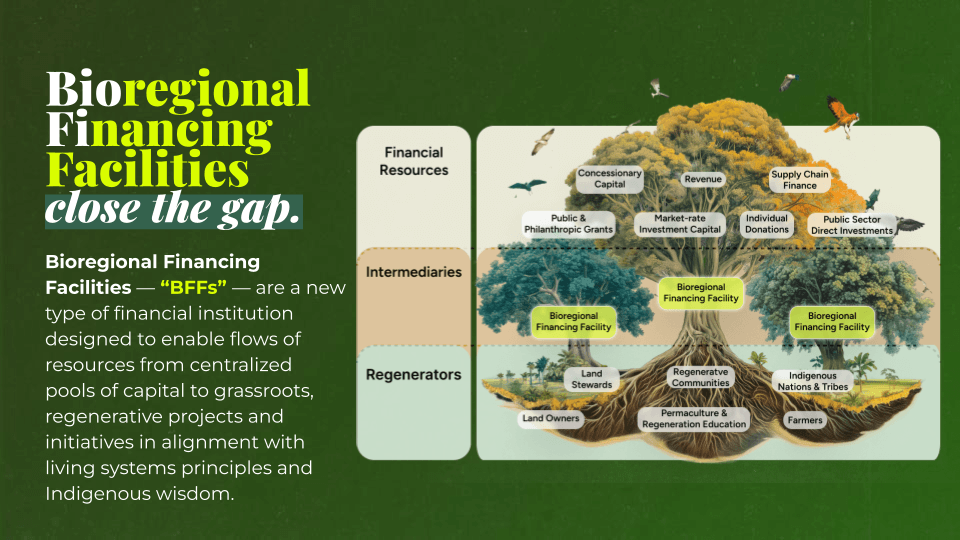
BFFs apply a wider lens to assessing risk and returns than legacy financial institutions. These are some of the returns they seek to generate—so financial returns are not prioritized over ecological and social returns.
We ran a learning and design journey for BFFs in the first half of this year that included these 22 teams from across the Americas.
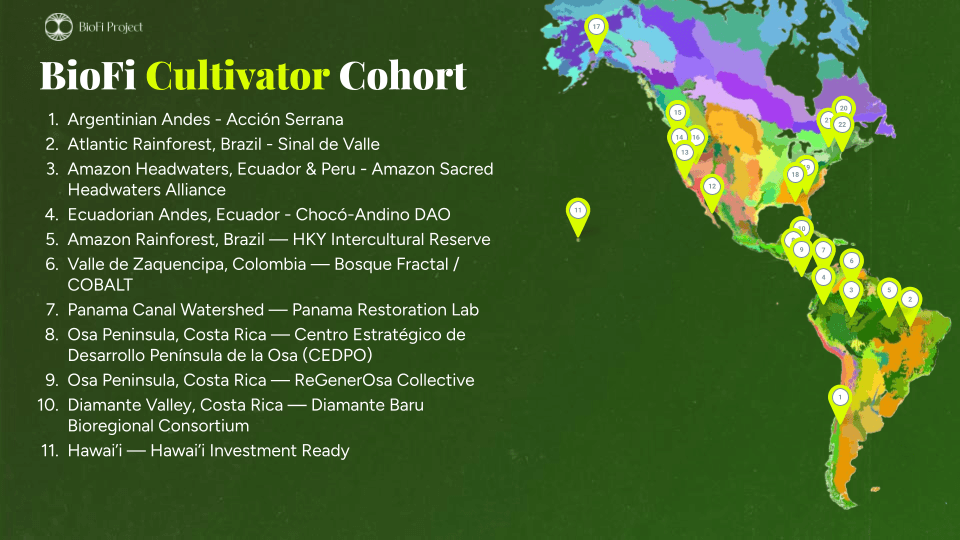
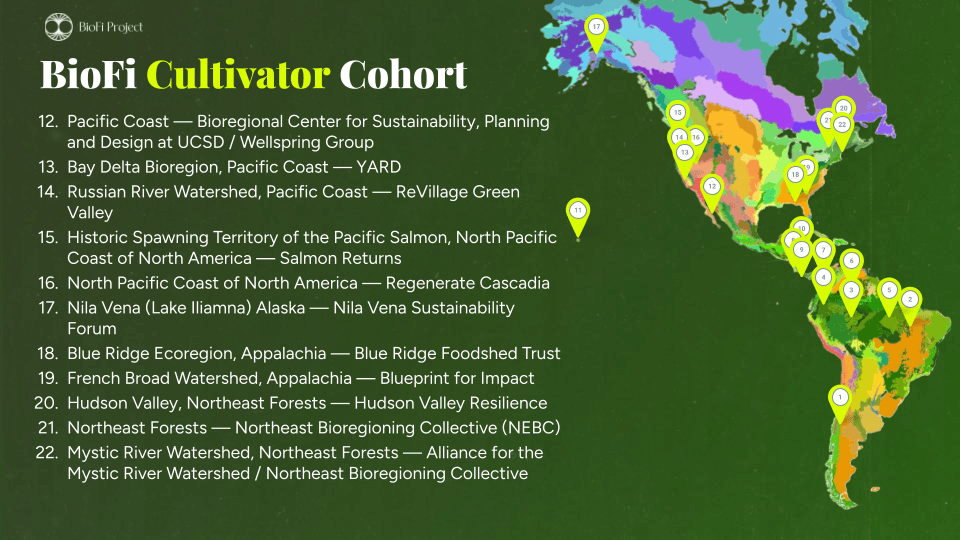
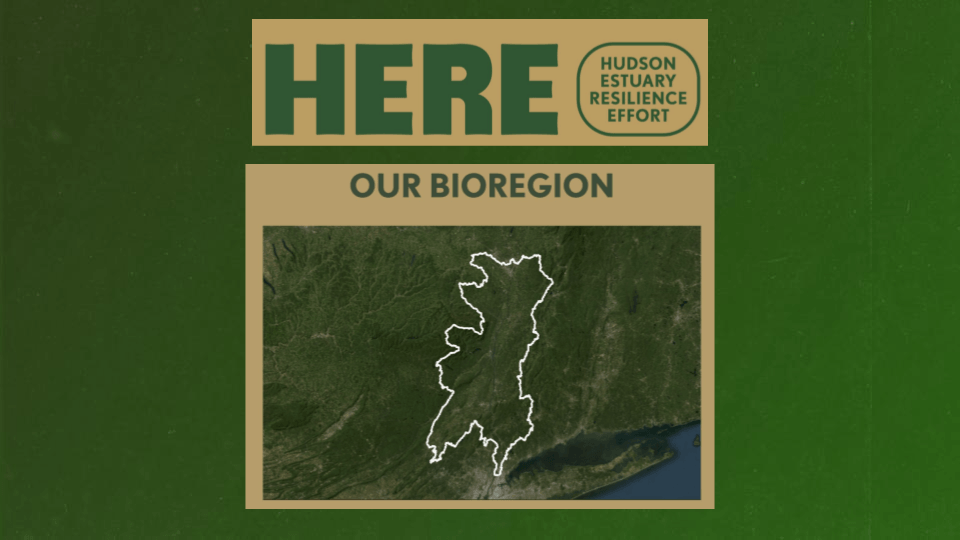
Matt Stinchomb and his colleagues at the Hudson Estuary Resilience Effort went through the Cultivator and launched their incredible Bioregional Fund at the end in June and there are other colleagues here who participated as well.
It’s important to note that BFFs are not meant to centralize all investment in a Bioregion—but to serve a specific purpose within the funding ecosystem. There are 4 templates for BFFs laid out in the BioFi book. These templates should be adapted and innovated upon.
It’s worth noting that we are currently living through the largest wealth transfer in history, as approximately $100 trillion changes hands between now and 2045 in the US as the baby boomers pass on their fortunes—often times to kids with entirely different worldviews and values. BFFs can play a critical role in preparing the soil for this wealth to reach the ground.
Yet, many of the people best qualified to do the weaving of portfolios BFFs are meant to serve are critically underfunded, spending their time chasing grants rather than bringing people, projects, and strategies together.
We, along with so many colleagues in this space, highly recommend to wealth holders that one of the best investments you can make in early stages of this process is to provide long term, steady general funding to the people and organizations that are highly trusted in a bioregion to weave together portfolios and patterns of cooperation.
There’s much more we could say—but we will leave it there for now—and invite you to check out the BioFi book—available for free in English and Spanish on our website as well as other guides we’ve developed.
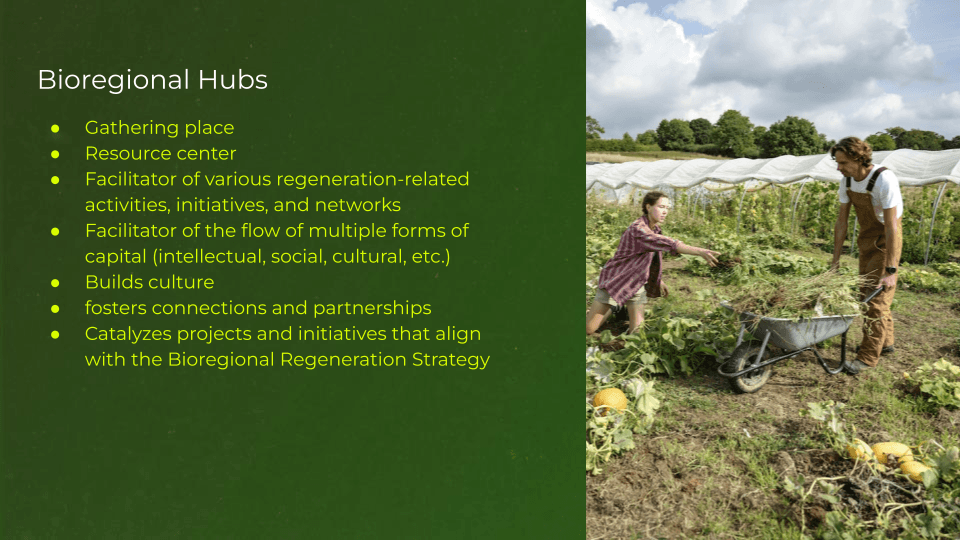
Next up we have Bioregional Hubs which are an amazing appropriate technology. They are community-led institutions that function as a gathering place, resource center, and facilitator of various regeneration-related activities, initiatives, and networks within a bioregion. They play a critical role in facilitating the flow of multiple forms of capital in the bioregion. They cohere and strengthen a synergistic bioregional collaboration network by building culture, fostering connections and partnerships, and catalyzing projects and initiatives that align with the Bioregional Regeneration Strategy.
Next we have Commitment pooling and mutual credit—this can be an incredible complement to a BFF—helping communities to tap into the assets they have and facilitate robust flow of goods and services without dependence on money. We recommend the excellent work of Will Ruddick of Grassroots Economics who makes clear the importance of social technologies (that generate and sustain a culture of commitments to community) in the efficacy of mutual credit systems.
Alternative currencies—we are so excited to be in the Berkshires and to get to use Berkshares while we are here! There are a range of inspiring local currency projects around the world and we would like to see these more deeply integrated within bioregional economic transition strategies and would love to be a part of this work.
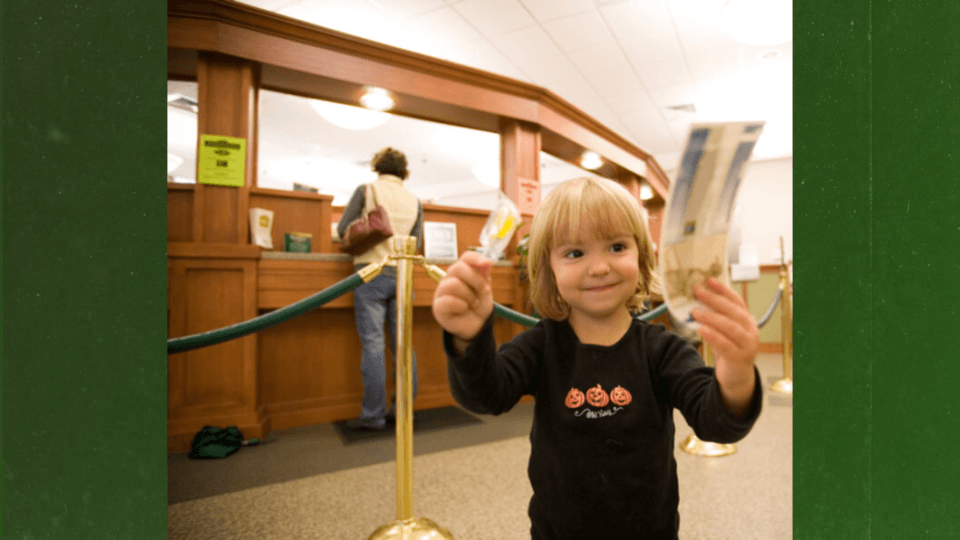
Local currencies can be connected to bioregional regeneration credits or eco-credits. We are lucky to be supporting two incredible biocultural regeneration credit projects with two separate multi-tribal Indigenous alliances: the Jaguar Biocultural Credit program in the Amazon Headwaters led by our friends at regen network and the Amazon Sacred Headwaters Alliance and the Salmon Biocultural Credit which is emerging in British Columbia led by Salmon Returns. Both of these programs aim to compensate Indigenous communities for their biocultural stewardship and regeneration.
Community land trusts, legal structures that allow for sovereign land, and Indigenous land return programs are all critical!
I’ll share a quote from Peter Berg where he reminds us of the importance of reinhabiting the land. I know this audience is well aware of the significant need for land rights and land access reform.
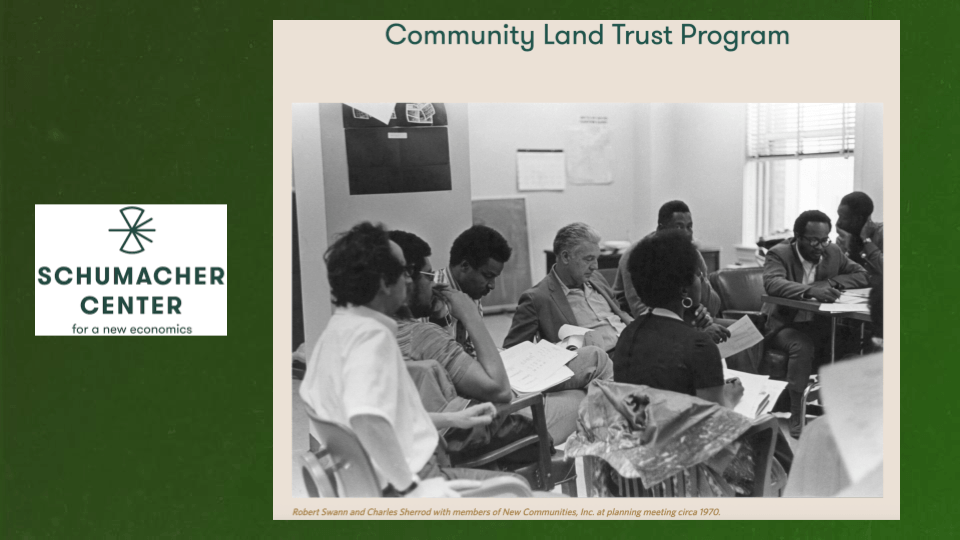
And Susan Witt and the Schumacher team have done such incredible work over the last 4+ decades supporting the transition of land to community ownership—a valuable technology for all people everywhere.
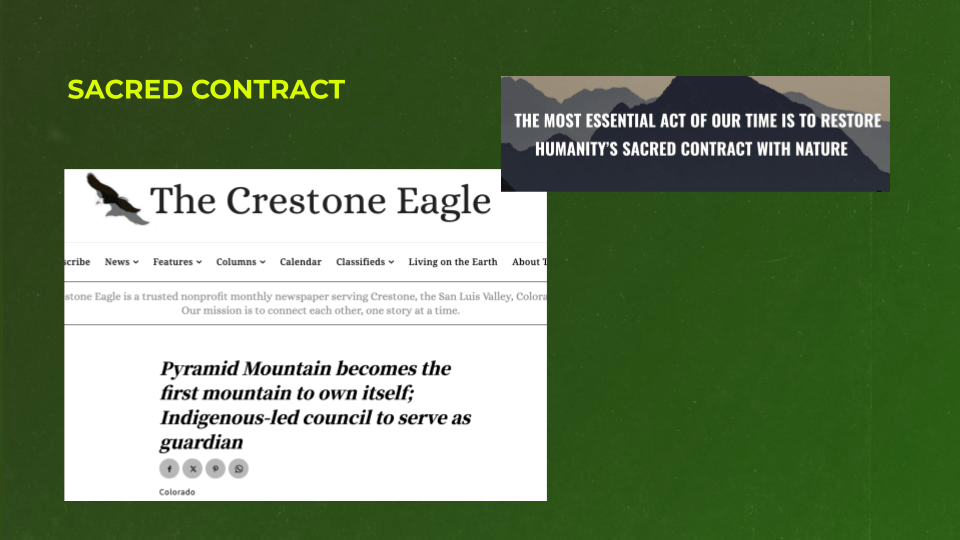
Our colleague Jennifer Menke has recently been working with a team called Sacred Contract that is supporting the liberation of land from human ownership—using a legal structure that enables the more than human inhabitants of the land to “own” itself and to begin to break the paradigm of human domination over nature. Jennifer and team recently supported Pyramid Mountain in Southwestern, CO to become the first sovereign mountain in North America and are looking at working bioregionally across that region and creating a BFF to support ongoing regeneration.
A technology we are really excited about and are looking for the right place to try is a special economic zone called a regenerative economic zone that operates under a customized, place-based regulatory framework within a host jurisdiction—granting it special permissions and governance powers to enable regenerative and life-aligned economic activity. There aren’t any applications of this approach yet that we are aware of, but we are interested in experimenting with this in the right place.
Cooperative ownership structures: At a high-level, we know we need to shift ownership of our core services and infrastructure to cooperative ownership to prepare for the great simplification. There is so much good work out there supporting the development of co-ops and bringing co-ops together in solidarity, but I am sure we all agree, there’s more room to realize the power of this technology as we engage in economic transition.The Center for Economic Democracy is doing some great work in this space in this bioregion—including supply chain mapping for co-ops.
Which connects to the next tool: import replacement, which can help to build solidarity between life-aligned organizations in a bioregion, as well as between bioregions.
Mutual aid networks—the more disasters we face, the more we realize what an appropriate technology these have always been and will continue to be. Mutual Aid Networks have been so many things in so many places. They provide disaster response, grassroots healthcare and insurance, and adaptive support. They’re also engines of joy and cultural resilience.
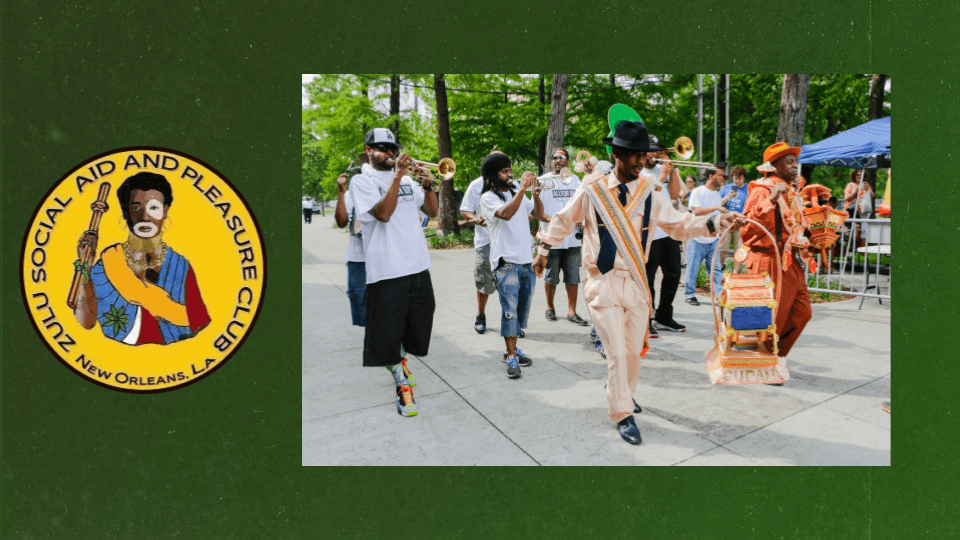
We’ve been inspired by the social aid and pleasure clubs in my hometown of New Orleans that turn celebration itself into a form of solidarity, healing, and collective power.
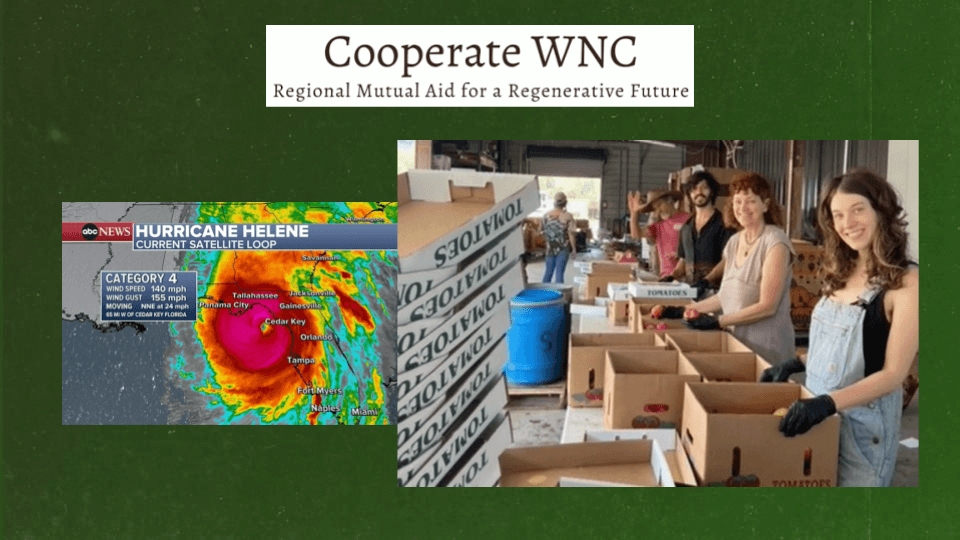
We’ve also seen how amazing mutual aid and cooperative organizations like Cooperate WNC in Western North Carolina are creating and serving as appropriate technology.
When hurricane Helene hit, they were positioned as prepared community leaders who were able to get to work, meet demand for their services, and educate others about the technologies they are stewarding. And that demand has sustained post disaster.
Tyler
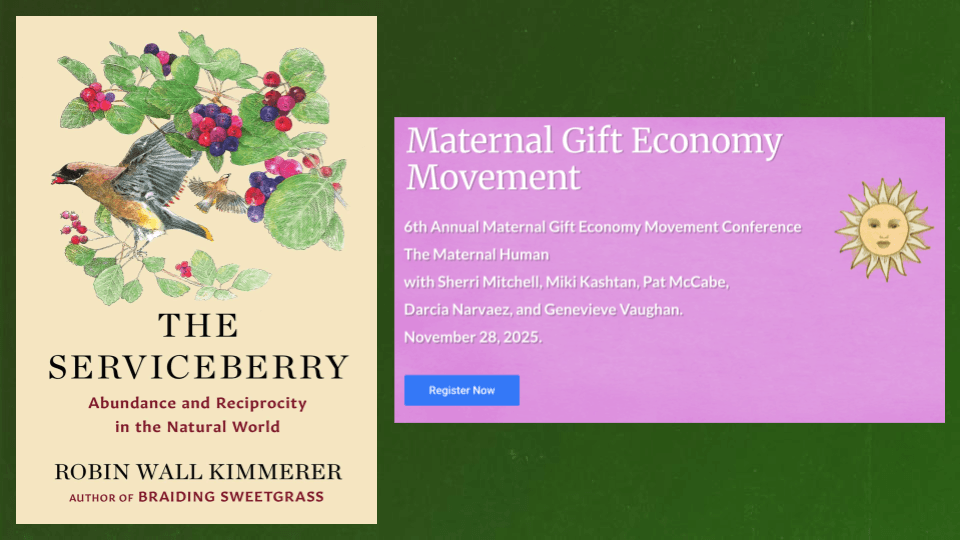
Gift Economy Hubs—As Robin Wall Kimmerrer shares so compellingly in her book The Serviceberry, nature’s gift economy is already operating all around us, including the way many of us give and receive freely with others with no expectation of return. Gift hubs can serve as practice spaces where we can relax our cultural norms of transactionalism, valuation, and simply practice meeting needs. Check out an upcoming conference on the Maternal Gift Economy next week!
Now, there’s one more area we want to bring attention to.
In the realms of social, economic, financial, and governance technology, we must face the sad truth that humanity’s muscles for prosocial cooperation—our capacity to face life’s risks in interdependence—have significantly atrophied. Colonialism and neoliberalism have violently attacked the commons and the cultural practices of commoning that sustained them for millennia. In their place, modernity drives us towards its crowning achievement of a successful life—accumulating enough money—what nonviolence teacher Miki Kashtan calls a “nonconsensual claim on the earth’s resources,” to retire worry free by exiting shared risk with other humans and the web of life.
These torn and weakened muscles of cooperation need tender care. We must attend to our intergenerational trauma, including wounds that pit communities against each other and wounds around money itself. We must create healing, educational spaces that help children and adults cultivate skills of nonviolence, cooperation, and compassion. The Maternal Gift Economy, and the Global Nonviolent Liberation Community’s Deaccumulation Lab, offer an inspiring vision and practice context where individuals and groups can discover the fears, beliefs, and wounds that disrupt our capacity to simply flow resources towards needs in reverence for and trust in life.
Samantha
As we’ve experienced today, we are wealthy in inspirational vision and case studies from specific projects (often at the edge of the mainstream or what is visible to most people). However, we have yet to see whole bioregional economies in the global north successfully demonstrating a comprehensive and densely networked application of these visions and technologies.
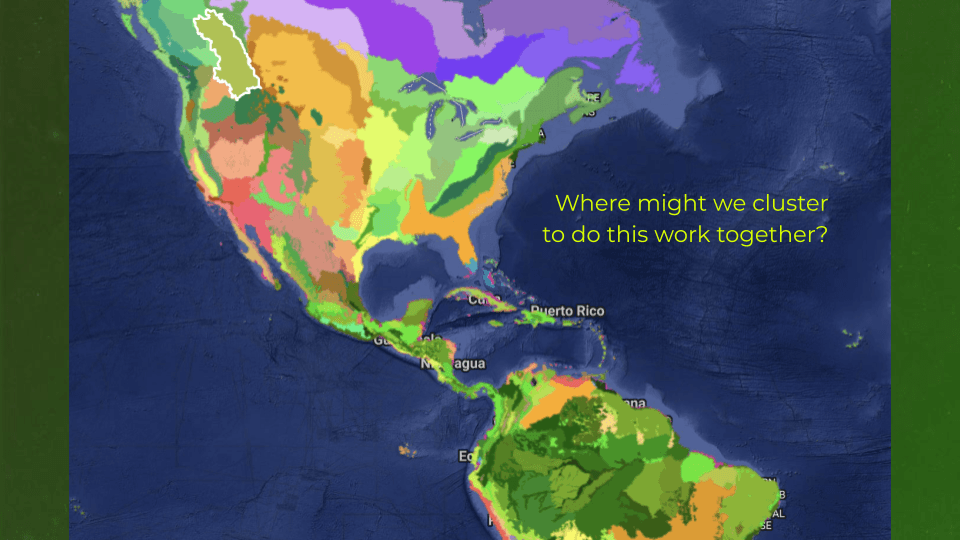
We need this work going on in every bioregion, all at once. And, for bioregional economies and appropriate technology to gain deep adoption, we believe there is a need to focus in a set of specific connected places to collaboratively support diverse and synergistic experimentation, document and evaluate these experiments, and tell coherent and powerful stories about their results and emergent potential.
This is what we are excited to be a part of during the next segment of our BioFi journey. One of the bioregions we are excited to deepen in is this one—the amazing Berkshires and Hudson Estuary that are so near and dear to our hearts. We are so grateful to have Susan, Matt, Alex, Chris, David, the whole Schumacher team, and so many of you here today, as collaborators and we are looking forward to engaging more deeply in this work in 2026.
Now, let us bring today’s journey to a close.
IX. Reality Check & Centering – Who are we being asked to become?
We believe bioregions are the right scale, bioregional economies are the right context, and bioregionalism is the right practice for developing and distributing the appropriate technologies that can catch us in periods of disruption, and serve as the soil from which life-affirming cultures grow.
Our relationships with these technologies, and their relationships with each other, will form the fabric of our experience and what we phenomenologically experience to be extensions of our minds and our physical bodies. They will make us.
So let us be careful, very careful, not to assume we have the design blueprints all figured out—especially those of us who may have found success and esteem in this life by efficiently wielding the technologies of modernity. In the intensity of these times and in the urgency of justice, let us be careful to not force our particular visions onto the world. Let us not close the doors to mysterious, unfamiliar, and unintelligible futures that are whispered to us in unfamiliar tones, rhythms, languages.
Rather, may we tend to possibility, together.
We’ll close with a poem from Nora Bateson:
When culture is disassembling, it is also reassembling.
The tone, the aesthetic, the language, and mutual care is what will FORM and in-FORM the connective tissue
of the new linkings.
The tone matters.
Kindness is a tone.