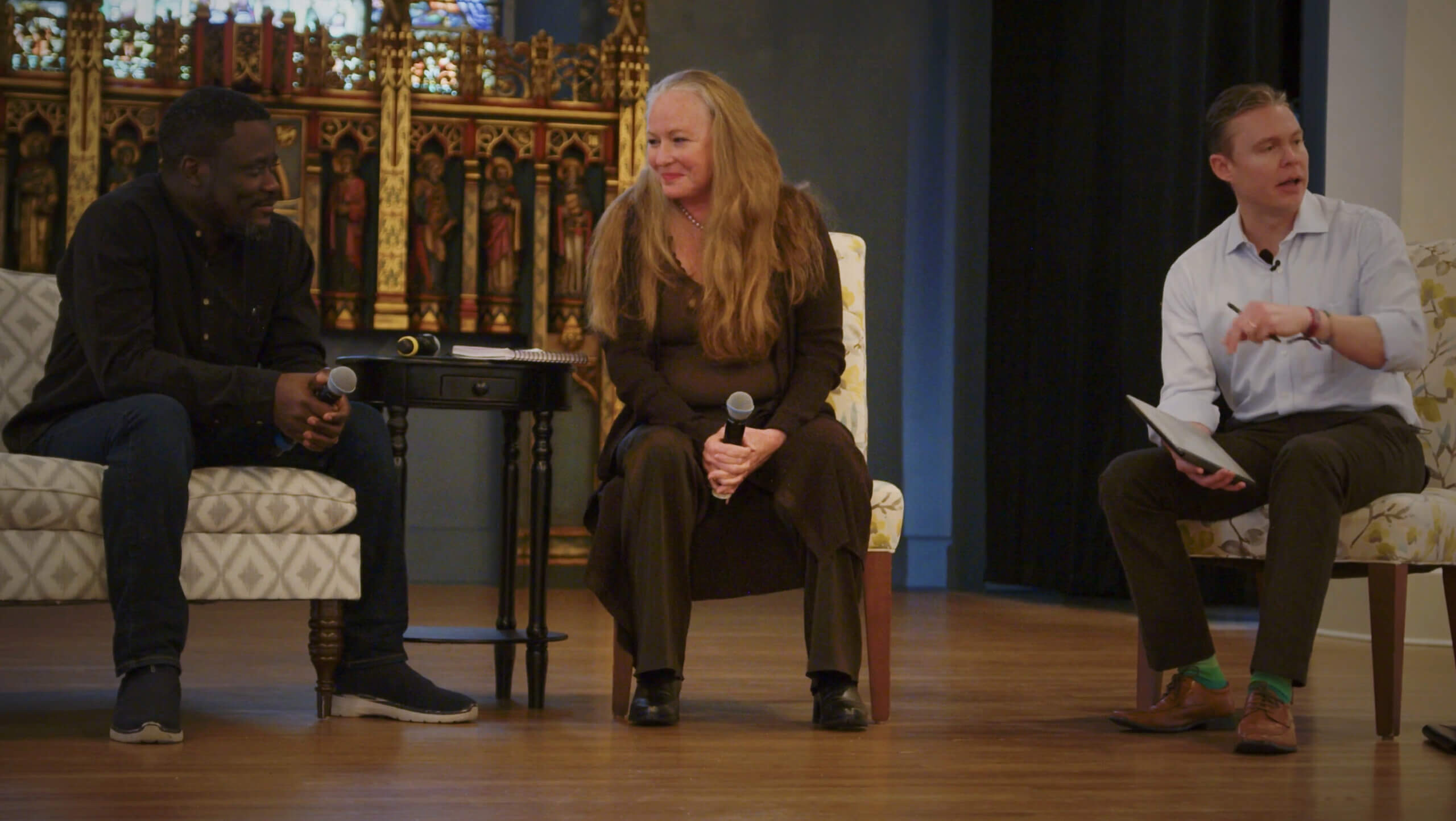
There is a growing sense that the frameworks we rely on—political, linguistic, cultural—are no longer able to hold the complexity of the present moment. On March 7th in Great Barrington, Báyò Akómoláfé and Nora Bateson joined Alex Forrester for Unnamed: A Conversation at the Edge of Sense, inviting participants into a different kind of encounter: one that resists immediate resolution, and instead lingers in uncertainty, relation, and emergence.
From the outset, the gathering represented a departure from conventional discourse. This was not a conversation designed to produce clarity or consensus, but one that asked a more difficult question: what becomes possible when we loosen our grip on naming, categorization, and certainty?
The Limits of Names
A central thread throughout the conversation was the insufficiency of names.
Bayo framed naming not as a neutral act, but as something entangled with power, history, and control. Modernity, he suggested, tends to equate naming with knowing, and knowing with being—collapsing the complexity of life into fixed categories.
“Modernity’s hospitality conflates the name with the being… It basically says what we know is what exists. If it’s beyond us, it’s because it hasn’t been named yet. But you see, sometimes we name things so assiduously that we get trapped in the codes that we spring. They become incarcerations. They become prisons in their own right. And so we start to circle like ants in a death spiral. And we’re not able to sense the world or be in the world in any other way except within the architecture of the ordinary, the architecture of the obvious.”
Yet names, he argued, are never complete. They carry “secret lives,” shaped by context, history, and hidden meanings.
“Names are not as totalizing as we think. Names go only so far. Like Nora says in her book, names are like spells. Words are spells. But the world exceeds nameability. The world exceeds legibility. The question we’re asking today is what spills beyond the name? What is lurking behind legibility? What else wants to happen or what else is already happening beyond our categories?”
Language, Power, and Fugitivity
Bayo offered a powerful historical example drawn from the transatlantic slave trade. Enslaved Africans, forced to adopt the religious beliefs of their captors, embedded their own cosmologies within imposed names—hiding meanings beneath the surface.
“What [the slaveowners] didn’t realize was that hidden in those names were the names of their own gods that they remembered. They inseminated Peter with Eshu. They said we’ll say Paul, but what we really mean is Oshun, right? So they took the Orisha name and they put those names inside the containers that their masters could comply with. They hid viruses in the codicil of legibility.”
This, he described as fugitivity:
“Fugitivity is not running away. Fugitivity is the inability of place to completely hold a body. It means you’re not fully held. You cannot be fully held because you only show up partially.”
The Breakdown of Shared Language
Nora extended this idea into the present moment, describing a growing fragmentation of communication itself.
Language, she noted, increasingly functions as a signaling system—marking affiliation rather than fostering understanding:
“The words that we’re using become flags that say ‘I’m on this team.’ Did you hear that word? I’ve done this work. Did you hear that word? I’m over here. I believe in this thing. And so we become a collage of these various signals that say you can love me because I’m this way with you. Or you don’t have to love me because I’m not on your team. And they bring us together in familiarity and they divide us. But are they us?”
In a landscape shaped by surveillance and polarization, speech becomes constrained. Every statement is categorized and, often, weaponized:
“What’s happening in this moment, when surveillance is everywhere, when the codes and the scripts of politics, of the education world, and of spirituality have somehow lost all of us? Somehow those codes can’t hold connection to spirit. Somehow those codes can’t hold learning. Somehow those codes can’t hold health or illness or healing.
Then what? When everything you say can and will be used against you. And the comment thread is an ever binary-making monster. ‘I agree. I disagree. It’s great. It’s terrible.’ What happens to our ability to be together?
The Unnamed as a Space of Possibility
As Bayo explained, the unnamed is not some separate land or untouched forest for our “gentrifying minds” to colonize:
“It’s not that there is something called the unnamed over there. The idea of the unnamed is that names are not particularly dedicated to identification… they have secret lives… strange commitments.”
Perhaps it is not outside of language, but within its limits—where meaning is still developing.
And Nora warned that not everything should be immediately named or fixed:
“Some things should be said and some things should not be said…Sometimes the demon is down there where things are forming and is not yet formed, and while it’s still forming, it can be moved. Call it up as a demon, and it’s a demon.”
Staying with Uncertainty
As to be expected from Bayo, throughout the conversation, there was a consistent refusal to offer easy solutions or prescriptions:
“This is not a blueprint. This is not a political project that arrives at utopia. This is staying in the place where words curdle and stutter and where we don’t exactly know what we’re saying, but we know that the world does not depend on our saying it. And there’s something to be done with that.”
Instead, the invitation was to remain with the discomfort of not knowing—to engage with the world as something dynamic, relational, and unresolved.
The conversation ended, appropriately, with a poem by Nora, called “Mama Now.”
Your eyes will see the derailing of assumptions,
Your hands will hold the crumble of the old Matrix.
I do not have any authority to lean into.
I have empty pockets where parents used to advise their children.
I do not have any maps, myths, or mother wisdom for you.
I can fix your breakfast, but not the culture.And when you ask about how to be a good person,
I cannot lie to you.
Everything you touch in a day is in some way bloodied.
You have been born into an edgeless violence.But I will not judge or measure you
Against a bygone metric.
I’m here too, ready to learn with you,
Unsure how to be or who to be.
I can only read fragments of your worry
As the future is a horizon of confusion.I cannot protect you,
And yet it is my only job,
Aching as I witness from this side of the hourglass.
Other generations of parents knew the outlines:
School, career, family, and retirement.
But your life will be another shape entirely,
Forming in the fractures.When you say you need a goal,
I offer you an expired ticket.
Superficial memes roll off the tongue
Right into your detector.
Success in the existing system is not going to do you much good.Your integrity is your rage,
And I will nourish it.
Your dignity is your curiosity,
And I am tiny beside it.
Your courage is your pain,
And I will sing to it with you.We will riot together.
We will notice the nuance of small graces in the day.
We will wash the grit of loss for each other.I am your mama,
And your future is the story of a storm.
I am your cabin,
Your boots,
Your rucksack.
You can access the full video recording of Unnamed here.
Warmest Wishes,
Staff of the Schumacher Center