MS: Susan, thank you so much for joining us today. The Schumacher Center was founded in 1980. What was the founding vision?
SW: Fritz Schumacher published Small Is Beautiful: Economics as if People Mattered in 1973. Among other things, the book argued that the most logical approach to economic development was to produce locally for local consumption. The goal of Bob Swann and other founding directors was to amplify the message of the book both in theory and practice.
MS: Over the 45 years you’ve operated, what would you say have been your greatest accomplishments?
SW: In 1994, Schumacher’s family donated his personal books and papers to the Schumacher Center. Since then, the collection has grown to include the libraries of some of the most respected decentralist thinkers from the 1960s, 70s, and 80s. The works are catalogued and maintained in our beautiful office and research library, where they can be accessed by a new generation of activists.
Along the way, we convened the Annual E.F. Schumacher Lectures, providing a forum for new voices working to build thriving local economies. Each lecture is transcribed, edited, and published in our lecture pamphlet series.
Our website is a treasure trove of decentralist history and stories from local economies.
MS: You’re one of the few people I know who has been in the “local economy movement” longer than I have. How do you think we’re doing? Where are we winning? And what needs to change?
SW: The local food movement was a wonderful impetus to the local economy movement, driven by consumers’ demand for fresh food, not jet-lagged. The Community Supported Agriculture (CSA) movement started in 1986 at Indian Line Farm, just down the road from the Schumacher Center. CSAs, in which consumers share the risk with local farmers, are now well known and broadly established.
What is needed is a citizen-led Community Supported Industry movement to complement CSAs. Community Supported Furniture using local wood. Community Supported Toys—safe, nontoxic, child-oriented. Community Supported Woolens. Community Supported Pottery. At a regional industrial scale. Larger than artisanal. Citizens working together to guarantee a level of production to justify the purchase of equipment and the hiring of workers.
It is not policy that will grow the local economy. It is consumers and producers working together out of shared interest. Random associations. Unpredictable. A spirit of inventiveness and risk-taking. Think of Jane Jacobs and her sidewalk ballet. An insurance agency that plans a new office and is willing to have all the office furniture sourced locally. Big enough to be bankable. Small enough to be beautiful.
MS: You often say that you’d like the local economy movement to focus more on “land.” What do you mean by that?
SW: All production requires access to land and natural materials. Land is nature given. It is finite. No new wealth is generated when transferring land—only speculative wealth. When businesses have to service debt on the land in addition to the costs of production, it often makes the resultant costs of goods unaffordable in the local economy.
Following the leadership of Bob Swann, we advocate holding land in Community Land Trusts (CLTs) to lease out in 99-year leases. The leases provide for private equity in the buildings and other improvements on the land, but not in the land itself.
We have come to realize that all the money in foundations and private philanthropy combined cannot pay for CLT purchases of land in quantities adequate to the needs of local economies. Consequently, we have initiated a movement for gifting working lands (suitable for workforce housing, office, retail, and light manufacturing) into CLTs. Our online directory of CLTs identifies groups ready to accept donations. Or start one in your own region!
MS: Rumor has it that you’re starting an adult education center. What would it look like? And when do you think it might open?
SW: Early in the history of the Schumacher Center, we convened weeklong seminars titled “Tools for Building Sustainable Local Economies.” The course material described the model programs we pioneered in the Berkshires: the Community Land Trust in the Southern Berkshires, SHARE loan collateralization program, BerkShares local currency, Community Builders, Indian Line Farm CSA, as well as applications in other regions.
Those were powerful gatherings. But always the most lasting was when more than one person attended from the same region. They spent the time imagining together how these tools could be applied in their own communities. Not merely a personal acquisition of skills, but a step toward a community-wide training.
Online learning, for a while, took the place of in-person training. Now in the legacy phase of the Schumacher Center’s work, reflecting on what is critical to make lasting change, the board of directors is newly committed to in-person training. The objective is to expand the Schumacher Center’s campus in the Berkshires to accommodate a year-round “academy” for regional economies. Certificate courses rather than formally accredited. Both short and multiyear courses. Where 10 to 20 people from one region can explore strategies for building their economies.
We also expect to partner with aligned groups who can offer their own courses.
We’ve learned over the years not to burden our ongoing programs with debt. We built out the research Library only as funds were available. So we are in the midst of a fundraising campaign with an exceptional property in our sights. We will keep you informed of progress and, of course, will want you on the faculty!
MS: That’s very kind—and of course you can count me in. Let’s shift to local money. In 2006, you embarked on a local currency effort called BerkShares that the New York Times called “a great economic experiment.” How has the experiment fared? What percentage of the local economy, would you estimate, does its transactions in Berkshares?
SW: When Jane Jacobs delivered her extraordinary 1983 E. F. Schumacher Lecture “The Economy of Regions,” she argued that regional economies required their own independent currency to regulate the flow of money appropriate to the unique regional capacities for production and consumption. The depressed Rustbelt of the Midwest would require a lower interest rate to free investment capital, whereas the heated-up Silicon Valley would do well with higher rates of interest to slow investment.
At the Schumacher Center, we had worked with local businesses to issue their own self-financing scrip—Deli Dollars, Monterey General Store Notes, Berkshire Farm Preserve Notes. But it was not until 2006 that we were funded to issue BerkShares. Jane Jacobs died that same year, ahead of seeing the printed currency.
We worked with local banks, which provided the storefronts for local exchange. A division of Crane Paper printed the currency under close security. The handsome design features local heroes and the paintings of local artists.
125,000 BerkShares remain in active circulation, mostly in the Southern Berkshires. Over 300 businesses formally accept payment in BerkShares, while more do so informally and on occasion.
With the rise of digital transactions, the use of paper currency has dwindled. We are exploring an open ledger system to issue a digital BerkShare, while still retaining a close tie with our local banks.
MS: Back in the 1930s, during the Depression, a number of cities and towns used local currencies to revive their economies. Would it be valuable if municipal governments deployed local currencies today? If so, what would they look like? And why haven’t more done so already?
SW: While individuals and organizations are permitted to issue currency by Constitutional authority, municipal governments cannot. We encourage municipalities to partner with nonprofit, regionally based, open membership organizations to issue local currency. Permission to accept tax payments in scrip should be sought by the Department of Revenue for the state. Employment contracts may be difficult to amend, so the payment of wages in a local currency would be on a voluntary basis.
A currency program also could create a scrip to loan to partnering municipalities at no interest or at least lower interest than what is charged on the market. These savings could encourage the citizen taxpayer to participate in recirculation.
In Barcelona, Spain, officials found municipal support of the arts, sports teams, and social welfare agencies was quickly leaving the local economy through purchases at big box stores and other international corporations. They invested in exploring how to issue a Catalonian currency until the mayor and other officials left the country under threat of arrest for encouraging secession.
In her song “Declare Independence,” the Icelandic singer, Björk, admonishes us to:
Start your own currency
Make your own stamp
Protect your language
, , , , , ,
Raise your flag!
Raise your flag (higher, higher)!
Find out which regions had the courage to start their own currencies with our international directory.
MS: One of the things I really respect about your approach to decentralization is that you often work with conservatives. What advice would you give to other groups about the importance of creating a multipartisan coalition for change?
SW: Building a local economy is not a Left or Right issue; it is a community issue. When you are deeply engaged with practical programs, there are wonderful stories to tell. Those stories give credibility to the programs and pull in others engaged locally, regardless of ideology. It is not theories that build local economies, but action—the action of enthusiastically supporting local merchants even when selection is limited, placing a farm into a CLT to lease to a farmer who grew up in the region, serving on the board of a local nonprofit, and advocating that they move to a local bank. Small acts, daily acts, showing up.
MS: I’ve long viewed you as a wise mentor, and you’ve helped launch the careers of hundreds of amazing young people. Many young people today, however, despair about their future and have trouble getting out of bed—let alone building a new world. What advice would you give them?
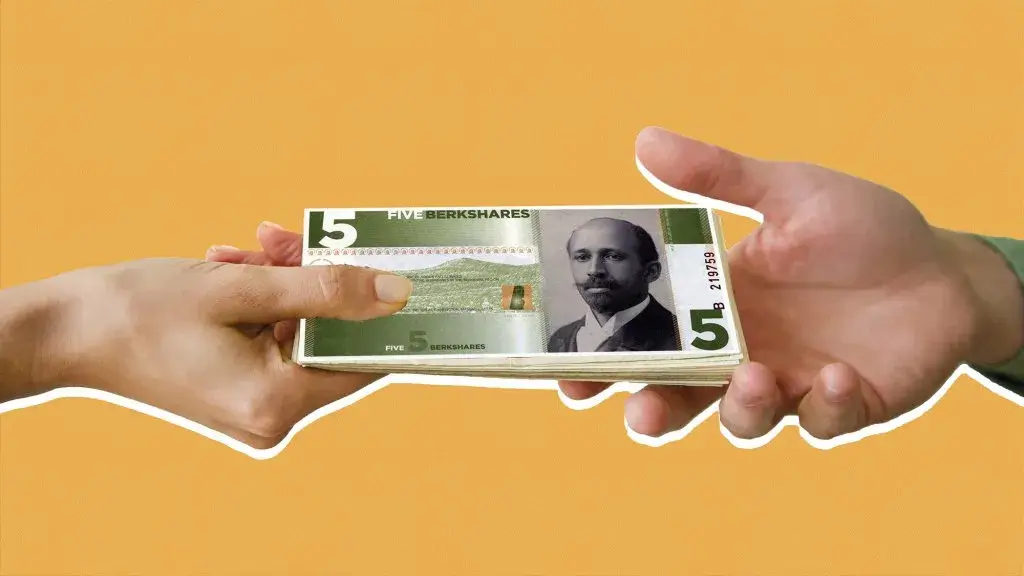
SW: Again, the secret is engaged action. When the Schumacher Center’s young colleagues see the surprised reaction from strangers when they pay for a meal in W.E.B. Du Bois 5s or Robyn Van En 10s or Herman Melville 20s, rather than Lincolns or Hamiltons or Jeffersons, they experience the hopeful possibility of local economies. When they see a young farmer enter a secure lease for land that they helped acquire after many hours of tabling at the farmers’ market and stuffing envelopes, the effectiveness of local action is visible. And seductive.
MS: Finally, do you invest your savings locally? If so, how?
SW: When Bob Swann and I founded the Schumacher Center in 1980, we had a clear vision of the work before us—decommodify land, democratize currency, and cooperativize labor. We did not chase the latest foundation funding. Our needs were simple. No children to support. Bob built our small home on CLT land. There were lean years. If we ran out of funds, Bob would go back to work as a contractor. I would often quip that, “I was a kept woman by a carpenter.”
So, my savings are modest. What savings I have are in cash or BerkShares or in the checking account of a locally owned mutual bank—one of the banks small and flexible enough to participate in the BerkShares local currency program, small and flexible enough to offer mortgages on community land trust land. All my contributions are made in BerkShares to local organizations that I know will circulate them in the local economy.