On November 22nd, 2025, the Schumacher Center gathered key leaders of the contemporary Bioregional movement in Great Barrington, MA to discuss strategies for financing the New Economy. Samantha Power and Tyler Wakefield, Co-Founders of BioFi Project, delivered the 45th Annual E.F. Schumacher Lecture, “The Promise of Bioregional Economies,” followed by a Q&A led by Schumacher Center board member, Alex Forrester.
Excerpts from the lecture follow. You can watch the entire lecture and Q&A here.
Samantha and Tyler set the tone of their lecture with the following words:
Our “why” is life. We are here today in service to life on this sacred garden planet that all of us have been blessed to be born into at this crazy moment in time.

They then continued with context for how they prepared for the occasion:
Beyond the care of holding each other through cycles of death and rebirth as well as clarity and confusion, we found our task was to let go, to let go of all we assumed we knew, the terms, the data, the books, the news headlines, and begin again, to look as clearly and non-reactively as we could at what this world seems to be, what seems to be happening in these times, and piece by piece, day by day, attempt to formulate some story, some true yet partial gesture of meaning that allows us to relate to it all.
This is a full-bodied process made flexible and spacious by deep grieving and made curious and courageous by listening to the visionary wisdom of heartbreak. And it’s a many-bodied process.
Tyler guided the audience through a snapshot of the challenges we’re currently facing as an entangled world:
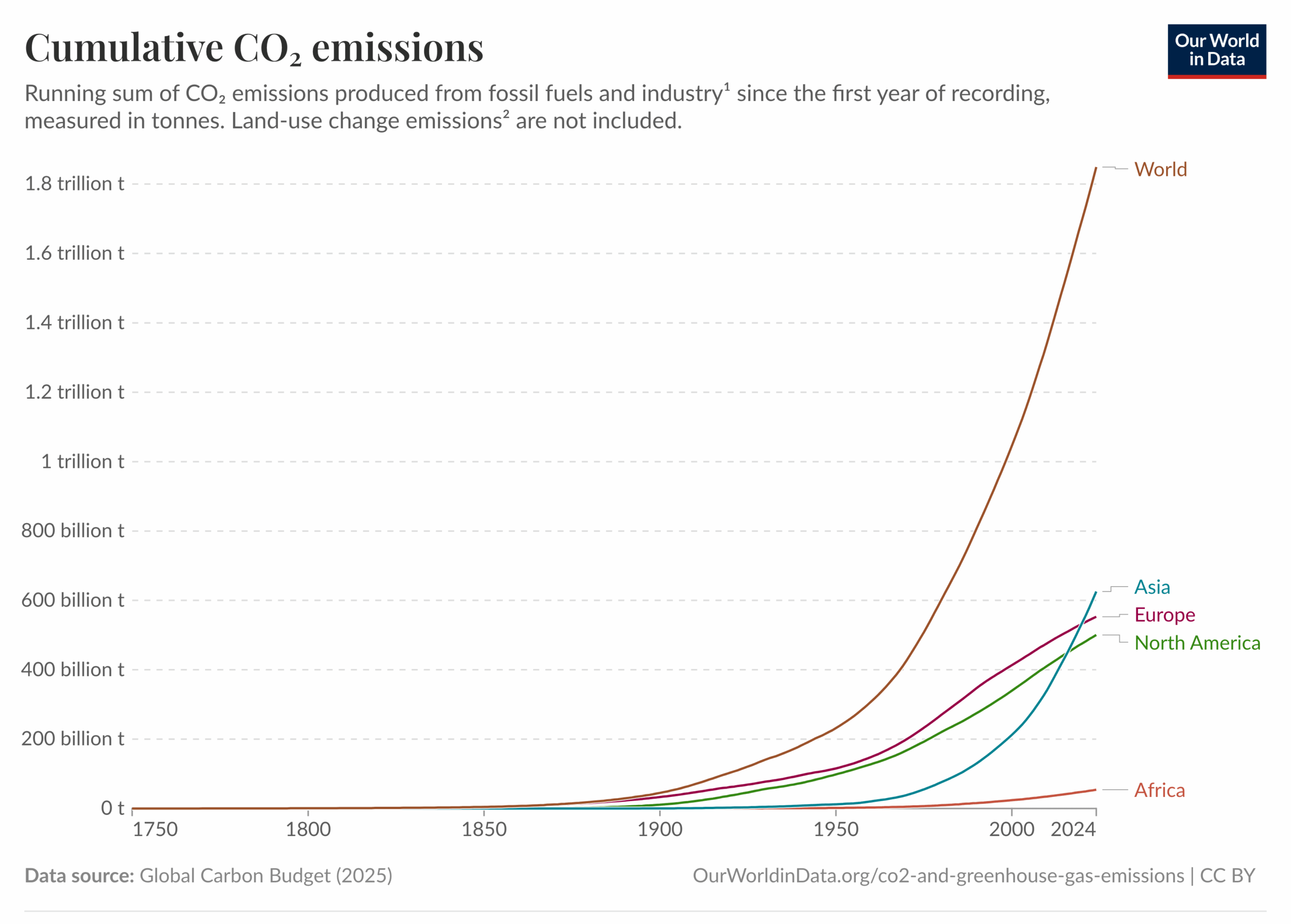
We’re aware of a series of exponential curves indicating that throughout our earth systems, we are depleting resources faster than ever, we are polluting faster than ever, and the trends just keep growing…We are consuming more energy than ever before and despite the rise of renewables, we are still consuming more and more fossil fuels year over year. Our CO2 emissions continue to rise. We have crossed the 1.5 degree threshold outlined in the Paris Agreement as the point at which we need to stay under to avoid catastrophe.
And we’re starting to see scientists predict the collapse of ocean currents that regulate the hydrological cycles and climate of the earth.
The people, often Indigenous folks, defending land from extraction and theft, are being killed and disappeared, largely in the Global South. And the militaries of the world are spending more each year. Trust in the United States government and other governments is on the decline…We see more people over the past 10 years becoming forcibly displaced. We see mental illness being diagnosed at rising rates in U.S. undergraduates.
He continued:
Before Samantha and I explore stories of a more beautiful future and how we might get there, we think it is important to sit for a moment with just how compromised we are. We are contextually enmeshed in technology, systems, and cultures that have been the product of millennia-long civilization-building processes. In particular, over the past several hundred years of intensified civilizational design, the myth of the separate, autonomous individual seeking liberty and happiness has been both the primary design assumption and client.
Our task is to let go, not just of these design assumptions, but the project of civilization-building itself, to find our way back into the role of participating fully in the aliveness of this wondrous ecological web. Yet, no matter how many times we can impressively slip in the word ontology into our day, during that same day we will still be silently designed over and over by the technologies and systems that we have surrounded ourselves with. In Good Work, [E.F] Schumacher describes this trap, saying, “Once a process of technological development has been set in motion, it proceeds largely by its own momentum, irrespective of the intentions of its originators. It demands an appropriate system, for inappropriate systems spell inefficiency and failure.”
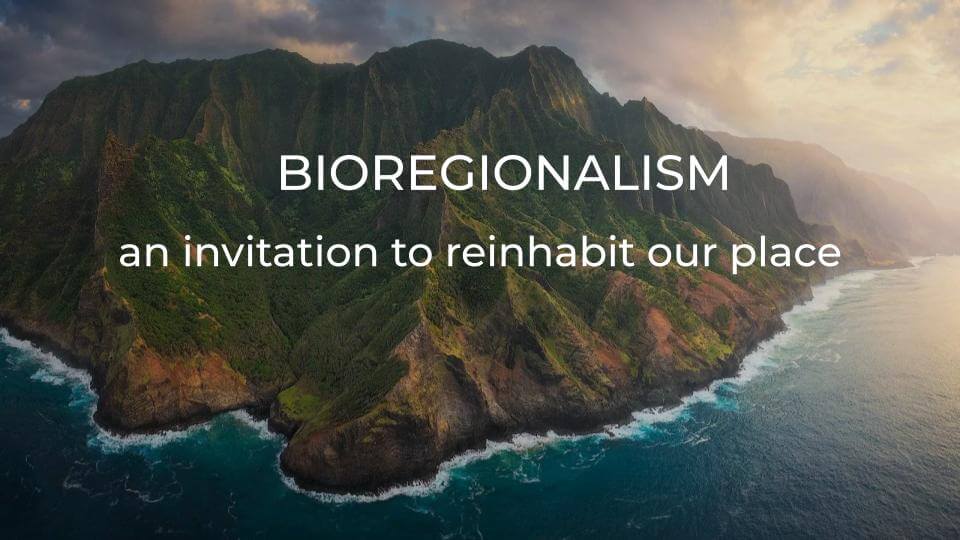
In response to the largely disheartening picture they had, at this point, painted of the current state of the world, Samantha and Tyler then posed the question, “Where does possibility grow?”. Their answer: in the bioregional.
We believe that bioregionalism, or what is now popularly being called bioregioning, offers exactly the invitation we need to practice inhabiting a different ontology, worldview, value system, scale of focus, and even relationship to time. And through this practice, we can become different people who create different technologies, giving rise to different cultures to create a different type of civilization.
A little bit about what bioregionalism is before we get into bioregions as the basis for technological development. Bioregionalism is a philosophy, as we understand it, that advocates for societies to be organized around biocultural regions or bioregions, where economic activity, ecological management, and governance align with the region’s natural systems and cultures. In bioregions, regions defined by hard lines, soft lines, and human lines, or their physical, ecological, cultural characteristics in the interconnections between these, can be seen as the natural units of place-based regeneration.
And, specifically, they see possibility in bioregional economics:
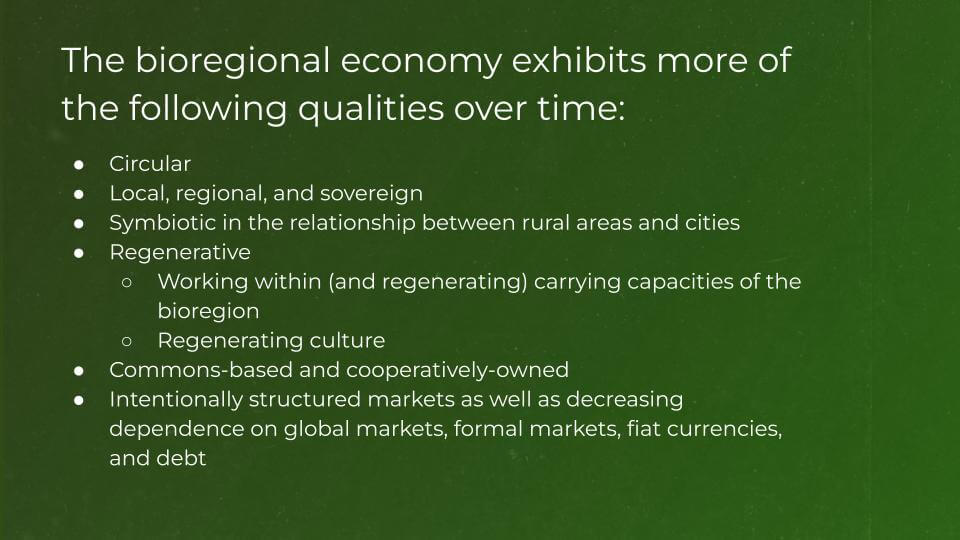
Building on the philosophy and frame of bioregionalism is a growing and recently re-energized body of work that is highly relevant to surfing the coming waves of the great simplification and responding to the broader meta-crisis. Work we call bioregional economics and bioregional finance.
This is the space we at the BioFi Project have been focused on. Both bioregional economics and bioregional finance advocate for appropriate financial and economic technologies that serve the well-being of all life in a bioregion. These two fields of work also chart the path to create a wide range of appropriate technologies and generate demand for them by building new appropriate markets.
Inspired by E.F. Schumacher’s concept of appropriate, or intermediate, technology, Samantha then offered an extensive list of “appropriate technologies” consistent with a bioregional economy:
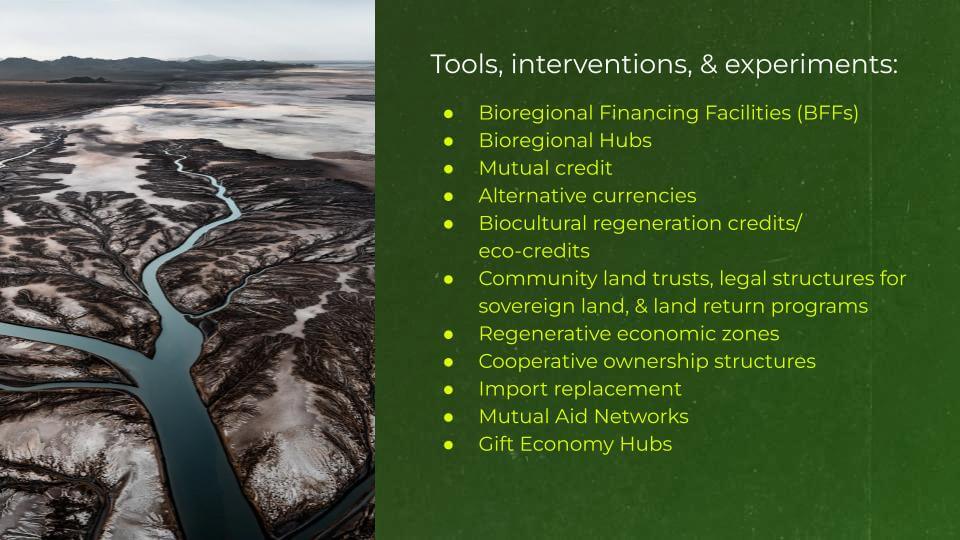
Out of the bioregional regeneration strategy, we can start to identify relevant tools, interventions, and experiments that can support the transition to the bioregional economy. These might be considered appropriate technologies. I am now going to share some examples of relevant tools, interventions, and experiments. Some of these are things we’ve created, some we’ve supported, and others we’re just admiring from afar.
These include:
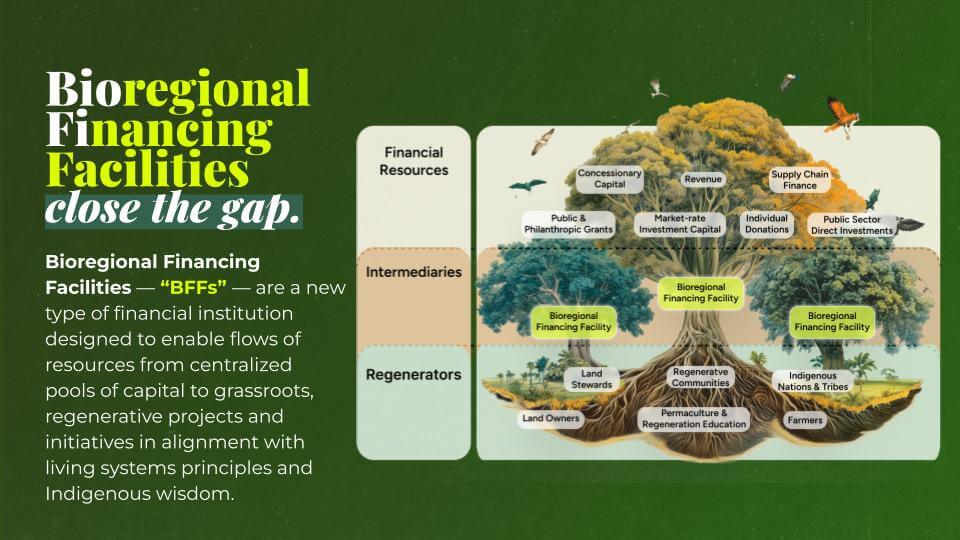
Samantha and Tyler brought their lecture to a close with the following remarks:
We believe bioregions are the right scale, bioregional economies are the right context, and bioregionalism is the right practice for developing and distributing the appropriate technologies that can catch us in periods of disruption and serve as a soil from which life-affirming cultures grow.
Our relationships with these technologies and their relationships with each other will form the fabric of our experience and what we phenomenologically experience to be extensions of our minds and our physical bodies. They will make us. So let us be careful. Let us be very careful not to assume we had the desired blueprints all figured out, especially those of us who may have found success and esteem in this life by efficiently wielding the technologies of modernity.
In the intensity of these times and in the urgency of justice, let us be careful to not force our particular visions onto the work. Let us not close the doors to the mysterious, unfamiliar, and unintelligible futures that are whispered to us in unfamiliar tones, rhythms, and languages. Rather, may we tend possibility together.
The full lecture and Q&A session can be viewed on our YouTube channel. Please share Samantha and Tyler’s hopeful and energizing words widely.
Warmest Wishes,
Staff of the Schumacher Center