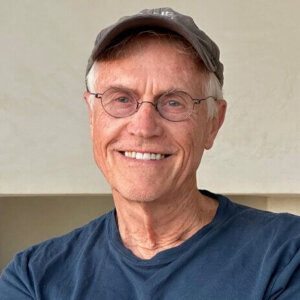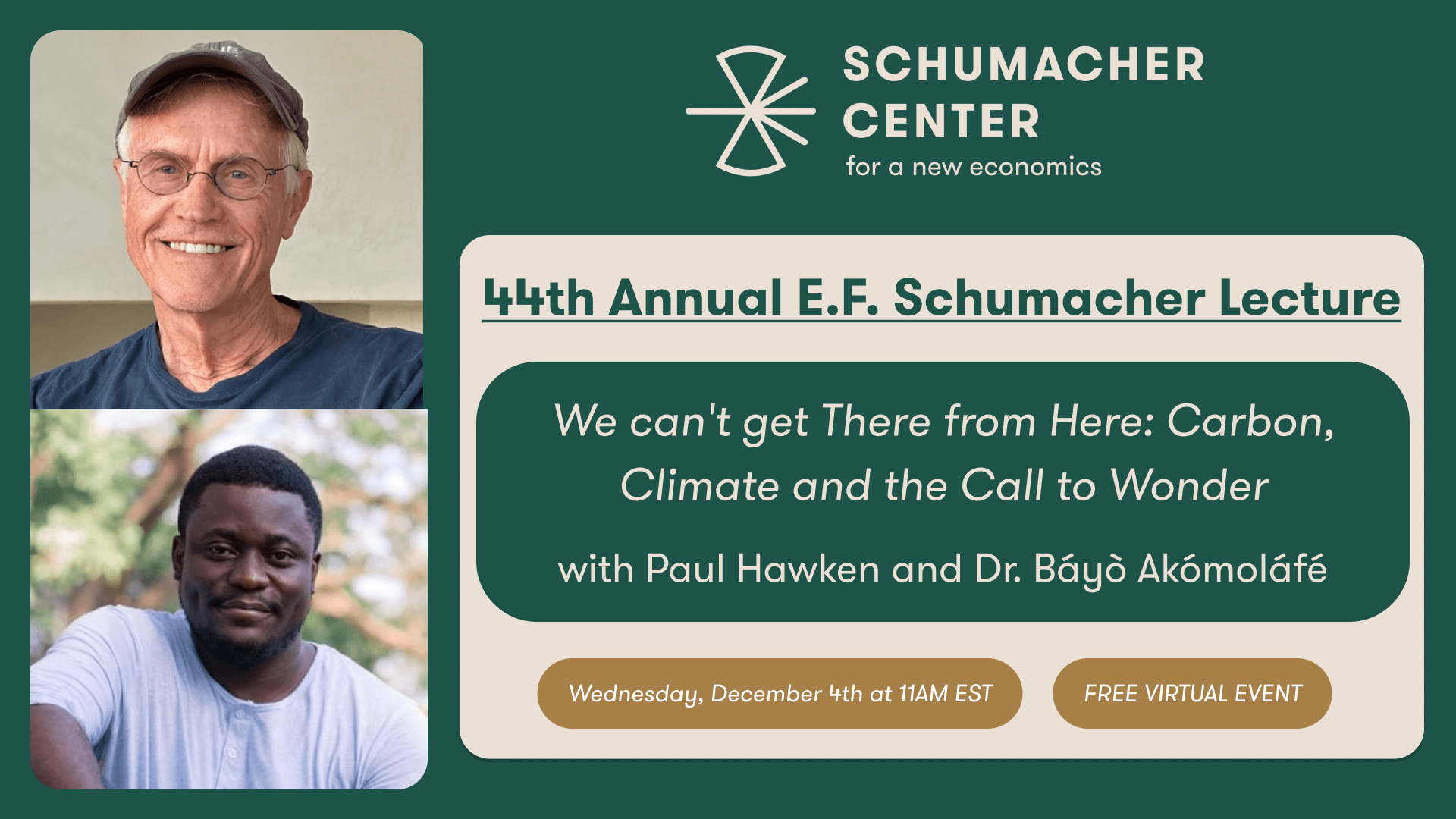
The 44th Annual E.F. Schumacher Lecture will feature Paul Hawken and Báyò Akómoláfé in conversation. This virtual event will be hosted and moderated by Alex Forrester, Board Member of the Schumacher Center for a New Economics and Co-Founder of Rising Tide Capital. The date is December 4th at 11:00AM EST. Registration is free.
Báyò invites us all into the conversation with the following:
Two tourists on a backroad in Ireland stop to ask a crofter leaning against his stone fence, “Can you tell us how to get to Dublin?” The farmer nods, looks far down the road to his left, then swivels and does the same to the right. He turns back and says, “Well, if I were you, I wouldn’t start from here.” When through their quizzical glances and smiles they ask why, the crofter replies, quite simply, “You can’t get there from here.”
In this theoretically significant Irish joke, “here” and “there” might be seen as more complicated than their frequent usages might suggest they are. Today, in the ways institutions and climate activisms around the world articulate planetary problems, seek out solutions, and imagine futures beyond our troubling moments, one might say they are actively attempting to move from ‘here’ to ‘there’. The problem, however, with drawing a straight line between ‘here’ and ‘there’ lies in the occlusion of what ‘here’ is – and what ‘there’ signifies.
‘Here’ is not just location; it is a cosmovision of humanity’s place in the universe – a story about what ‘we’ can do, what ‘we’ can achieve, what ‘we’ are accountable to, and what the world around ‘us’ is doing. It is the myth of mastery, a paean to our divinity, and the launchpad for our many attempts to leave the material behind and escape into the transcendent. ‘There’, on the other hand, often marks our hopes for a different kind of world, one in which the deleterious events that characterize the Anthropocene are no longer the order of the day. One might say that ‘There’ is our hope for arrival.
But in a relational world that moves, sighs, and sings, prospects of neat arrivals hint at our faithfulness to world-denying performances, which force an aesthetic of emergency, of technobureaucratic mastery, and of reductionistic applications.
What happens when cartography and the institutional certitudes that produce neat maps buckle under the weight of something else? When north is no longer north, south no longer below, and ‘here’ – the prestigious mark of our positionality – becomes slushy and begins to misbehave?
Paul and Báyò want us to appreciate a planet composed of flows, a world too dense and invested and animated for uncomplicated departures and exclusive arrivals. A world marked by errant lines, not static points. Through their investigations of indigenous traditions, they suggest that the ways we are being summoned to practice care in a time of endings and fire are exactly how the fire keeps burning. When Báyò Akómoláfé insists in his writing that “we are coming down to earth, and we will not arrive intact”, he challenges the ableist trajectories that centralize human actors as masters and background ecologies as passive stages inscribed with human drama.
In the same vein, Paul Hawken refuses to villainize carbon as the ingredient of demise. Instead, opening his new book (Carbon: The Book of Life), he writes:
“Carbon moves ceaselessly through the four realms—the biosphere, oceans, land, and atmosphere. It flows in rivers and veins, soil and skin, breath and wind. It is the narrator of lives born and lost, futures feared and imagined. It is the courier coursing through every particle of our existence… Carbon’s dance of life does not take sides; it is never right or wrong. It is a timeless path that endlessly unwinds before us…When discussing carbon, people refer to atoms instead of magnificence, physics rather than sentience. Life is a flow, a river, not isolated components. The flow of carbon provides better stories, other ways to see, visions of possibility different than the disjointed and chaotic narratives that engulf us.”
For Paul and Báyò, the belief that with good intentions, supreme effort, institutional coherence, and philanthropic benevolence, we could move from ‘here’ to ‘there’, obscures too much. Leaves out too much. It misses how ‘here’ is already a postponement of ‘there’. It misses the wonder along the way, the idea that these times aren’t asking us to travel from ‘here’ to ‘there’, but from ‘here’ to here.
A call to wonder is a call to get lost, to lose our way.
There’s a joke in there, somewhere.
Join us in this public lecture, the 44th in the E. F. Schumacher Annual Lecture series, as authors Paul Hawken and Báyò Akómoláfé investigate through conversation an errant world that flows beyond the solutionism and imaginaries of justice that have incarcerated our organized responses to climate loss.