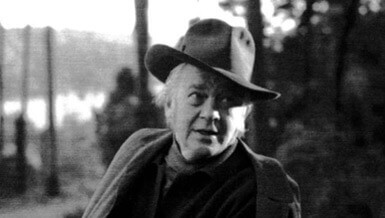
Fritz Schumacher was born on August 16, 1911. He was destined to be one of the most influential voices in the Twentieth Century for protection of the environment.
To mark his birthday, we return to our chapter-by-chapter look at David Boyle’s remarkable study guide, “Small is Beautiful Revisited…50 Years On,” reexamining Schumacher’s 1973 landmark collection of essays in light of our own time. The guide is a tool to spark generative discussions in college classrooms, workplaces, and circles of contemplation. (Each chapter guide is available on our site in addition to a full downloadable PDF.)
Chapter 9 deals with the topic of nuclear energy — a thorny subject divisive in its time as it still is today. Despite its many risks and vulnerabilities, nuclear remains prominent in discussion of energy futures. “Partly,” Boyle tells us, this is “because the prospects of a solar and wind-driven world have not emerged fast enough to reduce our carbon emissions toward net zero.” Still, the guide ends by uplifting alternative energy sourcing examples, such as Good Energy in the U.K., “entirely committed to the Schumacherian world view.”
Excerpt from the Guide to Chapter 9
“The main cause of the complacency – now gradually diminishing – about future energy supplies was undoubtedly the emergence of nuclear energy, which, people felt had arrived just in time. Little did they bother to inquire precisely what it was that had arrived. It was new, it was astonishing, it was progress, and promises were freely given that it would be cheap.”
— E. F. Schumacher, the opening lines of Chapter 9
“As the patron saint of appropriate technology, Schumacher’s spirit was vital to the vision of renewable energy that sustained anti-nuclear activists during the 1970s and early 1980s, when the direction of energy policy hung in the balance. His conviction that reactors were uneconomic in the most fundamental sense – because they worked against the betterment of society – helped stiffen the resolve of the anti-nuclear movement to demand a non-nuclear future.”
— Charles Komanoff, director of the Carbon Tax Center, in the 25th anniversary book (1999)
This chapter is Schumacher’s influential rant against nuclear energy. It was a struggle that – after a number of tense moments – he was to win. A key issue is whether it may only have been a temporary victory.
The text was based on his Des Voeux Memorial Lecture in 1967, Clean Air and Future Energy — Economics and Conservation, published by the National Society for Clean Air in London.
What the Chapter Says
Schumacher starts with a statement about nuclear energy of which he says: “At the time, it seemed highly unorthodox.”
The time he was referring to was six years before the publication of Small is Beautiful – which takes us to 1967. This was also the year in which he gave the lecture on which this chapter is based – so we can assume that he was referring to the reaction to the lecture:
“The religion of economics promotes an idolatry of rapid change, unaffected by the elementary truism that a change which is not an unquestionable improvement is a doubtful blessing. The burden of proof is placed on those who take the ‘ecological viewpoint’: unless they can produce evidence of marked injury to man, the change will proceed… that nuclear fission represents an incredible, incomparable, and unique hazard for human life does not enter any calculation and is never mentioned…’”
As he explains, insurance companies are reluctant to insure nuclear power stations anywhere in the world for third party risk. As a result it was necessary to put special legislation in place with the state accepting liability for nuclear failures. “Yet, insured or not, the hazard remains, and such is the thralldom of the religion of economics that the only question that appears to interest either governments or the public is whether ‘it pays’.”
In 1927, the American biologist, Hermann Muller, published a famous paper on genetic mutations produced by X-ray bombardment. He argued that people would suffer from the radiation – especially perhaps unborn children.
“A new ‘dimension’ is given also by the fact that while man now can – and does – create radioactive elements, there is nothing he can do to reduce their radioactivity once he has created them. No chemical reaction, no physical interference, only the passage of time reduces the intensity of radiation once it has been set going. Carbon-14 has a half -life of 5,900 years, which means that it takes nearly 6,000 years for its radioactivity to decline to one-half of what it was before. The half-life of strontium-90 is twenty-eight years. But whatever the length of the half-life, some radiation continues almost indefinitely, and there is nothing that can be done about it, except to try and put the radioactive substance into a safe place…”
Strontium-90 was the isotope that was endangering the lives of young children thanks to the atmospheric nuclear testing in the 1940s and 50s. We hear far less about it these days.
Why did we allow these monstrosities, he asks – and his conclusion is guilt about the bomb. “There is an understandable drive on the part of men of good will to build up the positive aspects of nuclear energy simply because the negative aspects are so distressing,” wrote the American nuclear physicist, Alvin Weinberg. Weinberg also described nuclear energy as a “Faustian bargain” – the first to do so.
Schumacher says:
“Our instinct of self-preservation, one should have thought, would make us immune to the blandishments of guilt-ridden scientific optimism or the unproved promises of pecuniary advantages….Once many more centers of radioactivity have been created, there will be no more choice, whether we can cope with the hazards or not.”
The issue is that we do not know how to deal with the waste produced by nuclear energy… At the time, the solution on both sides of the Atlantic was to dispose of the high level waste in the sea. Luckily, that doesn’t happen any more:
“The evident danger is that man may have put all his eggs in the nuclear basket before he discovers that a solution cannot be found. There would then be powerful political pressures to ignore the radiation hazards and continue using the reactors which had been built. It would be only prudent to slow down the nuclear power programme until we have solved the waste disposal problem…. Many responsible people would go further. They feel that no more nuclear reactors should be built until we know how to control their wastes.”
Schumacher’s conclusion then is particularly pungent:
“No degree of prosperity could justify the accumulation of large amounts of highly toxic substances which nobody knows how to make ‘safe’ and which remain an incalculable danger to the whole of creation for historical or even geological ages. To do such a thing is a transgression against life itself, a transgression infinitely more serious than any crime ever perpetrated by man. The idea that a civilization could sustain itself on the basis of such a transgression is an ethical, spiritual, and metaphysical monstrosity. It means conducting the economic affairs of man as if people really did not matter at all.”
We remain grateful for Schumacher’s strong cautionary voice that resonates across the decades. And we salute him on what would be his 113th birthday!
Continue to Guide to Chapter 9
To explore more deeply the themes put forward in Small Is Beautiful, visit our new Decentralism File: featuring 120+ heuristic selections of decentralist thought spanning 2,500 years.