The following message was circulated by BerkShares, Inc. last Friday to members and participants of the local currency initiative. We are pleased to share this timely reflection on W.E.B. Du Bois’ legacy more broadly.
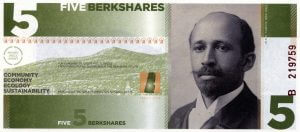
Each BerkShares denomination celebrates a different local hero — a figure who represents some of our communities’ highest ideals. Our 5 BerkShare note features Great Barrington-born civil rights activist and NAACP co-founder, Dr. William Edward Burghardt Du Bois.
BerkShares proudly joins our local partners in honoring Du Bois’ legacy on his Birthday, February 23. We reflect on the relevance of his broad and generous vision for change in our present time.
W.E.B. Du Bois, Champion of Community Economics
Among W.E.B. Du Bois’ many contributions to the Black Civil Rights movement is his inspired thinking on economic justice. Attentive to the racial dimension of economic exploitation in post-reconstruction America, his research highlighted the powerful role community played in securing just, thriving economies of place.
Works like “The Upbuilding of Black Durham,” (published nine years after The Souls of Black Folk,) show Du Bois inquiring into a flourishing black community, one which had developed robust manufacturing and service sectors. He sought to understand the economic success, documenting insights that could help others to build enduring community wealth.
A sociologist by training, Du Bois was an impeccable statistician. Visiting Black communities around the country, Du Bois would inventory the black-owned enterprises. Hand-written lists tallied the groceries, the drug stores, the barber shops. In Durham, he noted “a shoe store, a haberdashery, and an undertaking establishment,” as well as factories that produced “mattresses, hosiery, brick, iron articles, and dressed lumber.”
In other communities striving for sustainable development, the inventories highlighted critical gaps. Mapping in detail what a community already produces for itself makes visible what opportunities exist for import replacement. Where furniture-makers are buying stuffing from outside the community, for example, suggests an untapped market for local wool processing.
This inspiring piece of Du Bois’ legacy is particularly resonant with BerkShares’ broader mission to create a more self-reliant Berkshire economy. Building on the strategy of import replacement, our local currency can serve as a tool for a more circular local economy; one that sustains creative, purposeful livelihoods for its many diverse residents. One that is resilient to the shocks we now expect from the globalized economy.
Du Bois reminds us that healthy “habits” of seeing and acting must be consciously cultivated by us all. Using BerkShares is one of many small habits that shape empowered citizens capable of directing their own local economy.