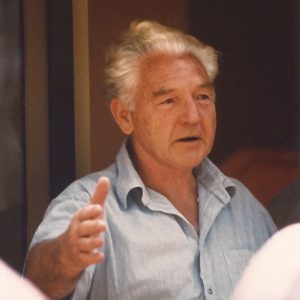
This audio recording features the Cambridge Forum program, “Should We Switch to Small Technology?” which was held at the First Parish in Harvard Square, Cambridge, Massachusetts in 1977. The program was also broadcast over the radio. The transcription below covers the opening remarks of Schumacher Center Co-Founder Robert Swann, who participated on a panel with a question period following opening remarks.
Cambridge Forum was originally founded by Rev. Herbert Vetter in 1967 as a program of the First Parish (Unitarian Universalist) in Cambridge to provide a platform from which to examine social issues. From the beginning, it brought expert scholars, writers, policymakers, and thinkers face to face with a public audience in a lively and engaged dialogue.
Reverend Vetter: Welcome to another in our series of Cambridge Forum programs on ethical issues in America, entitled “Should We?” Tonight we ask: “Should We Switch to Small Technology?”
The speakers will be: Robert Swann, Director of the International Independence Institute; Richard Eckaus, Professor of Economics at MIT; Langdon Winner, Assistant Professor of Political Science at MIT; plus a person who will serve as questioner of the speakers on this issue, [name unrecognized], Vice President of Arthur D. Little, Incorporated.
Our weekly forum, broadcast by the WGBH Educational Foundation, via WGBH FM, is open to the public without charge on Wednesday evenings at eight given Harvard Square at 3 Church Street.
The forum is presented by the Social Responsibility committee of the First Parish here in Cambridge, a Unitarian Universalist, and it is co-sponsored by the Interfaith United ministry at Harvard in Radcliffe.
Our first speaker is Robert Swann, Director of the International Independence Institute here in Cambridge. He’s directed that for the past 10 years. He is a native of Ohio, and went to Ohio State University. Before he and Ralph Borsodi formed the Institute, he was a builder and designer in Ohio and Michigan.
The present primary activity of the I.I.I. or international independence Institute, is the development of Community Land Trusts— community-held land. It is a privately-funded organization dedicated to the revitalization and economic development of rural areas. In addition to developing credit and land reform programs in the United States, Mexico, Indonesia and Ireland, the institute arranged for the first American speaking tour of E.F. Schumacher, author of Small is Beautiful: Economics as If People Mattered.
Swann: Thank you, Reverend Vetter. Let us begin by asking, what do we mean by ‘small technology’? Generally today, those of us who advocated a change in focus on technology would use a slightly different name. Schumacher himself has coined the term intermediate technology, but I think most popular today probably use the term appropriate technology. And I think we’re talking about the same thing when we talk about small technology. Other names would include soft technology, radical technology, and so on.
While all of these names may imply, and in fact, often do have a slightly different meaning, I believe that the four characteristics which Schumacher generally uses to describe such technology would generally be agreed on by the various advocates, even though they would apply slightly different adjectives.
These characteristics are, number one, the relative simplicity of a technology or a tool — a tool which can be understood and used by the average person, it does not require a great deal of training or sophistication to do so. For instance, I would say most carpenters’ tools would fall into this category. They’re also an obviously an ancient technology, even though they have been improved from time to time; in many ways, there isn’t a tremendous change in the and tools that a carpenter would normally use. By the same token, a technology should be simple to maintain, easy to maintain— it wouldn’t require an expert to come from some distant place to keep it working. Whatever the working parts are, would be capable to be rather easily-repaired locally.
It would also be a labor intensive technology, rather than a capital intensive technology. By contrast to most of our industrialized technologies, which tend to be heavily capital intensive, Schumacher would put the emphasis on labor-intensive technology. Obviously, this is of supreme importance—of greatest importance—in the developing countries.
It would also be constructed from local materials if at all possible; rather than bringing materials from the distant places to make the tool or the technology. It would be something which could be made relatively locally. Therefore, the emphasis again on greater self reliance.
It would also be, the final characteristic, Schumacher calls non-violent, or non destructive to the environment. It would not be a tool or technology which tends to destroy at the same time.
These characteristics, however, are not meant to be absolute, but rather to be the direction towards which such a technology should strive, and are meant to contrast with the general assumption that bigger is always better. But not to assume, necessarily, that smaller is always better. In fact, Schumacher said one time that, if everybody was advocating small technology, he would advocate larger technology.
The concept was intended by Schumacher, initially, to reply to the problems of the developing countries, where clearly large-scale technology is most inappropriate.
Now, this is not to say, however, that the experts—especially the Western experts—have always been clear that large scale technology is inappropriate in the less developed countries, in fact, rather the contrary. In fact, the concept was developed by Schumacher, in large part to respond to a fairly common situation which he ran into in his work in India and other parts of the developing world, where he was constantly running into a problem like the brick-making plant, which he found in Pakistan: a plant which had been financed by and developed by American technologists under an AID grant. And which, when he found [it] in Pakistan, when the officials took him to see it, was sitting, absolutely idle, wasn’t working at all.
And when he said, when he asked them, “What’s the matter, what’s the problem?” They said, “Well, obviously, we can’t operate it because the materials that is required to operate such a huge plant, making thousands and thousands of brick a day can’t possibly be found in this area without bringing him in from a long distance. And we just don’t have the trucks to transport do it. We don’t have the trains to do it. And the same thing is true of the bricks that it produces. We haven’t got the trains we transport to produce them.”
So, the plant was sitting there idle— millions of dollars of equipment sitting idle.
However, since 1973, when the OPEC countries decided to raise the price of oil to somewhat closer to its real economic value, considering its relative scarcity, the idea of appropriate technology has begun to spread to Western industrialized countries, where it has taken on a slightly different appearance.
That is, today in the Western countries, the emphasis has tended to be focused largely on simpler and non-destructive energy alternatives such as solar and wind mechanisms. The concept in the developing countries which it addressed itself to—that is that the concept of intermediate technology—was to the needs of those countries, as were felt by the people there: to begin new technologies, which were a step above the prevailing traditional technology.
In farming, for example, in farming: if a farmer could purchase or could make himself a better plow probably out of steel than the wooden one which he was used to using, then he would have a tool which could increase his productivity tremendously. But that doesn’t mean that he needed a tractor. A tractor could handle a great many more acres, but he didn’t have a great many more because all he had was maybe 2-15 acres which he could easily handle with his oxen, or his horse, or his donkey or whatever. He didn’t need a tractor— a tractor is a case of overkill in a country like that.
And contrary, I should say, in the industrialized world, the industrialized countries, the concept has addressed itself towards the needs to simplify technology by taking a step down from the relatively high capital- and energy-intensive technologies of our present day, our present lifestyles, and moves towards greater self sufficiency.
Again, we have to move in incremental steps. We cannot all give up the motor car and take the public transportation, motorcycles or bicycles— you can’t do this overnight at any rate, but we can begin to take those steps. And I think we see in President Carter’s new energy policy proposals, the outlines of how these steps will be taken. The emphasis on conservation, smaller cars, insulated houses, and so on, all point in that direction.
That these steps are being taken now is not so much that we’ve made a decision to move in this direction because we recognize that we will probably be better off more healthy and happier doing so—though I think we will be— but because reality of the world’s finite resources is now forcing us in this direction; so we really have no choice.
It is a fact. And although it has been pointed out again and again, it must be repeated, that our so called high standard of living depends upon using about 50% of the world’s resources. Even though we represent only 6% of the world’s population— I’m talking about United States.
Since world resources are limited, it becomes very clear that there is no way in which the rest of the world, the 94%, can ever realize the same high standard of living that we have. At the same time, the rest of the world wants and demands a higher standard than it presently has. In time, since these resources on which we depend exist in other parts of the world, the developing world will insist on raising its standard and refuse to supply, at least at the present prices, these resources to the industrialized world.
OPEC is of course, a beginning in this changing attitude on the part of the rest of the world. The question then becomes: will we in the industrialized nations have learned fast enough to simplify our technologies, our lifestyles and our demands on world resources that we can survive in harmony with the rest of the world from this point on? That’s the challenge as I see it.
Robert (Bob) Swann was the founder of the E. F. Schumacher Society, now the Schumacher Center for a New Economics. In 1974 E. F. Schumacher asked Robert Swann to start a sister organization to his own Intermediate Technology Development Group, but it was not until 1980, when prompted by Resurgence editor Satish Kumar, that Swann organized the E. F. … Continued
Newsletter
Sign up to get regular updates from the Schumacher Center.
Learn
Since its founding in 1980 the Schumacher Center has been a leading voice for building local economies.
The Schumacher Center for a New Economics is a 501(c)3 tax exempt organization. Donations are tax-deductible and can be made for general support or for specific programs.