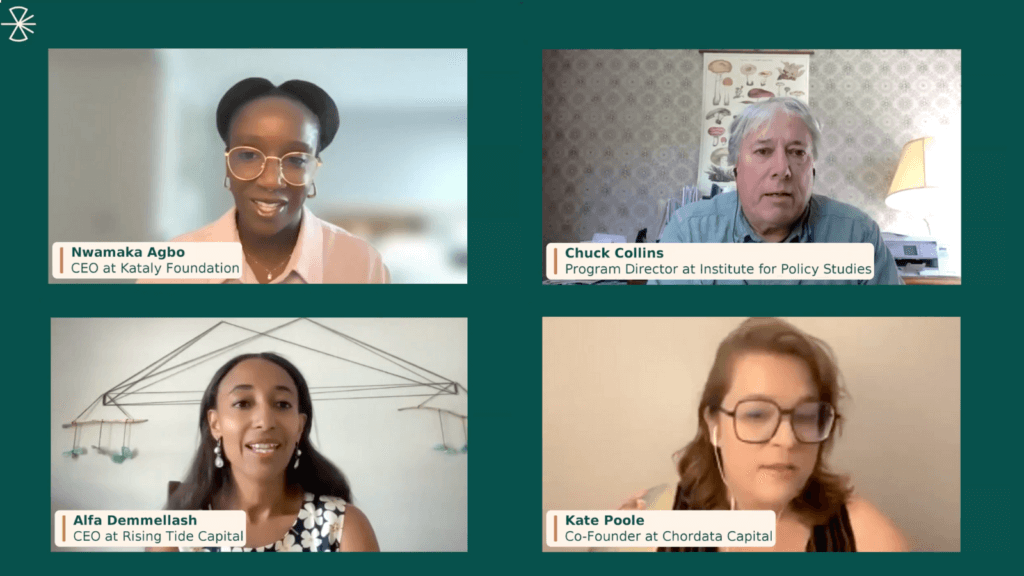
“Schumacher Conversations: Envisioning the Next 50 Years” continues into May with a timely look at the necessary shift from wealth accumulation to wealth redistribution — a movement showing real momentum since the events of 2020. The full recording of “Activating Stagnant Capital to Catalyze Local Transformation” is now available on our website and YouTube.
This month, Alfa Demmellash of Rising Tide Capital, Chuck Collins of the Institute for Policy Studies, and Kate Poole of Chordata Capital discuss innovative ways to move money and resources toward enduring community wealth-building. Nwamaka Agbo of Kataly Foundation, our moderator, deftly weaves their perspectives into a comprehensive whole.
“[W]hen communities have access to the resources they need,” Nwamaka says, encapsulating the theme, “they can build self-determined, dignified, and thriving livelihoods for themselves and their communities.”
Highlights from our May Conversation
Chuck Collins on the potential of shifting capital out of extractive systems
As Editor at Inequality.org and author of the recent book The Wealth Hoarders: How Billionaires Pay Millions to Hide Trillions, Chuck Collins is an authority on stagnant capital. While a useful concept, Chuck is quick to note that stagnant capital is not neutral; in many cases, capital is “harmfully deployed.” In addition to the extract-and-accumulate mindset of Wall Street, Chuck also manages to convey a sense of the scale of more recent developments in what he calls the “wealth-hoarding industry”:
“We estimate $25-36 trillion, owned by wealthiest in the world, [is] hidden: it is off-shore in tax havens, it is in trusts, in shell companies…[it is] moving to the shadows…”
In contrast, Chuck finds hope and power in an “emergent sector” of activity, one instead oriented around the “disgorging” and redistribution of individual fortunes. He underscores:
“…the potential and possibility of moving huge amounts of capital out of the extractive Wall Street capitalist market, into life-affirming, community-based, place-based economic activities.”
Chuck’s reflections flow into his fellow participants’ reflections working day-to-day to direct resources into underserved communities.
Alfa Demmellash on entrepreneurship, “patient capital” and moral imagination
At Rising Tide Capital, Alfa Demmellash serves those community entrepreneurs essential to local economic resilience. When well-supported, these creative and determined individuals shape livelihoods for themselves and others while bringing vitality to neighborhoods.
However, the demands on these entrepreneurs are evolving. As Alfa Describes, underserved entrepreneurs today navigate business start-up while holding down one or more jobs, with family care-giving responsibilities. In many cases, they’re doing so with a primary language other than English.
New instruments and renewed moral imagination are called for, Alfa says, “to shift stagnant capital to those who do provide for our livelihoods and vitality.” Institutions can meet underserved entrepreneurs “where they’re at” by: providing services on evenings and weekends, operating in additional languages including Spanish, and, critically, through “patient capital.”
Realistically, she explains, “[i]t probably takes 7-10 years for a business to get off the ground and be delivering revenue sustainably.” Rethinking what “return on investment” means in this context is key to fostering a resilient network of interdependent goods- and service-providers.
“Moral imagination also calls for… local entrepreneurs being the frontlines of hospitality in community… We need communities that are able to absorb, to welcome the Other; to feed, to nourish, to look after the young; to bury our elders with grace; to be really full, living humans who are not just distracted away from our largest and most important asset, that of our attention— our ability to tend to one another, and to tend to our neighbors, and to tend to the earth that we walk on…”
Kate Poole on the inner work of personal wealth redistribution
Rounding out this discussion, Kate Poole speaks from her work in helping individuals “pull money out of Wall Street and redistribute that wealth and invest into community-controlled load funds and community investments.”
As Kate describes, coming to this conviction involves connecting with one’s ethical or spiritual values. It also involves deep reflection of locating one’s own’s story within broader histories of extraction and power disparity:
“I really do not believe that you can invest in [publicly-traded] corporations if your values include racial and economic justice…
We help people get clear on the story of their money…wealth has come from harm and violence. Where did the harm happen, what could repair look like? [It is] a legitimate and powerful undertaking for us to bring our beliefs and [spiritual] practices into our economic practice…”
Learning to be in relationship with recipients of redistribution and non-extractive finance, Kate says, takes patient practice. There is a “need to lean into relationship and build trust,” she explains, in order to “stay present and not shut down or run away from uncomfortable conversations.”
To truly repair systemic harms and rectify imbalances of power, those with resources should hand decision-making power over to recipients. In this way, the act of redistribution becomes a vehicle for mutual empowerment and repair.
Upcoming Conversation
The next 2023 Schumacher Conversation, “Creating a Global Renewable Energy Commons,” will take place Thursday, June 15 at 2:00 PM EST. The participants will be:
- Stuart Cowen of the Buckminster Fuller Institute
- Naomi Davis of Blacks in Green
- David Sturmes-Verbeek of the Fair Cobalt Alliance
The Conversation will be hosted by Greg Watson, Schumacher Center Director of Policy and Systems Design. Register for this upcoming event here.