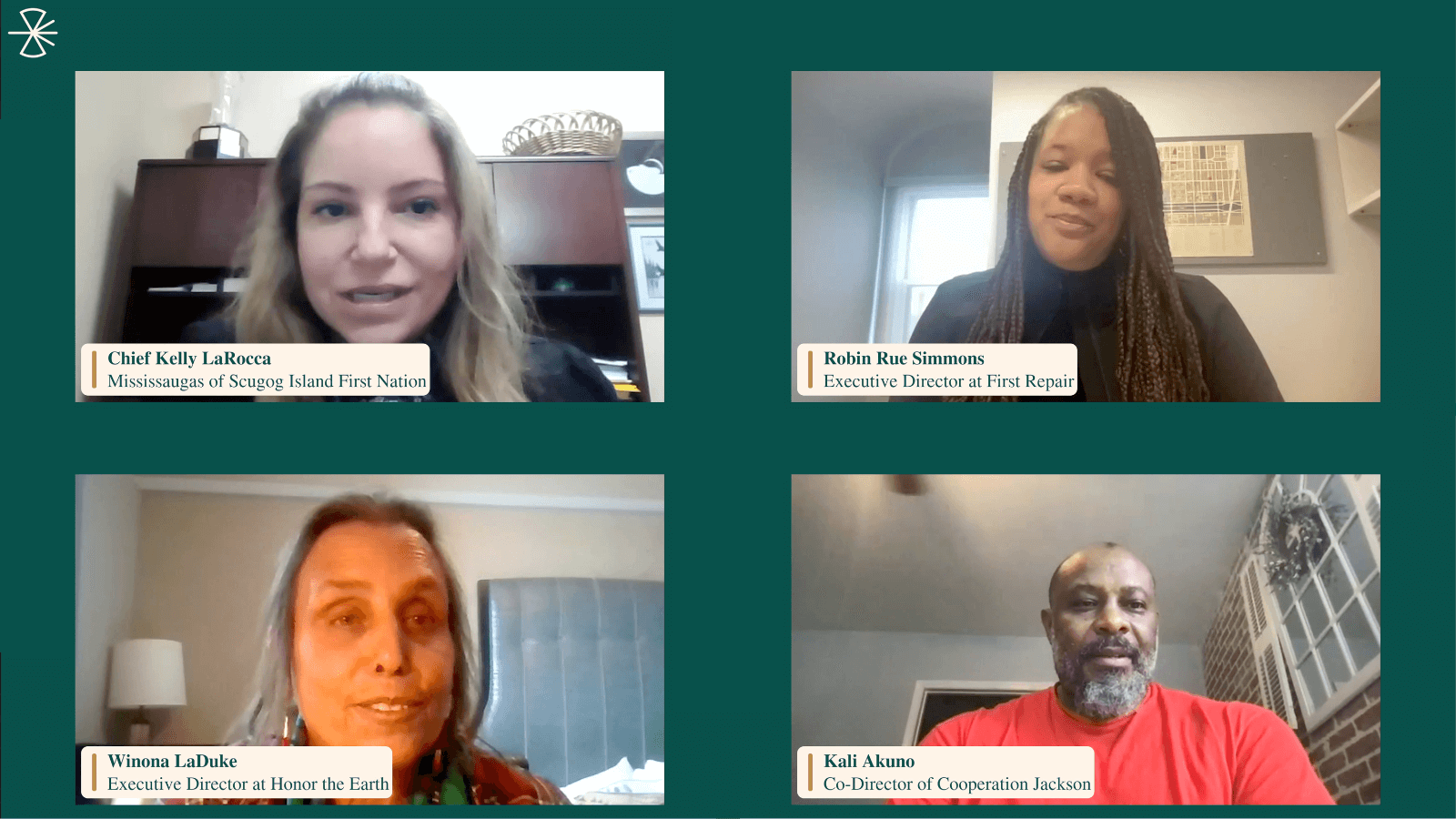
The second in our 2023 series “Schumacher Conversations: Envisioning the Next 50 Years” brings together leading activists from Black and Indigenous communities in the U.S. and Canada to discuss the power of reparations. The recording of “Making Reparations: Seeding a Just Future” is now available in on our website and YouTube channel.
In this Conversation, Winona LaDuke of Honor the Earth, Robin Rue Simmons of FirstRepair, and Chief Kelly LaRocca of the Mississaugas of Scugog Island First Nation meet for the first time. The group share the experiences of their own communities in pursuing restorative justice, as well as their perspectives on the future of reparations across North America. Kali Akuno of Cooperation Jackson (and a member of the Schumacher Center Board of Directors) joins as moderator.
Highlights from February’s Conversation
Robin Rue Simmons on the local context of Black reparations
Opening the conversation, the former alderwoman of Evanston, IL describes the persistent racial gaps in her community that informed their approach toward restitution. “At that time when I led the passing of reparation,” she explains, there had been “a $50,000 income gap between black and white Evanstonians. A life expectancy gap of thirteen years — and these numbers aren’t unique to our city.”
As Robin puts it, “reparations are in order…not just for the crimes of the transatlantic slave trade and its legacies…but also what has happened at local levels.” In Evanston, generations of anti-Black legislation in housing and zoning laws effectively limited much of the city’s Black community to a single area, which became a site of persistent disinvestment.
“In 2019, I made the introduction that we begin a path to reparations for Black Evanston: we do it with a legislative action that was funded—not another ceremony, not another proclamation without a budget, not another commitment without a plan— but with legislation that was funded, and [for which] we could measure the outcomes.” — Robin Rue Simmons
Given the evidence of unfair housing and zoning laws, and after community consultation, the first payments are being distributed as housing subsidies, helping qualified Evanstonians to secure their own homes and begin to build family equity. $10M of initial funding is written into the bill, sourced from new cannabis sales tax revenues to the city. But as Robin stresses, this is only the beginning, with the group calling on other institutions in town — Universities, industry, foundations — to join the movement toward repair.
Chief Kelly LaRocca on sustainable economic development via reparations
Next is Chief Kelly LaRocca of the Mississaugas of Scugog Island First Nation. She begins with a reflection on Schumacher’s Small is Beautiful, which “argues that economic systems should be designed to serve human needs and protect the natural world, rather than focusing solely on profit and growth.” This idea is relevant to the issue of Indigenous reparations, in her view, as it highlights the need to consider the long-term wellbeing of these communities, as opposed to short-term gains as “the planet is plundered in the name of ‘progress.’”
Chief Kelly recounts the story of the 1923 Williams Treaties, which deprived First Nations of Ontario rights to hunt, fish, and harvest their traditional lands. “Basically,” she explains, “it took us 90 years… to make the provincial and federal governments wake up to the fact that they’d made a mistake in how the treaties were being interpreted.”
“Systems of land governance…not only exclude Indigenous peoples from decision-making tables…they fail to set limits, driving wildlife decline and ecosystem degradation.”
— Chief Kelly LaRocca
With government reparations negotiated in 2018 and secured in a trust, Chief Kelly oversees community economic development efforts on her nation’s behalf to reinvest in land as well as individuals. Priorities include sustainable food systems, more self-reliant energy provision, and other “economic opportunities appropriate to the local context.” The Scugog Island Mississaugas are also focused on cultural reclamation, notably in efforts to reverse language loss among youth.
“Collaboration underscores our resilience as agents of change,” Chief Kelly concludes. “How we work is just as important to what we do…a theory of change must necessitate the need to unlearn, and focus on our interconnectedness…”
Winona LaDuke on land reclamation in Anishinaabe territory
Rounding out the conversation, Winona LaDuke of White Earth shares the story of the “One dish, one spoon” sovereign treaty between the Haudenosaunee and Anishinaabe. As Winona tells it, this treaty between Indigenous Nations, recorded in wampum, set in place a shared understanding of interdependence and approaches to living within ecological limits—”really Schumacher’s teaching as well.”

The White Earth Land Recovery Project continues its work of reclaiming lands back into Indigenous hands. Winona emphasizes the difference between the terms of private property law—which land activists are typically required to take on to advance their cause—with the Indigenous understanding of Akiing—”the land to which the people belong.” The latter is about stewardship, a covenant between land and people.
“It’s important not to have ecological amnesia. We have a history of it being a good world here, and a lot of people don’t know that history: what it was like when you could drink water from every river, when there were 50 million buffalo, and 10,000 varieties of corn…there was tremendous biodiversity, and wild rice, which still exists throughout our territory…we had a covenant, which is how you relate to each other and the land…” — Winona La Duke
To date, the project has been able to purchase lands via donations, including the site of a former library to be turned it into a museum. “Some people want a way out of the system they were born into—” Winona explains of Indigenous allies, “of white privilege and settler colonialism— they want to do something better.”

The next 2023 Schumacher Conversation, “Localizing Production: Communities Supporting Industry,” will be on Thursday, March 16 at 2:00 PM EST. The participants will be Zita Cobb of Fogo Island’s Shorefast, Michael Partis of the Bronx Cooperative Development Initiative, and author (and former Schumacher Lecturer) Michael H. Shuman, with the Conversation hosted by Alice Maggio of The Working World. Register for this upcoming event here.