The following article was published in the Winter 2022-2023 issue of The Natural Farmer, the quarterly publication of the Northeast Organic Farming Association, under the theme of “Challenging Corporate Capture.”
BerkShares: An Alternative Vision for Thriving Regional Economies
By Jared Spears, Director of Communications & Resources, Schumacher Center for a New Economics.
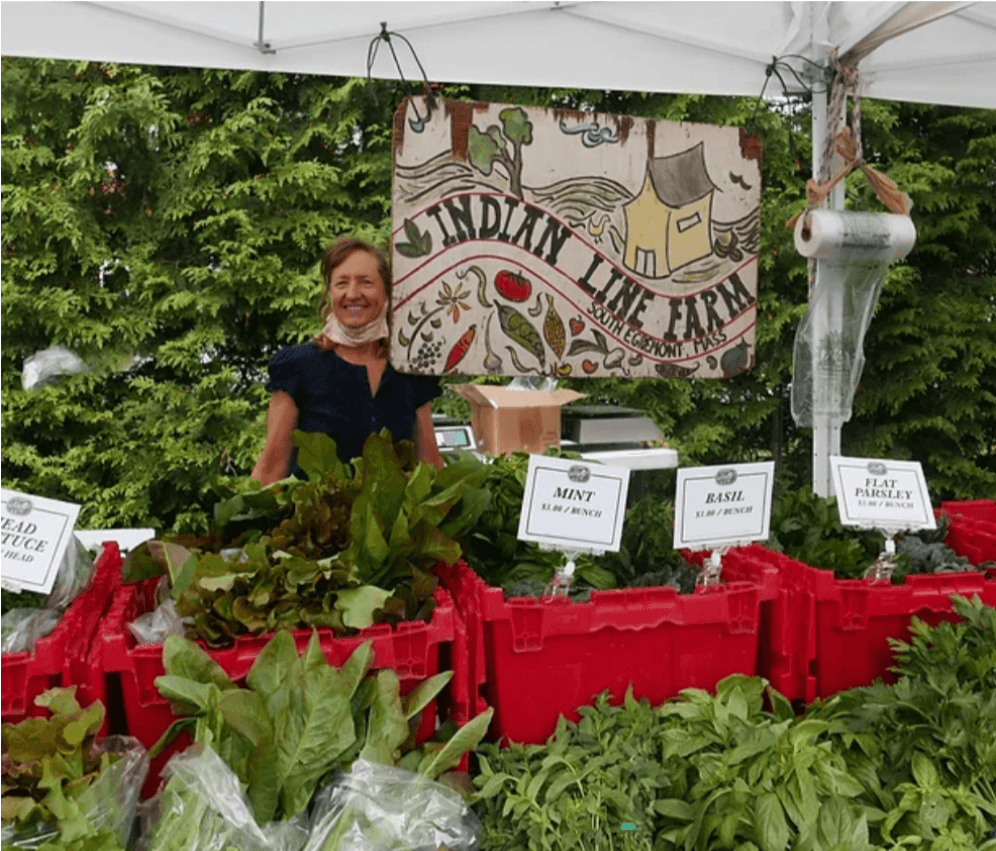
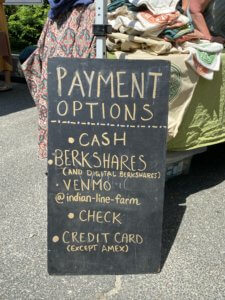
Visiting the Great Barrington Farmers’ Market this past season, you’d encounter all the hallmarks of a healthy, well-attended farmers’ market: fragrant smells, a convivial bustle and an array of bright, voluptuous produce. But something not obvious at first glance makes this market, in the Berkshire mountains of Western Massachusetts, unique. Approaching the register at Indian Line Farm’s stall, you’d see a chalkboard sign listing “Payment Options”: the familiar cash, check, credit card and (more recently popular) Venmo are listed alongside methods very particular to place: “BerkShares” and “Digital BerkShares.”
As mobile payment apps proliferate and as credit and debit cards continue to grow more ubiquitous, market sellers everywhere have had to adapt to new modes of transacting. And whether it’s credit card companies charging small sellers 2-4% of each swipe, or Silicon Valley tech companies getting into the mix, we’ve become increasingly beholden to far-away, profit-seeking entities for simple exchange between neighbors.
It can be easy for us to reach for our credit card, but those processing fees add up, creating a burden on small businesses as money trickles out of a local economy. From a community economic standpoint, substantial fees from cards and the loss of underlying deposits from small banks both represent wealth leakage outside of regions into a larger, faceless system.
The concentration of Americans’ financial activity among a few corporate banks disproportionately favors the “Wall Street” economy over that of “Main Street.” Like the devastating effects of big box chain stores on smaller, locally-owned businesses in recent decades, wealth leakage forms part of a broader narrative of disinvestment and extraction familiar in too many parts of the country, particularly rural economies.
But the presence of community-issued BerkShares currency over the past fifteen years has contributed to an alternative story here in the Berkshires: one of a more circular regional economy that leaves space for local exchange and production as a basis for resilience. Keeping money circulating locally by design, BerkShares stands for a conscious choice to support the individual storefronts, farms, and other organizations which imbue unique character and vitality to small towns and villages.
Elizabeth Keen, co-owner and farmer at Indian Line Farm, is among the local currency’s long-standing advocates. The notion of “community support” is, after all, baked into the ethic of Indian Line: “Community Supported Agriculture is a term coined in my dining room in 1986,” explains Keen.
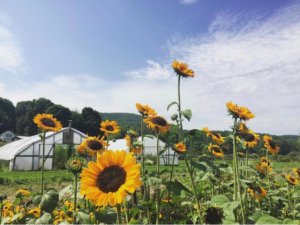
In this regard, Indian Line is fairly famous as farms go. Robyn Van En, evangelist for the radical CSA model that has been adopted by farmers around the world, farmed at this 20 acre plot down the road from Great Barrington from 1983 until her untimely death in 1997.
Keen was employed by Robyn at that time. Today, she and her partner Al Thorp carry on this legacy, farming organically while adding their own personal touch. As Keen explains, Community Supported Agriculture is a relationship between farmers and consumers: sharing the risk and also sharing the bounty that can exist on a farm. Accepting BerkShares for purchases is a natural extension of this ethos.
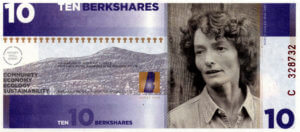
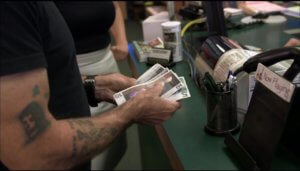
At the farmers’ market, they see plenty of the colorful paper notes—denominations of 1s, 5s, 10s, and 20s featuring the faces of local heroes—sorting them in a second cash drawer. Indian Line even accepts the local currency for CSA payments among its 250 full- and half-share members, a shift from the program’s early days.
Keen was at first wary about taking in more BerkShares than the farm could recirculate. But those concerns are now long past: “We’ll take Berkshares for the full price of a share and we’re creative enough now that we know where to spend them,” she says.
Indian Line can spend BerkShares with local suppliers and service providers, pay portions of farmhands’ wages, and even pay their lease fees to the Community Land Trust on which the farm is situated. In this way, BerkShares recirculates with over 350 locally-operating organizations which employ local people and tend to care for community (as one resident memorably put it: “is Amazon going to sponsor your kids’ little league team?”). By participating, merchants distinguish themselves as locally-owned and community-minded while saving on card fees and recirculating back into the local economy.
BerkShares can at first sound a bit funny to outsiders. But as all BerkShares in circulation remain backed 1:1 with US Dollars at community banks, it leaves no doubt about the underlying value. The currency is free to accept and reuse, with only a 1.5% fee if a business chooses to exchange BerkShares back to US Dollars. While competitive to cards and mobile platforms, the modest fee provides participants a positive nudge to keep money earned within the community.
When it comes to big purchases like an annual CSA payment, Indian Line has in recent years forwarded a small surcharge on to customers who chose to pay via credit or debit. Thus, BerkShares offers a feel-good alternative that benefits both parties. In 2022, a digital BerkShares beta app even experimented with making such payment possible from a smartphone, a proof of concept to inform a future digital iteration.
Whatever the format, using BerkShares encourages recirculation and reinvestment within the region and fosters personal bonds between producers and their communities. The need for tools that empower area citizens to shape regional economic transformation grows all the more important in the face of climate change. Just climate action makes the relocalization of basic production an urgent necessity. Here in the Northeast, for example, non-profit Food Solutions New England has set the goal of achieving 50% locally-sourced food by 2060.
With regenerative farms like Indian Line, the Berkshires have a strong head-start. Local currency can provide a vehicle to accelerate such ambitions, helping to usher in a more vibrant and ecologically sound regional economy. (At scale, BerkShares, Inc. even proposes to have productive loans issued in the local currency, spreading the wealth of such investments in the area.)
“Any way we can fight back against these big systems that otherwise seem inevitable,” Keen says, “is inspiring.”
Learn more about BerkShares and other local currencies on our program page.